

TL;DR: What Role Do Champions Play in CAD Workflow Adoption?
Champions are key to making CAD workflows stick. They educate teams on benefits, simplify tool integration, and foster teamwork across departments like engineering and legal. By addressing resistance to change and prioritizing intellectual property security, champions ensure smoother transitions and long-term success in distributed manufacturing setups.
💡 Ready to boost your CAD adoption strategy? Check out Training and Change Management for Secure CAD Adoption for actionable insights.
What Impact Do Champions Have in CAD Workflow Adoption?
Adopting new CAD workflows is rarely straightforward, particularly in industries heavily reliant on precision, collaboration, and intellectual property protection. Champions, the individuals who lead these initiatives, play a critical role in achieving successful implementation. Their contributions go beyond technical expertise: they shape organizational readiness, bridge communication gaps, and align teams on priorities.
In sectors like design engineering and manufacturing, which increasingly utilize tools like Autodesk Inventor, champions ensure workflows are not only adopted but continuously optimized to meet industry needs. Leaders like Violetta Bonenkamp, CADChain’s co-founder, highlight the importance of ensuring secure ownership of CAD data, especially in distributed supply chains.
“A champion isn't just a promoter; they're the bridge between capability and organizational culture, ensuring adoption happens at every level.”
Violetta Bonenkamp, co-founder, CADChain
Why Champions Make a Difference in a CAD Environment
At their core, champions influence three pivotal areas of CAD workflow adoption: education, integration, and collaboration. Here’s how:
- They educate teams about the benefits of advanced CAD workflows, addressing resistance often rooted in lack of understanding.
- They streamline integrations, ensuring tools like BORIS for Autodesk Inventor function optimally within established processes.
- They foster collaboration, connecting departments like engineering, legal, and IT in shared IP-protection goals.
For example, a champion driving the adoption of effective communication strategies for CAD process changes will likely mitigate friction during transitions by aligning teams around common objectives. Without champions, siloed departments might resist adopting protocols requiring interdepartmental coordination.
A champion does not replace the other people involved in a rollout. The table below shows how the role differs from the ones it works alongside:
How Champions Align Teams During CAD Rollouts
Champions are instrumental in overcoming barriers during CAD workflow rollouts. They achieve this in three ways:
- Demonstrating Value: Champions contextualize why adopting new workflows, like digital ownership certification for CAD designs, is essential for mitigating IP theft risks.
- Providing Continuous Feedback: Interventions such as feedback loops improve implementation. Tools that track adoption through measurable KPIs are especially effective.
- Advocating for Transparent Leadership: Champions ensure leaders articulate the business logic behind workflow changes, boosting trust across teams.
“A structured feedback system during CAD rollouts transforms user hesitation into actionable improvements.”
Dirk-Jan Bonenkamp, co-founder, CADChain
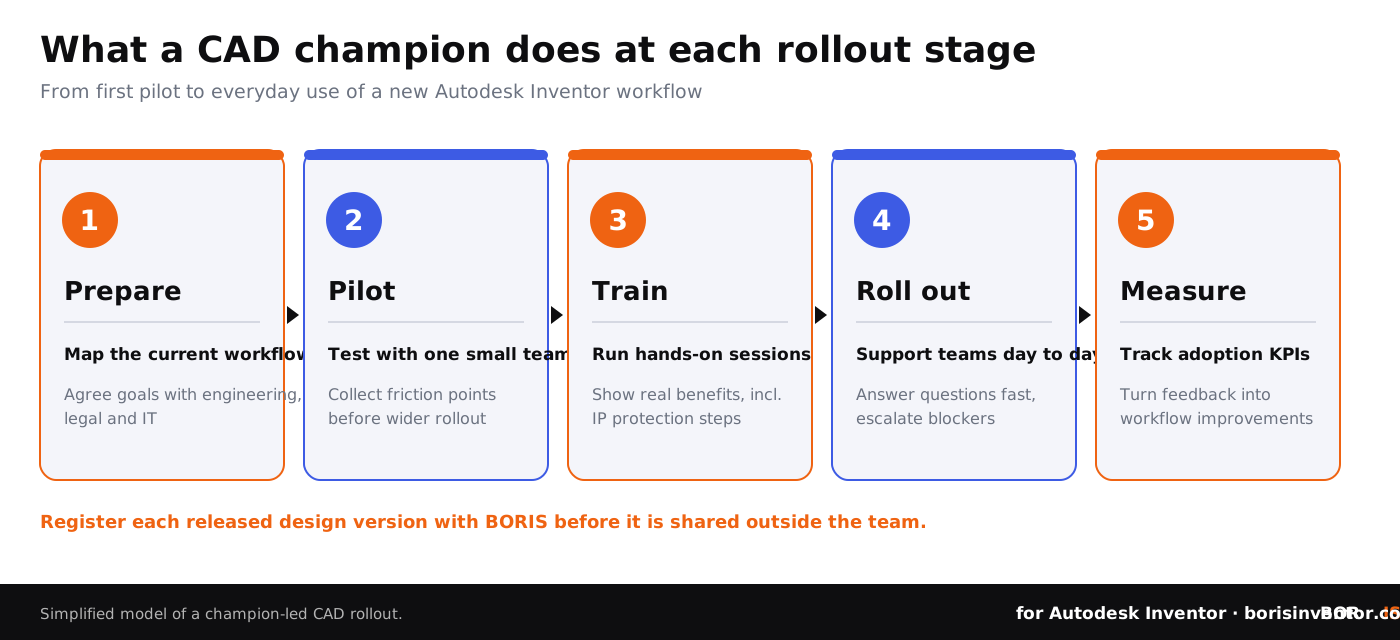
What Should CAD Champions Focus On? Key Insights
Champions should prioritize these tasks to ensure their efforts translate into visible success for CAD workflow adoption:
- Knowledge Sharing: By acting as educators, champions reduce onboarding gaps for design and IP-protection functionalities, especially relevant when integrating systems like Autodesk Inventor (see change management frameworks for CAD process updates).
- Data Security Advocacy: Ensure teams understand risks, such as the consequences of unsecured CAD data in global manufacturing setups.
- Cross-Departmental Ownership: Champions drive collaboration across design, legal, and operations to achieve seamless workflow alignment.
Common CAD Workflow Pitfalls Champions Solve
Despite the best intentions, organizations often encounter pitfalls during CAD workflow implementation. Champions mitigate these by addressing:
- Resistance to Change: Champions push for training courses placing practical benefits at the forefront, as described in training and change management guides.
- Technical Silos: They ensure infrastructure is designed for interoperability between CAD systems and licensing protocols.
- Neglect of IP Protection: Champions make intellectual property an integral discussion point throughout workflow updates.

Key Characteristics of Successful Champions
Successful CAD champions share several defining traits that make them invaluable during workflow adoption:
- Technical Expertise: Champions possess a detailed understanding of tools like BORIS for Autodesk Inventor, ensuring features are optimized.
- Empathy for Teams: They recognize user constraints and build solutions accordingly.
- Strategic Advocacy: Champions prioritize workflow outcomes supporting measurable business gains.
Boost Your CAD Security Knowledge
Discover strategies to protect intellectual property across CAD workflows effectively.
👉 Explore CADChain Insights
Conclusion: Investing in Champions for Secure CAD Adoption
Champions are more than workflow advocates; they’re vital to the success of CAD workflow adoption in any organization reliant on intellectual property. By focusing on bridging capabilities, promoting secure design ownership, and aligning multi-department collaboration, champions ensure CAD workflows are truly transformative.
For organizations navigating distributed design ecosystems, investing in champions represents an investment in security, innovation, and agility. Transitioning smoothly to CAD workflows backed by protection frameworks requires aligning internal expertise with global best practices.
Next, explore how champions can integrate training and change management strategies specifically tailored toward secure CAD adoption.
People Also Ask:
What is the role of the BIM champion?
A BIM champion is responsible for overseeing and advancing the use of Building Information Modeling within an organization. They research, develop, and integrate new BIM-based approaches to improve workflows and ensure efficiency in design, construction, and operational processes. This role also involves the promotion of BIM adoption through training and collaboration with various team members.
What does a CAD champion do?
A CAD champion guides their team in implementing and effectively using Computer-Aided Design tools. They assess existing workflows, suggest improvements, and train employees to adopt new systems. Their primary goal is to make CAD tools transformative for project design speed and accuracy.
Why are champions essential for workflow adoption?
Champions play a central role in facilitating smooth transitions during workflow improvements by reducing resistance to change. They serve as advocates and educators, helping teams understand the benefits of adopting new processes or tools while addressing concerns and resolving conflicts.
What are the responsibilities of a technology champion?
Technology champions encourage their colleagues to adopt and use technology to its full potential. They act as role models, addressing challenges, communicating the value of change, and ensuring consistent engagement throughout the organization.
What are success factors for champions in technology adoption?
Successful champions possess expertise in their field, strong communication skills, and the ability to motivate others. They build trust within teams, address resistance proactively, and demonstrate the practical advantages of proposed changes.
How do AI champions contribute to implementation success?
AI champions help organizations integrate artificial intelligence tools effectively. They identify areas where AI can provide value, advocate for its implementation, train users, and address operational challenges that may arise during adoption.
How do technology champions support construction workflows?
In construction, technology champions ensure that any new tools or processes are fully understood and adopted by all stakeholders. They work closely with teams to streamline project management, design methods, and operational practices.
What qualities make an effective champion?
An effective champion is passionate, knowledgeable, and approachable. They communicate effectively, solve problems creatively, and inspire confidence in the changes they advocate for. Their ability to adapt and empathize with team challenges also sets them apart.
What role do champions play in workflow standardization?
Champions actively encourage consistency by documenting best practices, promoting their use across teams, and ensuring adherence to standardized processes. This leads to improved collaboration and fewer errors across projects.
How can champions address resistance to change?
Champions can address resistance by understanding team concerns, offering clear communication about the benefits of the change, and providing hands-on training and support. They also engage stakeholders by incorporating feedback into the new workflows.
FAQ on the Role of Champions in Secure CAD Workflow Adoption
What steps do champions take to address resistance in CAD workflow changes?
Champions mitigate resistance by educating teams on the value of new protocols, addressing misconceptions, and promoting success stories from other departments. By implementing phased rollouts and fostering collaboration, they ensure smoother transitions. Discover strategies for overcoming change resistance in CAD workflows at avoiding CAD workflow pitfalls.
How do champions ensure CAD workflow optimization post-adoption?
Post-adoption, champions analyze usage metrics, encourage user feedback, and continuously refine workflows. By introducing tools tailored to team needs, they help maintain productivity and innovation. Detailed guidance on organizational optimization is highlighted in efficient CAD file management.
How do champions foster cross-department collaboration in CAD systems?
Champions build communication bridges between teams like engineering, IT, and legal, ensuring unified goals for CAD adoption. They facilitate collaborative planning and align workflows to protect intellectual property across departments efficiently.
What qualities make a great champion in CAD workflow adoption?
Effective champions combine technical expertise, leadership, and empathy. They drive alignment with organizational objectives, prioritize secure data handling, and communicate the benefits of CAD systems clearly to their teams.
What tools do champions recommend for ensuring seamless CAD integration?
Champions often recommend PDM and PLM systems such as Autodesk Vault (the native choice for Autodesk Inventor) and Siemens Teamcenter for metadata management and version control, ensuring reliable collaborations across platforms. They optimize workflows by leveraging secure, interoperable infrastructure components.
How do champions address technical challenges during CAD adoption rollouts?
Champions troubleshoot implementation issues by conducting pre-rollout testing and gathering feedback from pilot teams. By structuring training sessions, they prepare staff to confidently navigate technical complexities in updated CAD workflows.
Why is intellectual property protection crucial in CAD workflows?
Protecting intellectual property ensures competitive advantage and compliance within global supply chains. Champions work to embed security protocols into daily workflows to guard against breaches and accidental data misuse.
How do champions align CAD workflows with evolving industry needs?
Champions stay updated on industry advancements and regulatory changes, tailoring workflows to embrace modern technologies like cloud-based platforms while prioritizing data security and team adaptability.
What role does consistent feedback play in CAD workflow improvements?
Continuous feedback enables champions to identify user concerns and refine processes. Tools tracking KPIs effectively measure workflow success, ensuring adjustments boost efficiency and adoption rates.
How can champions use metadata to streamline CAD projects?
Enhancing metadata usage leads to better file organization and automation across CAD projects. Champions recommend PDM systems, such as Autodesk Vault for Inventor teams or SolidWorks PDM in SolidWorks environments, for improved searchability and streamlined collaboration. Learn how metadata optimizes CAD workflows at metadata application insights.