
TL;DR: What is the future of CAD data management?
The future of CAD data management combines AI automation, blockchain-based proof of design ownership, central version control and controlled, global collaboration. SMEs and startups in particular can use tools like BORIS from CADChain to record dated, tamper-evident proof of their designs alongside access controls and clear sharing rules.
💡 Discover how CADChain supports IP protection, check out CADChain’s IP Protection Tools today!
What is the future of CAD data management and why it matters for businesses?
In 2026, the field of CAD (Computer-Aided Design) data management is no longer just about storing and accessing design assets. It has evolved into a multidisciplinary practice that combines AI-driven automation, blockchain-based proof of IP ownership, and collaborative design workflows with controlled access. For businesses, small startups, SMEs, or large organizations, understanding and adapting to these changes can mean the difference between securing your industrial designs or losing them to misuse and infringement.
Startups and SMEs in particular face unique challenges due to limited budgets and legal resources. By combining tools like Autodesk Inventor and Autodesk Vault with technologies like blockchain, these companies can not only document and safeguard their intellectual property but also streamline file sharing and collaboration on a global scale.
Blockchain and AI are changing how businesses record design ownership and respond to IP theft. Dated proof of who created what, and when, is no longer optional; it’s necessary.
Are your CAD designs protected against theft?
Protect your CAD models with BORIS, CADChain’s proof-of-ownership tool for Autodesk Inventor. Register a fingerprint and timestamp of each design before you share it and work with confidence!
👉 Check it now!
Why does CAD data management matter now?
Today, manufacturers, designers, and engineers consistently face the risk of data misuse, especially in globally distributed design ecosystems where partners, suppliers, and contractors interact with sensitive files. Every extra copy of a model sent by email, uploaded to a portal or exported to a neutral format is one more copy you no longer control.
Startups using tools like Autodesk Inventor need modern solutions not only to secure their designs but to meet GDPR, intellectual property laws, export-control rules and customer contracts. Legal tech startups working on engineering IP make blockchain-secured CAD tools accessible and scalable for small teams.
New frameworks shaping CAD data management in 2026
1. Blockchain-backed CAD ownership certification
Blockchain technology makes the record of a CAD file’s existence verifiable and auditable. A registered fingerprint and timestamp cannot be changed later, so it serves as dated evidence of a design, which helps in ownership disputes and alongside, not instead of, patent or design-right filings. CADChain, active in Europe’s engineering IP sector, offers BORIS to register CAD models directly from Autodesk Inventor and issue a certificate. BORIS stores only the fingerprint, never the design file, and how much weight the proof carries depends on the court and jurisdiction.
2. AI and machine-learning integration in CAD workflows
AI enhances accuracy and saves time by automating repetitive CAD tasks such as creating drawing views, checking designs against rules and flagging likely design errors before they reach production. Generative design explores many shape options from loads and constraints. BORIS for Autodesk Inventor is not an AI tool: it records a fingerprint and timestamp of each registered version, so the record of who created what and when does not depend on manual logs. Access control stays with your PDM system.
3. Real-time collaboration with embedded security
With global teams collaborating across continents, shared design work often leads to risks like version mismanagement and unauthorized file sharing. PDM and cloud tools with permission-based access controls address these challenges. For instance, Autodesk Vault keeps Inventor files in a central repository with check-in and check-out, version history and role-based permissions, while cloud services such as Autodesk Docs give outside partners controlled access to the files they need.
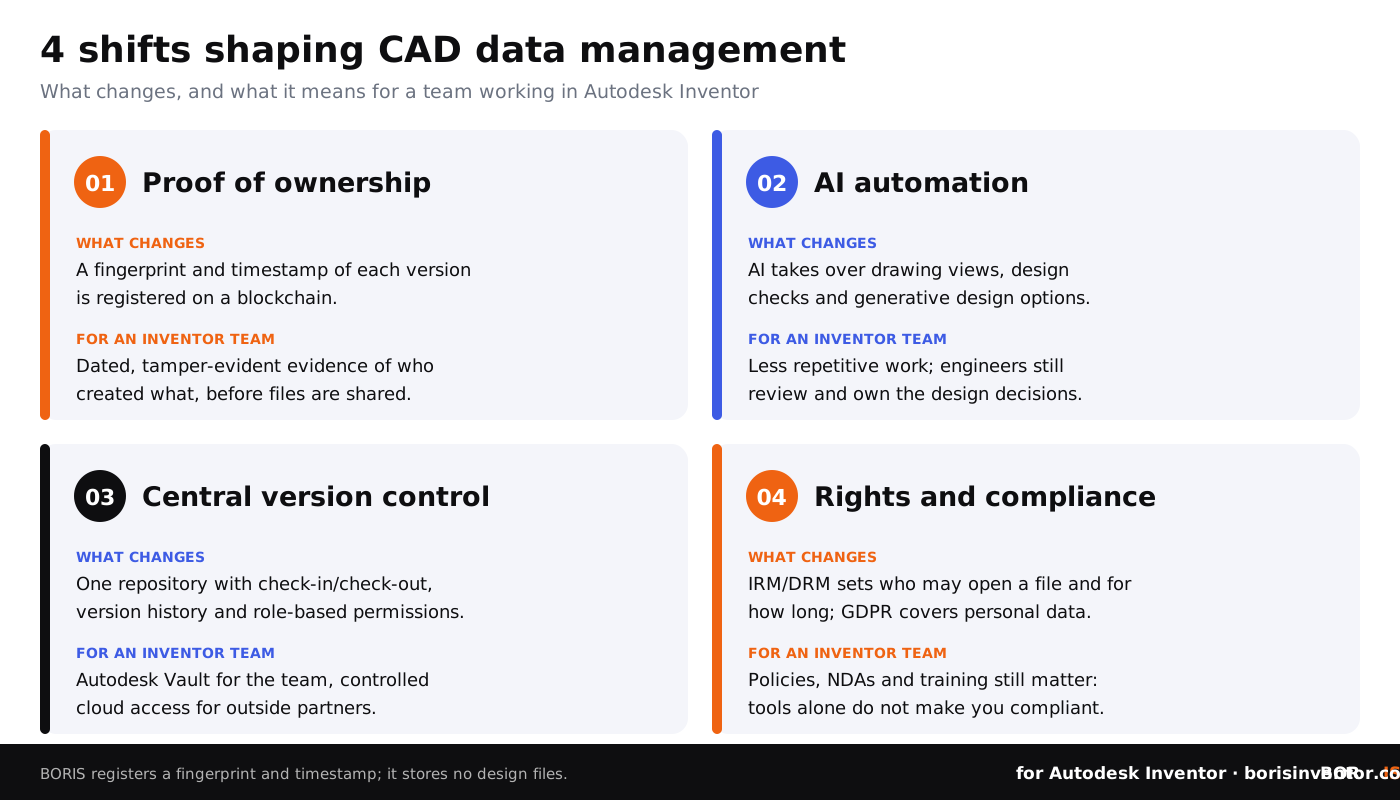
4. Universal compliance tools for CAD files
Data-protection rules like GDPR in Europe, export-control rules and stricter customer contracts all set requirements for how design data is shared. Tools that add IRM (Information Rights Management) or DRM to CAD workflows control who can open a file, for how long, and whether access can be revoked later. They help companies meet these requirements and keep control in global supply-chain transactions, but they do not make a company compliant on their own: policies, contracts and training still matter.
Each approach covers a different part of CAD data management. The table compares the options Inventor teams use most often.
Start certifying your digital designs today!
Get blockchain-based design ownership tools tailored for Autodesk Inventor.
👉 Blockchain Certification Guide for CAD Files
How to adapt to the future of CAD data management
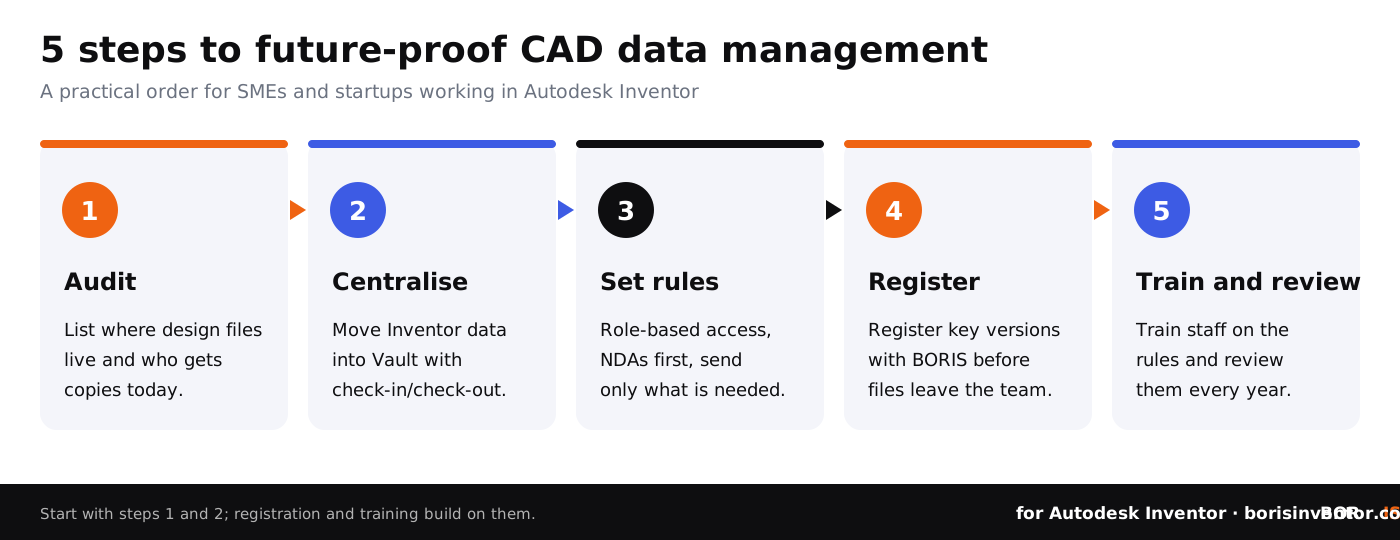
Adapting to the future of CAD data management begins with assessing your current processes. Here are actionable steps to transition smoothly:
- Audit your existing CAD file security practices and identify vulnerabilities in data-sharing workflows.
- Register key design versions with BORIS for Autodesk Inventor so you have dated proof of ownership before files leave the company.
- Provide design collaboration while restricting access with role-based permissions and encrypted file access technologies.
- Develop a GDPR-compliant CAD data protection policy that incorporates both local and international standards.
- Train staff on the sharing rules for distributed teams: NDAs first, send only what the job needs, and register versions before sharing.
Poor CAD file protection is a common weak spot for European SME manufacturers, and moving to secure, documented workflows makes it far easier to keep and prove their IP.
Secure your CAD workflows now!
Read more about ensuring safe CAD compliance standards in our guide.
👉 Compliance and Standards for Secure CAD Workflows
Closing thoughts: The way forward for CAD data protection
As the CAD industry continues its transformation in 2026, companies must adopt dynamic frameworks that not only secure their assets but also grant them competitive advantages in innovation and IP management. By registering designs with blockchain tools like BORIS for Inventor, using AI where it saves time in design flows, and complying with regulations proactively, businesses can stay ahead.
Next, explore how CAD file formats and metadata affect workflows and privacy. Adopting early is not just about protection, it’s about preparing for design-driven growth aligned with emerging standards in IP security.
People Also Ask:
Will AI make CAD drafters obsolete?
AI is not replacing CAD drafters but is automating repetitive tasks and enabling professionals to focus on more specialized aspects of design. In 2026, the role of CAD drafters is evolving rather than diminishing: learning tools like generative design and Building Information Modeling (BIM) helps professionals stay relevant.
What is replacing traditional CAD software?
Cloud-based platforms like Onshape and AI-enhanced software offer collaborative, real-time design environments and are gaining ground alongside desktop tools such as Autodesk Inventor. These platforms focus on connectivity and reducing file-based inefficiencies while improving accessibility.
What trends define CAD's future in 2026?
The key trends include AI-driven automation, integration of digital twins, and cloud collaboration. The rise of multi-axis machining and enhanced simulation tools is also reshaping workflows in manufacturing and engineering sectors.
Is learning AutoCAD still worth pursuing in 2026?
AutoCAD remains a valuable skill for those entering design and engineering fields. Its versatility and compatibility make it a foundational tool. Additionally, it serves as a gateway to mastering more advanced software solutions.
What challenges does CAD data management face today?
In 2026, key hurdles include managing large datasets efficiently, ensuring smooth collaboration across platforms, and maintaining data security amid cloud-based operations.
Are CAD tools integrating with new technologies?
Yes, CAD tools are increasingly aligned with augmented and virtual reality platforms, as well as 3D printing technology. These integrations improve both the visualization and production aspects of design.
What skills complement CAD expertise in 2026?
Skills in programming, data handling, and understanding AI systems are valuable additions for CAD professionals, allowing greater creativity and problem-solving capabilities in complex design scenarios.
How is AI enhancing CAD workflows?
AI automates repetitive processes, improves simulation accuracy, and accelerates design iterations. Generative design powered by AI enables exploration of multiple design alternatives quickly.
What sectors benefit most from CAD advances?
Industries such as architecture, aerospace, automotive, and healthcare are leveraging advanced CAD tools for better customization, precise modeling, and simulation of complex systems.
What are the environmental benefits of modern CAD systems?
CAD advances promote improved material efficiency and support sustainable practices by allowing simulation and optimization before physical production. This reduces waste and minimizes environmental impact.
FAQ on the Future of CAD Data Management
How can startups compete with larger firms using modern CAD tools?
Startups can use affordable, blockchain-secured tools like BORIS for Autodesk Inventor to record proof of their designs, streamline IP certification, and reduce collaboration inefficiencies. Cost-effective systems make it easier to meet international standards while facilitating partnerships. Check this guide on using Digital Rights Management (DRM) tools for CAD for actionable insights.
What are common mistakes in CAD data governance?
Common mistakes include using outdated systems, relying on unsecured sharing platforms, and neglecting compliance with regulations like GDPR. Businesses should use version tracking in a PDM system such as Autodesk Vault, role-based permissions, and robust encryption to prevent unauthorized access and data breaches.
How does blockchain enhance CAD security and IP protection?
Blockchain provides records of a file’s fingerprint and timestamp that cannot be changed later, which gives dated, traceable proof of ownership across collaborations. It does not encrypt or store the files and does not stop anyone from copying them. For example, CADChain’s BORIS records registered versions and ownership certificates, which helps you respond to IP theft. Learn more about protecting CAD data effectively.
Why is AI important in CAD workflows?
AI automates repetitive tasks such as drawing creation and design checks, reduces design errors, and in simulation helps predict where parts may fail. Version control itself is handled by PDM tools such as Autodesk Vault; together they make workflows smarter and help teams detect design problems earlier.
What role does GDPR play in CAD data management?
GDPR applies to personal data in CAD files and PDM systems, such as names in iProperties and title blocks, user accounts and access logs, not to the geometry itself. Companies need appropriate security measures such as access controls and encryption, and clear rules on who may see that data, to align with GDPR and avoid legal penalties.
How can SMEs future-proof CAD data against threats?
Adopt blockchain-based certifications, AI-powered threat detection, and keep an eye on post-quantum cryptography for long-term file security. Explore strategies for effective IP management in the post-quantum computing era through articles like securing CAD against quantum threats.
What compliance tools are essential for CAD workflows?
Information Rights Management (IRM) tools in CAD workflows support regulatory alignment while enabling secure global transactions. They control who can open a file and for how long, which reduces operational risks and legal exposure during collaborations across borders.
How can businesses optimize collaborative CAD workflows?
Adopt PDM and cloud-based CAD solutions with permission-based controls and activity logs. Tools like Autodesk Vault and Autodesk Docs keep global teams on the same version while reducing the risks of version mismanagement and unauthorized file sharing.
What benefits do startups gain from blockchain-backed CAD tools?
Startups get dated proof of their design IP that they can show to partners, customers and investors, which builds trust in global partnerships. These tools record traceable ownership data without storing the design files themselves.
Are AI-integrated CAD tools expensive for small companies?
AI-powered CAD solutions are increasingly scalable and affordable for small businesses, and cloud-based AI platforms offer cost-efficient automations. Proof-of-ownership tools like BORIS are a separate step that small teams can add to their workflow.