
TL;DR: Case Study on Improving Compliance Audit Outcomes with CAD Data Controls
Consistently passing compliance audits is a major challenge for CAD-heavy industries. Weak data controls lead to penalties, reputational risks, and IP theft. By using tools like enhanced audit trails, version tracking, and intellectual property authentication through blockchain, companies are reducing risks while improving compliance outcomes. Learn actionable strategies for safeguarding your files and intellectual property in high-stakes inspections.
💡 Discover how engineers are protecting their designs with strong CAD IP evidence, read how CAD IP tools are changing the game.
Case Study: Improving Compliance Audit Outcomes with CAD Data Controls
How often does your engineering or design firm pass compliance audits with minimal friction? For many companies relying on CAD design workflows, compliance remains a complex puzzle. Failing to secure and manage CAD data can spell severe penalties, reputational damage, and even operational shutdowns. But what if the solution lies hidden in your file management strategy?
This article dives into how businesses improve compliance audit outcomes by implementing robust CAD data controls. You'll learn from case examples, discover practical strategies, and explore the groundbreaking work of Violetta and Dirk-Jan Bonenkamp at CADChain in empowering companies, especially SMEs within Europe, to protect their intellectual property (IP), all while navigating audits with confidence.
By leveraging innovative tools like CAD asset management, blockchain-integrated IP proofs, and compliance-friendly workflows, companies are transforming their CAD processes into governance powerhouses.
Many compliance concerns raised during audits in CAD-heavy industries come down to poor data visibility and missing version control, and both are solvable with the right tools.
What Are CAD Data Controls, and Why Do They Matter?
At their core, CAD data controls involve processes, tools, and policies to manage, secure, and track your digital design files. In industries such as manufacturing, aerospace, and automotive, compliance audits often scrutinize how securely you store and share your CAD data. Poorly managed designs risk not only failure during inspections but also cyberattacks and IP theft.
The stakes are particularly high for European SMEs operating under the GDPR, which covers the personal data in their systems, and quality or security standards such as ISO 9001 and ISO/IEC 27001. CADChain co-founder Dirk-Jan Bonenkamp often makes the point that CAD workflows need to evolve from informal storage practices to traceable, secure pipelines that can stand up to scrutiny.
By integrating CAD data controls and leveraging blockchain and DRM (digital rights management), companies can address compliance by default. With blockchain-enabled tools like those offered by CADChain, firms can create timestamped, tamper-evident records of authorship and registration history, which are useful evidence during compliance audits and in disputes.
A Compliance Audit Nightmare: Lessons from the Real World
Case studies have repeatedly highlighted the risks of insufficient controls. A typical scenario, described in our look at the costs of CAD data breaches, is a mid-sized manufacturer whose unprotected CAD files are accessed by unauthorized third parties. The company then faces regulatory questions, GDPR exposure if personal data was included, and lost business when stolen designs are rebranded and sold in other markets.
These stories expose key gaps, including:
- Lack of access logs: Auditors often require proof of controlled file use, and many companies fail to deliver.
- Unverified ownership: Without certifying ownership at creation, disputes arise over who legally owns the intellectual property.
- Version chaos: Inconsistent file versions lead to errors, production delays, and significant compliance liability.
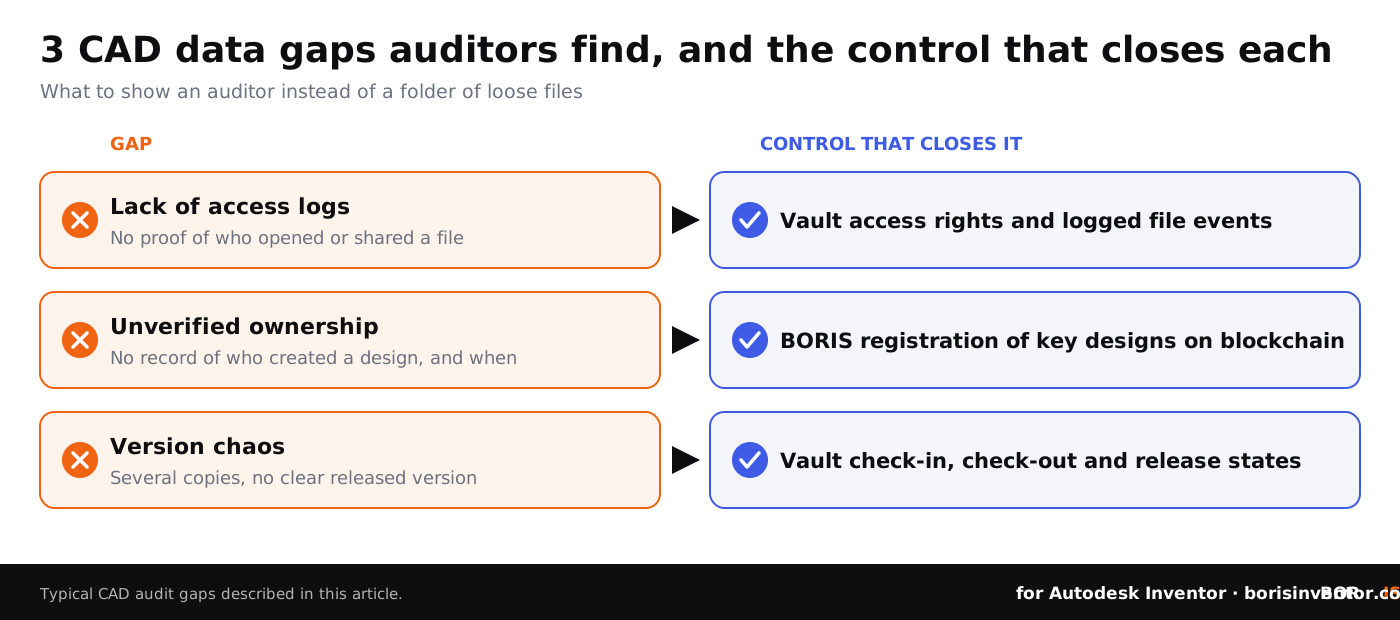
CADChain's BORIS plugin for Autodesk Inventor addresses the ownership gap directly: it registers a fingerprint of each design on blockchain with a timestamp, and supports protected sharing with partners. Together with a PDM system such as Autodesk Vault for version control and access logs, this gives a critical layer of compliance readiness.
How CAD Data Controls Improve Compliance Outcomes
Improving compliance audit results starts with visibility, traceability, and control over your digital assets. CADChain’s founders emphasize the importance of secure workflows that seamlessly fit engineering teams’ needs without disrupting productivity. Here's how effective data controls help:
- Automated audit trails: Logs track every file interaction for easier inspections.
- Blockchain authentication: Tamper-evident certificates record who registered a design and when, without reliance on manual records.
- Version management: PDM tools like Autodesk Vault, combined with BORIS registration of key versions, reduce rework and liability, as detailed in this case study.
- NDAs and licensing: Digital agreements, optionally backed by smart contracts, record and help enforce usage rights in collaborative or outsourced projects.
The table below shows what auditors typically ask about CAD data, and how weak and strong controls answer:
When implemented effectively, such measures not only simplify audit preparation but also offer strategic insights into your intellectual property.
Implementation Steps: Ensuring Compliance with CAD Data
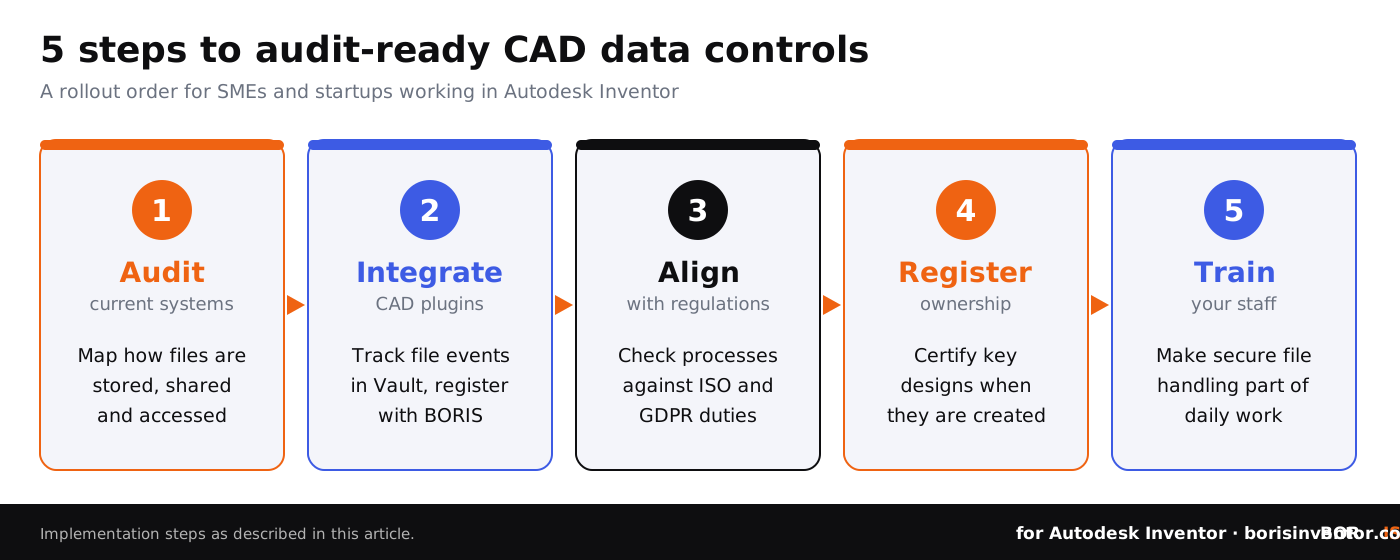
Here’s a step-by-step approach for SMEs and startups to adopt reliable CAD data controls:
- Audit Current Systems: Map how CAD files are stored, shared, and accessed across teams.
- Integrate CAD Plugins: Use integrated tools like Autodesk Vault and BORIS for Autodesk Inventor to track file events and register designs automatically.
- Align with Regulations: Check that processes meet the ISO standards you follow and your GDPR duties for personal data.
- Blockchain Registration: Register and certify CAD file ownership upon file creation to reduce disputes.
- Staff Training: Educate team members on secure workflows, emphasizing accountability in file handling.
For SMEs unsure where to start, CADChain's resources offer templates and plug-and-play solutions that bridge the gaps and prepare you for any audit challenge.
Secure Your Inspiration!
Protect your designs with next-gen compliance tools like BORIS for Inventor. See how chain-integrated solutions reduce liability from audits and data breaches.
👉 Start Now
What’s Next? Beyond Compliance Readiness
SMEs are transforming paperwork headaches into competitive advantages by adopting CAD-focused IP solutions that also secure their file systems. Your next steps? Begin exploring allied topics like advanced standards for CAD workflows or legal frameworks specific to digital manufacturing.
Dive deeper into topics like Compliance and Standards for Secure CAD Workflows or discover how to enhance your engineering IP protection plan further.
People Also Ask:
What is an example of a compliance audit?
A compliance audit example includes ensuring adherence to General Data Protection Regulation (GDPR) within an organization. This audit reviews data management practices, analyzing whether personal information handling complies with legal standards, showcasing the importance of privacy protection in operations.
What are the two types of compliance audits?
Compliance audits typically fall into internal and external categories. Internal audits involve team members from within an organization assessing conformity to policies. External audits are carried out by impartial third parties, focusing on industry regulations or legal requirements.
How does a compliance audit support ethical data management?
Through mechanisms like SOC 2 compliance, audits improve ethical data handling by verifying security, availability, confidentiality, and privacy practices. This assures stakeholders that strict standards for protecting sensitive information are enforced, facilitating a responsible approach to data management.
What are the objectives of compliance audits?
Compliance audits aim to evaluate whether operations align with governing authorities and regulations. Their main goal is fostering confidence among intended users, ensuring transparency, and confirming adherence to established standards and institutional policies.
What are the challenges in conducting compliance audits?
Challenges include navigating complex regulatory frameworks, ensuring accurate data collection, and maintaining comprehensive records. Auditors must balance procedural rigor with operational disruptions, often encountering limitations in available resources or expertise.
How can CAD data support better compliance outcomes?
CAD data enhances compliance through accurate digital modeling and streamlined visualization of operational processes. It enables tracking and validating performance against engineering or procedural standards, fostering consistency and reliability.
Why are external audits essential for data compliance?
External audits provide impartiality and credibility by assessing compliance independently. They highlight gaps overlooked internally, offering a broader perspective on adherence levels, and reinforcing accountability in enforcing standards.
How do compliance audits impact organizational trust?
Audits strengthen trust by demonstrating commitment to following established rules, whether legal or ethical. Transparent compliance practices reassure clients, stakeholders, and regulators, fostering reliable and positive relationships.
What is SOC 2 compliance, and why is it significant?
SOC 2 compliance evaluates an organization’s controls related to security, confidentiality, privacy, and more. Its importance lies in providing assurance about responsible data handling practices, especially for entities dealing with sensitive information or cloud services.
What role do data controls play in audits?
Data controls are central to audits as they safeguard operational integrity and ensure compliance in digital environments. They make monitoring outcomes more practical, minimize risks, and form the bedrock of ethical standards.
FAQ: Enhancing Compliance in CAD Workflows
What are the key benefits of integrating CAD data controls into compliance strategies?
Integrating CAD data controls improves audit readiness, minimizes risks of IP theft, and supports regulatory alignment. Features like access logs, encrypted sharing, and version control streamline inspections and enhance data visibility, which helps with GDPR duties and ISO requirements.
How can SMEs ensure GDPR compliance when managing CAD files?
GDPR applies to the personal data in CAD workflows, such as user accounts, access logs and author names in file metadata. SMEs can meet it with role-based access controls, encryption, data minimisation, clear retention rules and compliance-ready cloud systems. For detailed steps, check out the GDPR Compliance Guide for Autodesk Inventor.
What are common gaps in CAD data compliance audits?
Common gaps include untraceable file usage, missing authorship proofs, and inadequate version control. Address these issues by implementing tools for automated audit trails, blockchain certification, and digital rights management.
Can blockchain improve intellectual property protection in compliance workflows?
Yes, blockchain provides tamper-evident, timestamped records of CAD file authorship and registration history. This strengthens IP protection and supports compliance by making disputes easier to resolve and audit questions easier to answer.
What tools streamline compliance for ITAR-regulated CAD files?
ITAR compliance for CAD files involves controlling where technical data is stored and who can access it, typically U.S.-based servers or end-to-end encryption, plus automated tracking tools. Learn more about compliance steps in the ITAR Compliance Guide.
What is geometric fingerprinting, and how does it aid compliance?
Geometric fingerprinting creates unique identifiers for CAD designs, allowing companies to verify ownership and help identify unauthorized copies. This supports compliance, especially in industries handling sensitive or regulated designs.
How does version control impact compliance audit outcomes?
Version control reduces file inconsistencies and production errors and ensures traceability during audits. PDM tools like Autodesk Vault manage versions, and BORIS adds a tamper-evident record of registered versions, safeguarding against compliance liabilities while boosting operational confidence.
Are compliance tools suitable for small and medium enterprises (SMEs)?
Yes, compliance tools like CAD asset management and blockchain integrations cater to SMEs by offering cost-effective, scalable solutions. Easy-to-implement plugins simplify compliance preparation for smaller teams while reducing risks.
What are the biggest risks of not implementing CAD data controls?
Without proper controls, companies risk data breaches, IP theft, compliance penalties, and failed audits. Poor management can damage reputations and disrupt operations, which is why controls like those from CADChain are so valuable.
What steps can startups take to align CAD workflows with ISO standards?
Startups should map existing workflows, integrate tools for automated data tracking, and train staff on secure practices. Regular audits and version control support ISO compliance and reduce liability risks.
Are cloud-based CAD systems reliable for compliance?
They can be. Compliance-ready cloud platforms provide encrypted storage, access controls, and automated backups that support GDPR, ITAR, and ISO requirements, but compliance still depends on how they are configured and on the provider’s certifications and data locations.