
TL;DR: Managing CAD Ownership Transfer During M&A
Shifting CAD file ownership in mergers and acquisitions is complex due to digital IP disputes and risks. Tools like BORIS for Autodesk Inventor provide blockchain-powered tracking for secure, tamper-proof ownership transfers, reducing conflicts and ensuring file integrity.
💡 Engineers are safeguarding their rights with proven solutions, explore this success story on CAD IP protection.
Managing CAD Ownership Transfer During M&A: Challenges and Solutions
Mergers and acquisitions (M&A) often come with the substantial challenge of managing intellectual property (IP) ownership, particularly when CAD designs are involved. As engineering firms grow or merge, ensuring the secure transfer of CAD ownership while maintaining file integrity and IP rights sits at the core of success in these transitions. For engineers using platforms such as Autodesk Inventor, the question arises: how can we streamline CAD ownership transfers while protecting against disputes and potential intellectual property theft?
Incorporating blockchain technology into this process might sound futuristic, but it is already in use. CADChain, a Netherlands-based company co-founded by Violetta Bonenkamp and Dirk-Jan Bonenkamp, automates CAD IP registration and ownership protection. Their solutions certify digital design ownership and bring much more clarity to M&A transactions.
A seamless CAD ownership transfer during an M&A isn't just a logistical necessity; it's about safeguarding engineering workflows, designs, and intellectual value at every step.
Certify Your CAD Ownership Instantly
Manage CAD file ownership transfers with blockchain-backed proofs using Autodesk Inventor plugins.
👉 Automate Your IP Certification Now
Why Is CAD Ownership Transfer So Complex in M&A Deals?
Ownership of CAD files encompasses more than just legal rights; it details every aspect of authorship, modifications, and sharing history. During an M&A, acquiring and transferring these rights gets complicated because of their intangible digital nature and potential disputes over ownership in multi-party collaborations.
A common roadblock? The lack of verifiable ownership data. In traditional IP management scenarios, proving authorship for CAD files might rely on NDAs or generic contracts, which often fail under rigorous legal scrutiny. Furthermore, untracked CAD file exchanges across teams introduce operational risks, making ownership disputes all too common post-merger.
For example, an engineering firm that registers every released Autodesk Inventor design with a timestamped proof of creation has clear ownership evidence ready, which makes handovers during M&A much smoother. Learn how to prove design ownership in legal disputes.
Each type of evidence answers a different question in M&A due diligence. The table below compares the most common ones:
How Does Blockchain Strengthen M&A Workflows for CAD Data?
Blockchain offers an immutable audit trail for CAD events, from creation to versioning and ownership transfers. Here's why this matters during M&A:
- Proof of Ownership: Blockchain certificates provide strong, tamper-evident evidence of who created and registered the CAD designs.
- Immutable Records: Each registered version or transfer gets a traceable blockchain ledger entry, which prevents manipulation and reduces disputes.
- Automated Smart Contracts: Agreements linked to blockchain ledger entries streamline NDAs and legal terms tied to CAD data transfers.
- International Scalability: For EU SMEs, blockchain solutions that keep personal data off-chain support GDPR compliance in cross-border CAD transactions.
By addressing both technical and legal gaps, tools like BORIS for Autodesk Inventor let companies automate IP certification for their design data quickly and efficiently. Delve deeper into this approach with our guide on how to manage company CAD asset portfolios.
Practical Steps: Managing CAD Ownership Transfer During M&A
For SMEs and engineering firms, successfully transferring CAD ownership during M&A requires meticulous preparation. Here's how to approach it step by step:
- Audit Existing CAD Data: Inventory all CAD files, including design histories, ownership records, and metadata, using your PDM system and BORIS registration records.
- Create First-in-Time Proofs: Before initiating the M&A, register all new or disputed CAD designs on blockchain to secure ownership claims.
- Define Transfer Agreements: Set out ownership and licence terms in the transfer agreement and, where useful, link them to smart contracts in the blockchain-powered registry.
- Verify Identity before Transfers: Ensure all transferring entities (e.g., employees, external contractors) are identity-verified within your CAD management system.
- Communicate with Legal Experts: Work with IP lawyers who understand CAD ownership and GDPR before the deal closes.
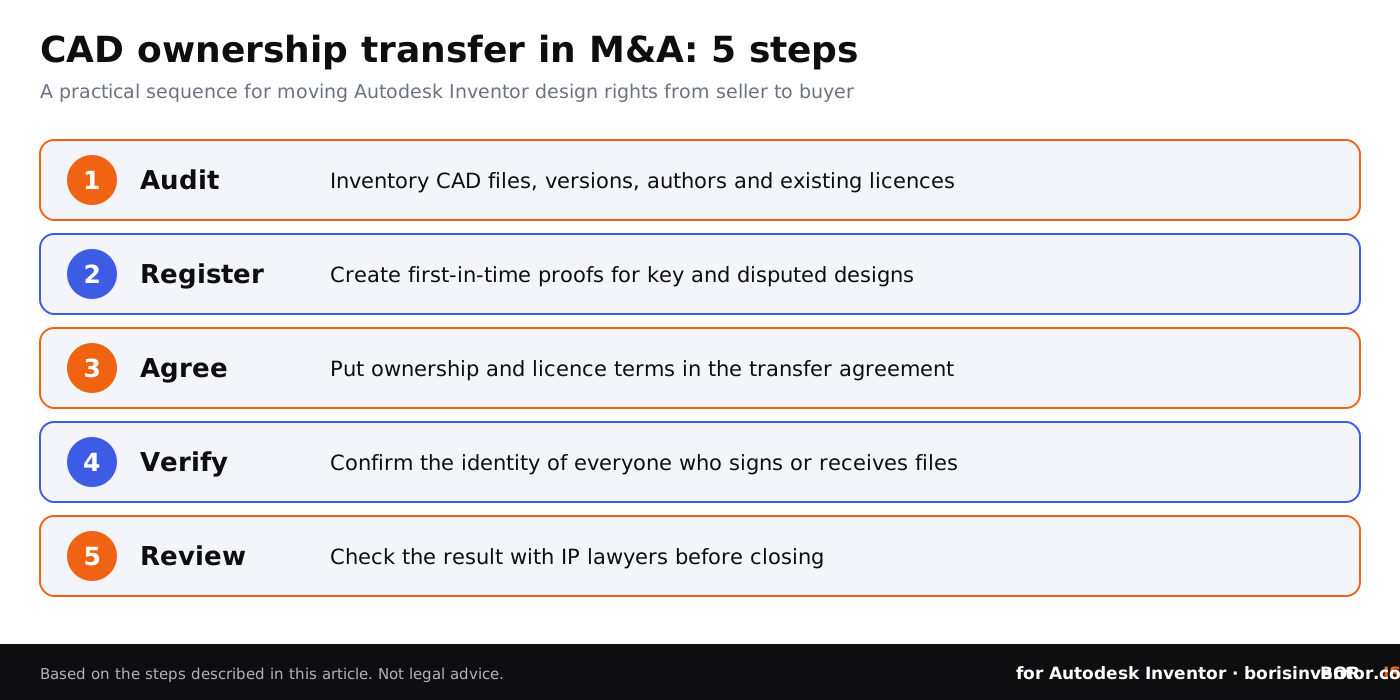
By following this structured approach, engineering teams can avoid lapses in file security while completing ownership transfers that align with M&A goals. With blockchain-based systems, such as the one described in our guide on how to automate CAD file registration in Inventor, ownership disputes become far less likely. For the buyer side, see how to conduct due diligence for CAD asset purchases.
Track and Certify Every CAD Change
Secure ownership transfer workflows with BORIS plugin integrated into Autodesk Inventor.
👉 Learn How to Prove Design Ownership
Conclusion: Looking Forward with Digital IP Protections
As we prepare for the next evolution of Industry 4.0, managing CAD ownership during M&A using technologies like blockchain will not only save time but also uphold IP integrity across global supply chains. Reflecting on insights from Dirk-Jan and Violetta Bonenkamp, automation in Autodesk Inventor workflows could redefine how fast-moving industries handle IP risks during complex transactions.
For firms exploring advanced protection solutions, this opens the door to a broader conversation about protecting CAD Intellectual Property. These tools are no longer optional but essential for competitive industries gearing up for 2026.
People Also Ask:
What is IP due diligence in M&A?
IP due diligence involves identifying and addressing issues related to intellectual property during mergers and acquisitions. This includes assessing litigation history, ongoing disputes, compliance with proprietary rights, and the potential involvement of infringing third-party IP. A thorough review ensures value validation and mitigates risks before finalizing the transaction.
What are the 4 types of acquisitions?
The four primary types of acquisitions are horizontal, vertical, conglomerate, and congeneric. Horizontal acquisitions occur between companies in the same industry operating at the same level. Vertical acquisitions involve companies at different stages of the supply chain. Conglomerate acquisitions are between businesses in entirely dissimilar industries, while congeneric acquisitions involve related industries, but without direct competition.
What challenges arise with CAD ownership transfer during M&A?
Challenges include tracking ownership rights of CAD files that may have been handled by multiple entities, ensuring intellectual property compliance, and aligning licensing agreements. Additionally, maintaining file integrity and resolving conflicting software formats between merging businesses add complexity.
How do companies manage IP assets in a merger?
Managing IP assets during a merger involves inventorying all intellectual property, assessing ownership and licensing agreements, and ensuring proper documentation. It's essential to confirm legal compliance and resolve disputes or overlaps between the merging entities' IP. Regular audits, supported by legal and technical teams, can streamline this process.
Why is data archiving crucial in M&A?
Data archiving is important for legal compliance, information accessibility, and preventing data loss during transition phases. Companies must establish retention policies, maintain audit trails, and ensure encrypted methods to safeguard sensitive records during and after a merger.
What is the role of software vendors in M&A asset transfers?
Software vendors play a critical role in ensuring licenses and software ownership rights are correctly transferred from one entity to the other during M&A. Open communication with vendors is required to facilitate these transitions, review related policies, and possibly renegotiate agreements.
What are common risks related to CAD data transfers?
Risks include loss of data integrity, unauthorized access, and licensing conflicts. Encryption tools, ownership audits, and using blockchain can help prevent breaches and ensure proper tracking during and after a CAD asset transfer process.
How does due diligence support a seamless transition in M&A?
Due diligence helps identify issues early, ensuring that all proprietary assets, legal documentation, and digital tools like CAD files are evaluated. This reduces risks associated with compliance, ownership disputes, and unanticipated liabilities, helping to create a smooth integration process for the entities involved.
What measures protect CAD data during mergers?
Protecting CAD data calls for applying encryption, maintaining secure backups, and monitoring version history. Blocking unsafe file transfers, ensuring legal compliance, and involving cybersecurity experts further safeguard CAD data during mergers or acquisitions.
Why is ongoing software management needed post-M&A?
Post-M&A, continuous management ensures that software licenses remain up-to-date and compliant. Regular audits, renewal checks, and standardized policies help organizations prevent unauthorized usage, minimize costs, and maintain operational consistency across merging business units.
FAQ: Managing CAD Ownership Transfers in M&A Deals
Why is CAD ownership critical during M&A transactions?
CAD files store valuable intellectual property that defines an organization’s competitive edge. During M&A transactions, ensuring precise ownership transfer prevents IP disputes, protects design integrity, and smooths the legal transition of design rights to the acquiring entity.
What tools simplify blockchain-based CAD ownership tracking?
Tools like BORIS integrate into CAD software (e.g., Autodesk Inventor) to provide blockchain-backed ownership proofs. These certify authorship, make tampering evident, and create immutable audit trails. Learn how they improve file security in an article on CAD security for Industry 4.0.
How do multi-party CAD collaborations complicate ownership transfer?
Ownership disputes arise when multiple collaborators contribute to CAD designs without registering contributions properly. Blockchain can attribute and timestamp each registered design version, ensuring transparent authorship records that simplify transfer processes for M&A.
What role do NFTs play in securing CAD IP during transfers?
NFTs can tokenize CAD ownership, creating secure digital certificates. These make IP exchange traceable and immutable, reducing disputes. For more, see how NFTs protect CAD intellectual property.
What are CAD-specific risks in M&A due diligence?
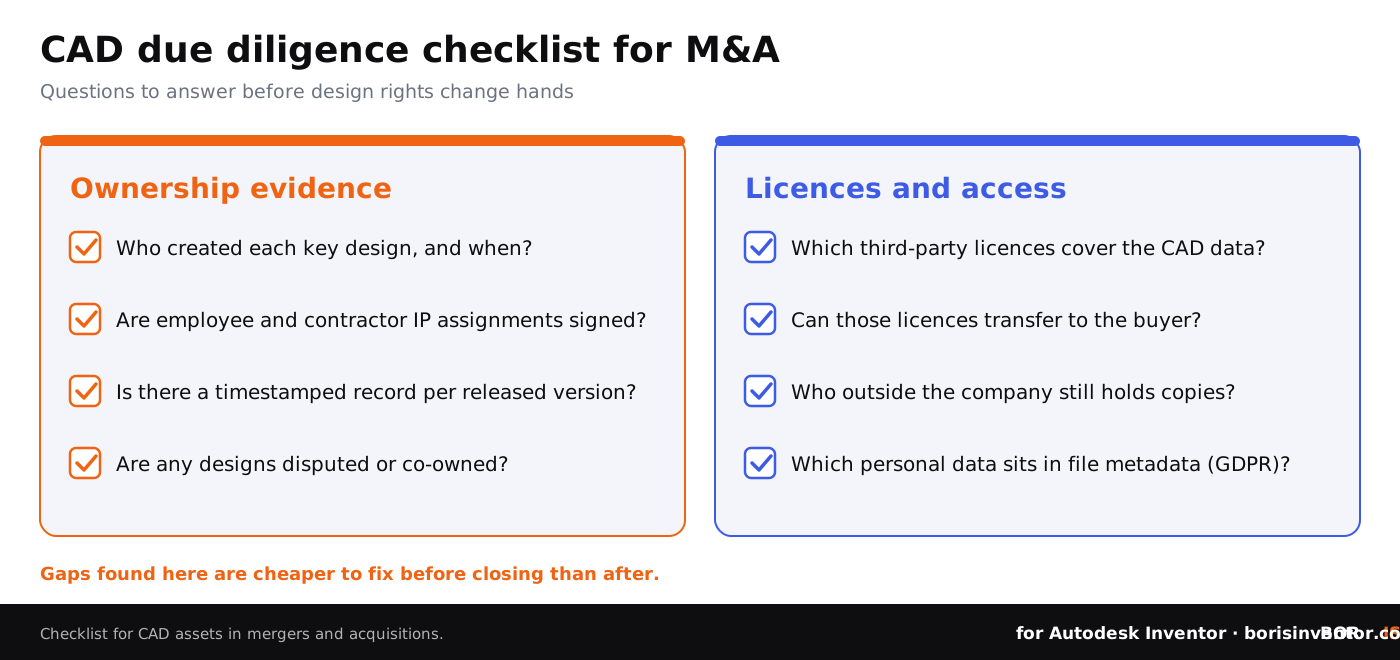
Risks include undocumented design history, missing proofs of ownership, and legal gaps in IP assignments. A thorough audit, supported by blockchain records, improves compliance, ownership traceability, and the integration of CAD assets post-merger.
How can blockchain reduce CAD asset disputes post-acquisition?
Blockchain creates tamper-proof records of registration and modification, protecting CAD data integrity in M&A. Immutable audit trails give strong evidence of ownership, which helps resolve disputes faster.
What are smart contracts in the context of CAD ownership?
Smart contracts are self-executing agreements on a blockchain that can automate steps in ownership transfers. For CAD, they streamline compliance, bind parties to terms digitally, and support secure asset handovers during mergers or acquisitions.
How do GDPR regulations affect CAD IP transfer in the EU?
GDPR requires that personal data within CAD systems, such as author names in file metadata, stays protected during transfers. Blockchain systems that keep personal data off-chain support GDPR compliance while enabling CAD ownership handovers across borders.
What happens if no proof of CAD authorship exists?
Without verified authorship, disputes can stall CAD transfers. Registering designs with blockchain proves when a design existed and who registered it, resolving issues before they arise. Tools like BORIS for Autodesk Inventor support IP integrity during asset acquisition due diligence.
What practical steps prevent CAD IP ownership errors?
To prevent errors, audit CAD files, track changes with blockchain, and establish transfer agreements via smart contracts. For smoother transitions, engage IP attorneys specializing in CAD asset transfers for detailed arrangements.
How can CAD ownership improve post-M&A operational synergy?
Establishing clear ownership ensures uninterrupted engineering workflows, maintains design reliability, and fosters team trust. Advanced solutions like CADChain enhance cross-team collaboration by verifying ownership transparently and mitigating operational disruptions.