
TL;DR: Protect Your CAD Trade Secrets
A global manufacturing case study showcases how blockchain technology secured CAD files within Autodesk Inventor, safeguarding intellectual property and ensuring tamper-proof ownership records. Engineers and SMEs can now use smart contracts, lifetime version tracking, and legal certificates to control file access and protect against theft.
💡 Discover strategies engineers use to defend their CAD IP, read about engineers securing IP.
Case Study: Protecting Trade Secrets in a Global Manufacturing Network
How do manufacturers protect their most valuable CAD trade secrets in an era where global supply chains and distributed collaborations are the norm? The answer lies in sophisticated digital tools combined with protective legal frameworks, a concept deeply explored by CADChain's founders. Violetta Bonenkamp and Dirk-Jan Bonenkamp share expertise on how blockchain-based IP management, Autodesk Inventor integrations, and meticulously crafted legal measures can reshape CAD file security for modern manufacturing networks.
Never lose control of your CAD files!
Learn how manufacturers protect their designs when production is spread across several countries.
👉 Read how to protect designs in global manufacturing
Why Are CAD Trade Secrets So Vulnerable?
At its core, manufacturing relies on digital designs for prototypes, production, and process efficiency. But CAD files often face risks of unauthorized sharing, reverse engineering, and intellectual property theft. According to Dirk-Jan Bonenkamp, traditional protections like NDAs rarely cover the complex downstream pathways that CAD files take. This limitation leaves companies vulnerable to breaches and legal disputes that can be avoided with proactive measures.
Every hand-off of a CAD file to a freelancer, supplier or sub-supplier is a moment where control over a trade secret can be lost.
These vulnerabilities highlight the need for technical solutions that integrate directly into CAD software workflows. Take Autodesk Inventor: CADChain’s BORIS plugin for Inventor users embeds rights management into every design stage, so data isn’t just secured but also backed by evidence down to the file level. The same applies when you share CAD files with freelancers.
How Blockchain Elevates IP Protection in Manufacturing
Blockchain technology, when properly utilized, offers an immutable ledger to track CAD file ownership, modification history, and access events. With CADChain's BORIS tool, design engineers using Autodesk Inventor can register their CAD designs immediately upon creation, ensuring a verifiable digital certificate of ownership. This proof becomes invaluable in cases of dispute, such as unauthorized reverse engineering.
- Digital Fingerprints: Each CAD file is hashed to generate a unique fingerprint stored securely on a blockchain ledger.
- Licensing Automation: Smart contracts embedded directly within CAD workflows define access limits and enforce license terms.
- Secure Transfers: Ownership transfers are gated by identity verification, reducing risks in international collaborations.
“Blockchain isn’t a gimmick for CAD; it’s a cornerstone for creating tamper-proof IP records.”
Violetta Bonenkamp, co-founder, CADChain
Learn from real-world CAD data breaches.
Discover what sensitive CAD file leaks cost manufacturers and how to prevent them.
👉 See the costs of CAD data breaches
Common Mistakes in CAD IP Management
Many SMEs overlook fundamental measures that could ensure robust CAD file security and IP preservation. Here are three critical oversights highlighted by Dirk-Jan Bonenkamp:
- Failing to Register Ownership: Without timestamped ownership records, proving authorship years later becomes very difficult.
- Overreliance on NDAs: NDAs protect initial collaborators but rarely enforce downstream sharing restrictions.
- Ignoring Version Control: A lack of visibility into CAD file modifications leads to drawn-out disputes about originality.
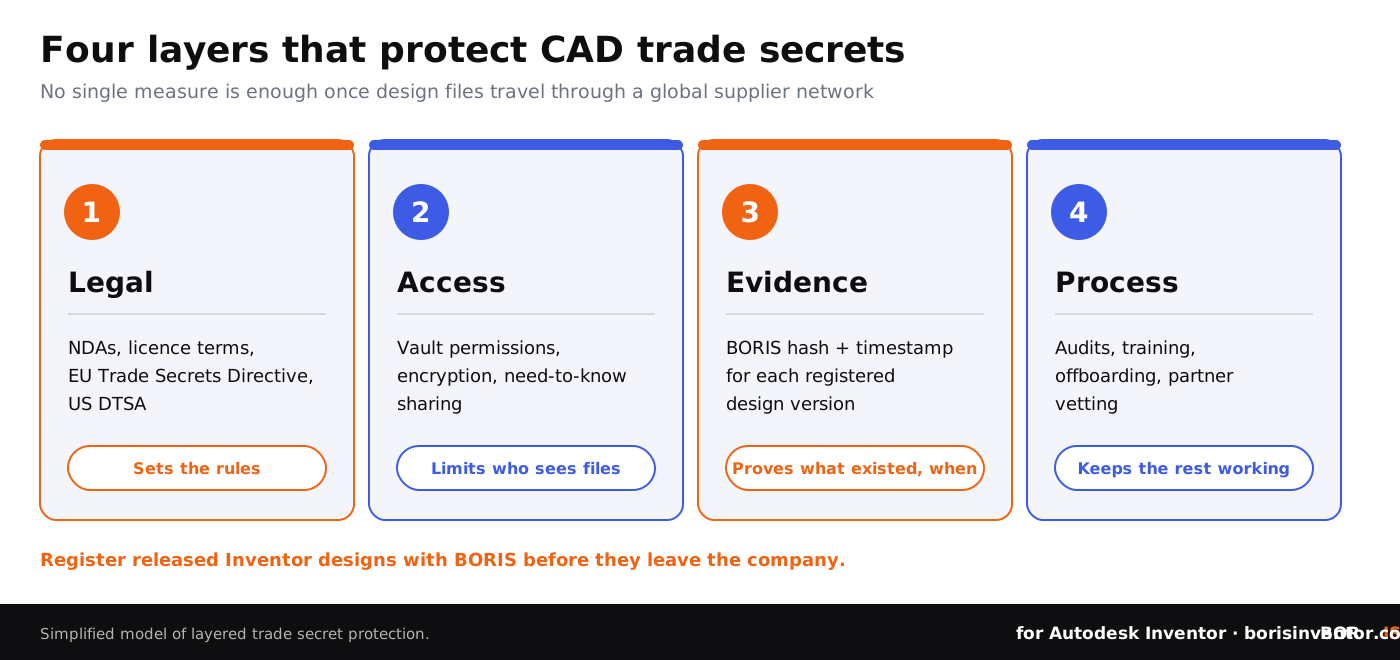
Each protection measure covers a different part of the risk. The table below compares the most common ones:
Actionable Steps to Protect Trade Secrets with Autodesk Inventor
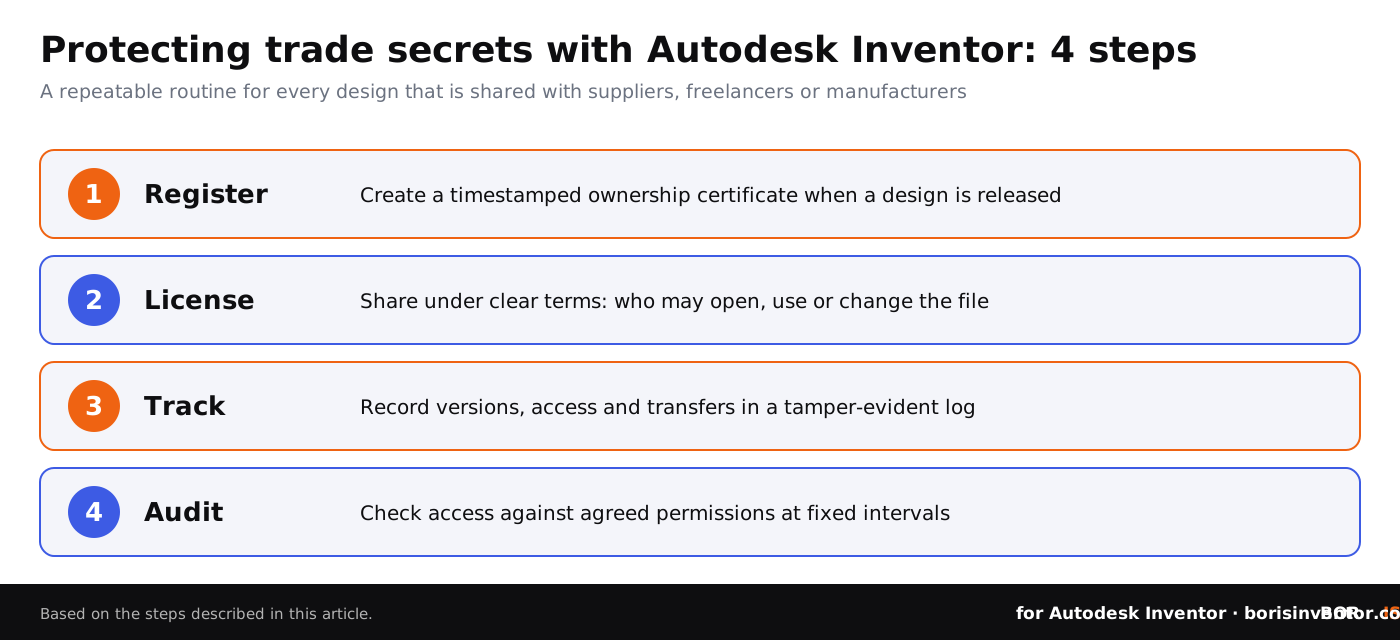
Implementing design ownership solutions within Autodesk Inventor can significantly improve your ability to safeguard CAD IP. CADChain recommends the following steps:
- Install Autodesk Inventor-integrated tools like BORIS to create digital ownership certificates as soon as a design is created or released.
- Use smart contract-driven access licenses for external collaborators, freelancers, and manufacturers.
- Track every event and modification in the lifecycle of your CAD design using tamper-evident blockchain records.
- Conduct periodic audits to ensure all access complies with predefined permissions.
The European Case for Enhanced CAD Protections
Europe’s reliance on intricate supply chains and fragmented manufacturing networks amplifies IP risks. Regulatory frameworks like GDPR also require addressing privacy concerns in CAD file-sharing practices. CADChain uniquely aligns technical protections with compliance requirements in European jurisdictions, giving SMEs tools to defend their rights.
Dirk-Jan Bonenkamp emphasizes that blockchain-backed certificates strengthen the evidence in IP disputes: they show which file existed at a given moment and who registered it, which courts can weigh alongside contracts and other proof.
Secure manufacturing IP and CAD data in the EU!
Discover practical tips to protect your trade secrets and comply with regional legal requirements.
👉 Explore supply chain security strategies
Closing Thoughts: What Comes Next?
For engineers and SMEs in the EU, securing CAD trade secrets isn’t just an option; it’s a necessity for survival in competitive global networks. Solutions like CADChain’s BORIS plugin position companies to not only protect their IP but also use it strategically during collaborations and disputes.
Building on the principles outlined here, the next step for innovative manufacturers is to explore tailored frameworks that combine legal and technical safeguards. For deeper insights into actionable protections, read guides on CAD intellectual property defense.
The European focus on CAD data security will only intensify as new challenges such as cyber threats and AI-driven reverse engineering emerge. Equip your workflows today to meet tomorrow’s IP demands.
People Also Ask:
What are trade secrets and why are they important?
Trade secrets are confidential business information that provide a competitive edge. Examples include formulas, processes, designs, and customer lists. Safeguarding trade secrets is vital as they drive innovation, maintain uniqueness, and protect against competitors using proprietary knowledge without permission.
How can global manufacturers protect trade secrets?
Global manufacturers can implement measures like Non-Disclosure Agreements (NDAs), restricted access to sensitive data, robust cybersecurity frameworks, employee training on confidentiality, and legal action against breaches. Ensuring legal compliance across jurisdictions is also crucial when protecting intellectual assets globally.
What are the legal strategies for safeguarding trade secrets internationally?
Legal strategies involve leveraging jurisdiction-specific trade secret laws, including the Defend Trade Secrets Act (DTSA) in the US or the EU Trade Secrets Directive. Companies can also include choice-of-law clauses in contracts to set clear legal terms and enforce protections under appropriate laws.
What are common risks to trade secrets in supply chains?
Risks include data breaches, insider threats, reliance on untrustworthy suppliers, and unauthorized sharing of information. Weak points often occur during information exchange with partners, highlighting the need for secure communication protocols, monitoring, and proper vetting of all supply chain members.
What is the role of technology in protecting trade secrets?
Technology helps safeguard trade secrets through encryption, access controls, network security tools, and blockchain applications that verify data integrity. Advances in AI can monitor and flag suspicious activity, while cloud services can securely store critical data with robust access restrictions.
What are examples of successful trade secret protection in manufacturing?
Examples include companies like Coca-Cola, which maintains tight security around its secret formula, and manufacturing firms that use compartmentalized knowledge to prevent full disclosure to any single employee or partner. These methods stop leaks and ensure continuity of competitive advantages.
How do trade secret laws vary across countries?
Trade secret protection laws differ globally, with countries like the US, EU members, and China following unique regulations. For instance, the US uses the DTSA and states have additional laws, while the EU harmonized laws through its directive. Companies should adapt by aligning practices with local requirements.
What is the impact of insider threats on trade secrets?
Insider threats include employees, contractors, or partners exposing confidential information for personal benefit or through negligence. To mitigate these risks, companies implement training, conduct regular audits, and establish accountability using background checks and access limits for sensitive data.
Can blockchain technology improve trade secret protection?
Blockchain adds value by securely tracking transactions and access to sensitive information. It ensures data integrity and transparency without disclosing underlying proprietary details. For manufacturing networks, blockchain can create tamper-proof records of who accessed or modified confidential data.
Why do trade secret breaches often lead to costly outcomes?
Breaches result in financial losses, legal battles, reputational damage, and loss of competitive advantage. A single incident can disrupt business operations and reduce market share, particularly for manufacturers reliant on proprietary processes or designs.
FAQ on Protecting Trade Secrets in a Global Manufacturing Network
What is the biggest risk to trade secrets in a global manufacturing network?
The largest risk is unauthorized sharing or theft of CAD files during collaborations with external manufacturers or freelancers. These risks are heightened with global supply chains due to differences in legal protections, regulatory enforcement, and cybersecurity infrastructure.
How does blockchain improve CAD file security?
Blockchain secures CAD files by creating immutable records of file ownership, access, and modifications. It enables tamper-proof proof of authorship for legal disputes and complements smart contracts for access control. Detailed initiatives are discussed in Blockchain for CAD Protection.
Which industries benefit most from CAD-centric IP protection?
Industries like automotive, aerospace, consumer electronics, and machinery manufacturing, with intrinsic reliance on proprietary designs, derive the greatest benefits from CAD-centric IP protection. Strong safeguards against reverse engineering or unauthorized distribution prevent competitive loss.
Are NDAs enough to safeguard CAD designs?
NDAs establish legal grounds but are insufficient for complex manufacturing networks. They rarely enforce downstream access controls, making digital rights management and blockchain-based verification vital for comprehensive protection strategies.
How does Autodesk Inventor enhance IP security?
Autodesk Inventor works with plugins such as CADChain BORIS to manage IP rights directly within the design workflow. From file hashing and timestamped ownership certificates to access-controlled licenses, these features add legal and technical safeguards across the CAD lifecycle.
Why is version control important for CAD files?
Version control tracks design changes, ensuring originality and reducing disputes in collaborations. Without it, unauthorized edits can undermine product integrity and lead to legal complications. PDM tools such as Autodesk Vault manage versions, and BORIS adds a timestamped ownership record for each registered version.
What role does GDPR play in CAD file security?
GDPR protects personal data, not designs as such. CAD files and their metadata can still contain personal data, such as author names, e-mail addresses or customer details, so sharing them in EU-based manufacturing must follow GDPR rules. Protective measures include encryption, data minimisation and traceable sharing. The designs themselves are protected by trade secret law and IP rights.
What are common mistakes in protecting trade secrets?
Mistakes include neglecting IP registration, over-relying on basic contracts like NDAs, and skipping cybersecurity measures such as encrypted file transfers. Learn more strategies in 2026 IP Protection Strategies.
Is encryption sufficient for CAD security?
Encryption is vital but not standalone. It needs to be paired with blockchain-based verification, identity authentication, and secure file-sharing protocols to protect CAD files effectively throughout their lifecycle.
How can SMEs afford robust CAD file protection?
SMEs can leverage cost-effective tools like plugins integrated into existing CAD software and non-dilutive funding grants. Implementing scalable, modular solutions ensures phased adoption of advanced security measures without straining budgets.