
On 5 October 2026 Autodesk announced passthrough billing for Autodesk Platform Services (APS). It lets the makers of third-party apps move the cost of the Autodesk API calls their apps make onto the customer, who then pays from the API capacity included in an eligible Autodesk subscription, or with Flex or Pay as You Go. Developers can prepare now; Autodesk says the customer setup step arrives early next year.
APS, formerly Forge, is the set of cloud APIs behind viewers, translators, cloud automation and data connectors across the Autodesk world. Over the past year Autodesk has been moving those APIs to a paid model. Pricing for the Manufacturing Data Model APIs took effect on 17 August 2026, AEC Data Model pricing followed on 6 October, and Autodesk has named more APIs that will become paid later. Passthrough billing is the next piece: it decides who pays when an app you use calls those APIs on your behalf.
For most Inventor users this will not change anything on Monday morning. Add-ins and iLogic rules that only use Inventor's own desktop API run on your workstation and are not APS calls. But many CAD teams now use web viewers, configurators, cloud automation, PLM connectors and AI tools that do call APS. For them, this is a change in who pays, in what has to be set up, and in how much a third-party app can see and do with your design data. Below we explain what Autodesk has actually announced, what is still open, and what CAD managers and manufacturing SMEs should check.
TL;DR: APS passthrough billing in one paragraph
Until now, the developer of a third-party app usually paid for the Autodesk API usage that app generated. With passthrough billing, eligible usage can be charged to the customer instead, first against the API capacity included in an eligible Autodesk subscription, then against Flex or Pay as You Go. It is optional and opt-in on both sides, works only for apps that sign users in with 3-legged OAuth, and adds a step where the user picks which Autodesk account context pays. For a developer, the move is one-way. For customers, it means a second bill line to watch, an extra consent step, and a good reason to review which apps can reach your Inventor and Vault data in the cloud.
What exactly did Autodesk announce?
Autodesk published two posts on the APS developer blog on 5 October 2026: an announcement and a guide for independent software vendors (ISVs). The announcement explains the change in plain terms. Today, eligible API usage generated through a third-party application is usually billed to the app's owner. With passthrough billing, that usage can draw on the customer's own APS capacity instead: either the included API usage that comes with an eligible Autodesk subscription or another APS purchasing option such as Flex or Pay as You Go. You can read Autodesk's passthrough billing announcement on the APS blog.
Autodesk is clear that this is a choice, not a forced switch. In its words, "Passthrough billing is opt-in on both sides." The developer has to enable the application and build the required authorization step, and each customer has to complete a setup before any usage can be attributed to them. A developer can keep paying for usage as today, launch a new app that uses passthrough, move an existing app across in stages, or run both models side by side.
The rollout comes in two phases. The first phase, which is open now, gives developers time to evaluate the model and prepare their applications. The second phase introduces passthrough billing to users. According to the ISV guide, the integration workflow customers need to complete will be available early next year. Autodesk has not published an exact date for that customer step, and it has not named any Inventor or Vault apps that will adopt the model.
How does passthrough billing work for the customer?
The mechanism sits in the sign-in. Passthrough needs to know which customer's APS subscription should pay, so it needs a signed-in user. That is why it only works with 3-legged OAuth, the flow where a person logs in with an Autodesk account and grants the app access. Apps that only use 2-legged, server-to-server access are not supported in the initial release.
When a passthrough-enabled app asks you to sign in, Autodesk adds one step. The sequence becomes: authenticate, select a usage context, give consent, return to the app. The usage context you pick decides which customer account funds the API usage. That choice is tied to the access token and kept when the token is refreshed, so you will not see the question every day. If no valid usage context can be found, or the user cancels, the sign-in fails rather than falling back to some other payer. Autodesk calls this fail-closed.
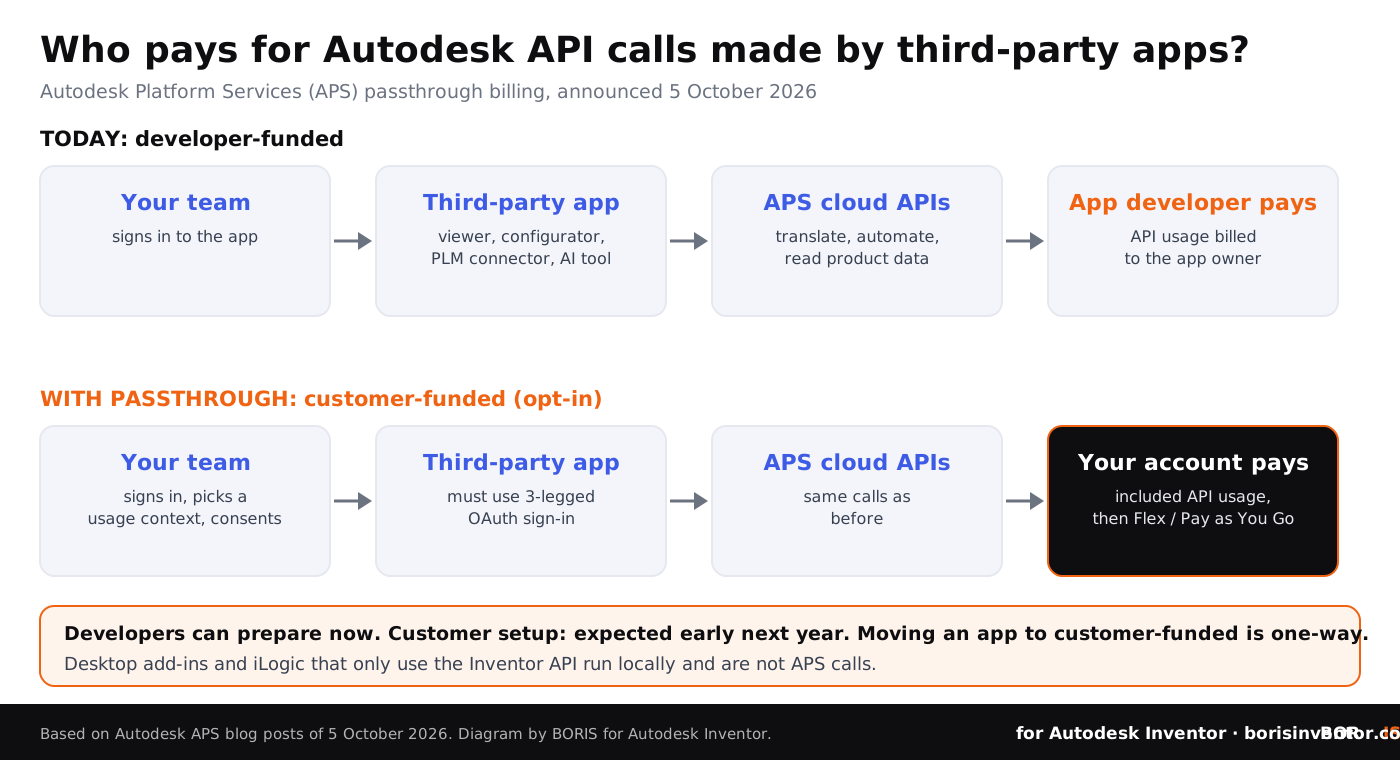
On cost, the guide spells out that the developer's product and the Autodesk API capacity it consumes are separate costs, billed by each provider. Customers who use more than the capacity included in their subscription need Flex or Pay as You Go on their account to cover the rest. Autodesk's September post on the Data Model APIs adds two useful details: included usage is pooled at team level when you hold several subscriptions, and usage above the included amount needs an active paid APS offering, otherwise the service can be interrupted. Autodesk has also promised that API pricing changes will be communicated at least 90 days in advance.
Which Autodesk APIs are already paid, and which are next?
The ISV guide lists the APIs that are currently part of the paid model and the ones that will be added later. This is the list to compare against the tools your team uses. If your design data reaches the cloud through any of them, the funding question applies to you.
The last row matters for budgeting. The Inventor API that our guide to Inventor automation with iLogic, add-ins and the API describes runs locally. If you have built your own tools, our walkthrough on building a first add-in for the Inventor API is still the right starting point, and nothing in this announcement puts a meter on it.
Why should Inventor teams care if they never write code?
Because the apps you buy will make the choice for you. A configurator, viewer or PLM connector vendor that switches to passthrough will expect you to hold an eligible subscription with APS capacity, complete Autodesk's setup, and possibly buy Flex if your usage grows. Autodesk notes that once a developer moves an existing app to customer-funded only, customers who have not completed the setup lose access through that app. If nobody in your company owns that setup, a working tool can stop working.
It also changes the budget conversation. Autodesk's own blog says high-volume use, such as large-scale automation, data processing or AI-driven workflows, is exactly where API costs grow fastest. Under passthrough, that growth lands on the customer's capacity, not the vendor's. CAD managers who already track named users and tokens, as we explained in our article on Autodesk Assistant, Fusion Connected Client and Flex tokens after AU 2026, now have one more meter to watch.
Finally, there is a data question. Every app that calls APS on your behalf has been granted access to some of your design data in the cloud. The new consent step is a natural moment to ask what each app can read, where it stores derived files such as translations and thumbnails, and who owns those outputs. Our guide on securing sensitive CAD data in cloud storage covers the basics, and the post on monitoring third-party use of your CAD designs explains how to keep track of where your files travel.
What does this mean for design data ownership?
Passthrough billing is a billing change, not a change to who owns your models. Autodesk's posts say nothing about data rights, and you should not read anything into that silence. What it does show is the direction of travel: more of the work done on Inventor data happens through cloud APIs and third-party apps, more of it is metered, and more of it depends on account settings that sit outside the CAD file.
That makes independent evidence more valuable, not less. If a design is translated, viewed, configured and edited by several services, the question "who created this, and when?" gets harder to answer from logs you do not control. A dated, verifiable record created at the source, on your own workstation, does not depend on which app or subscription paid for the last API call. Our Inventor IP management best practices and the article on how to prove design ownership in legal disputes explain why that record matters when a supplier or customer relationship goes wrong.
Keep proof of your designs that no cloud bill can switch off.
BORIS for Autodesk Inventor registers your CAD files with a blockchain timestamp and a certificate of ownership, directly inside Inventor.
👉 Discover BORIS for Autodesk Inventor
What should CAD managers do now?
- List every app that touches your Autodesk cloud data. Viewers, configurators, PLM and ERP connectors, AI assistants and any Autodesk Docs or Fusion integrations. Separate them from desktop add-ins that only use the Inventor API.
- Ask each vendor about passthrough. Will they keep paying for API usage, move to passthrough, or offer both? When, and with how much notice? Get the answer in writing.
- Find out what your subscriptions include. Check which of your Autodesk subscriptions are eligible for included API usage, which team the capacity sits in, and whether your apps are registered in that same team.
- Name an owner for the setup. Someone with admin rights must complete Autodesk's customer setup when it arrives early next year, or a vendor's switch to customer-funded only can cut off access.
- Budget for Flex or Pay as You Go. Heavy automation and AI workflows burn API capacity fastest. Agree a monthly ceiling and who approves going over it.
- Review data access at the consent step. Check scopes, storage of derived files and contract terms on outputs, and keep independent proof of key design versions with a CAD data protection plan that does not depend on any one cloud account.
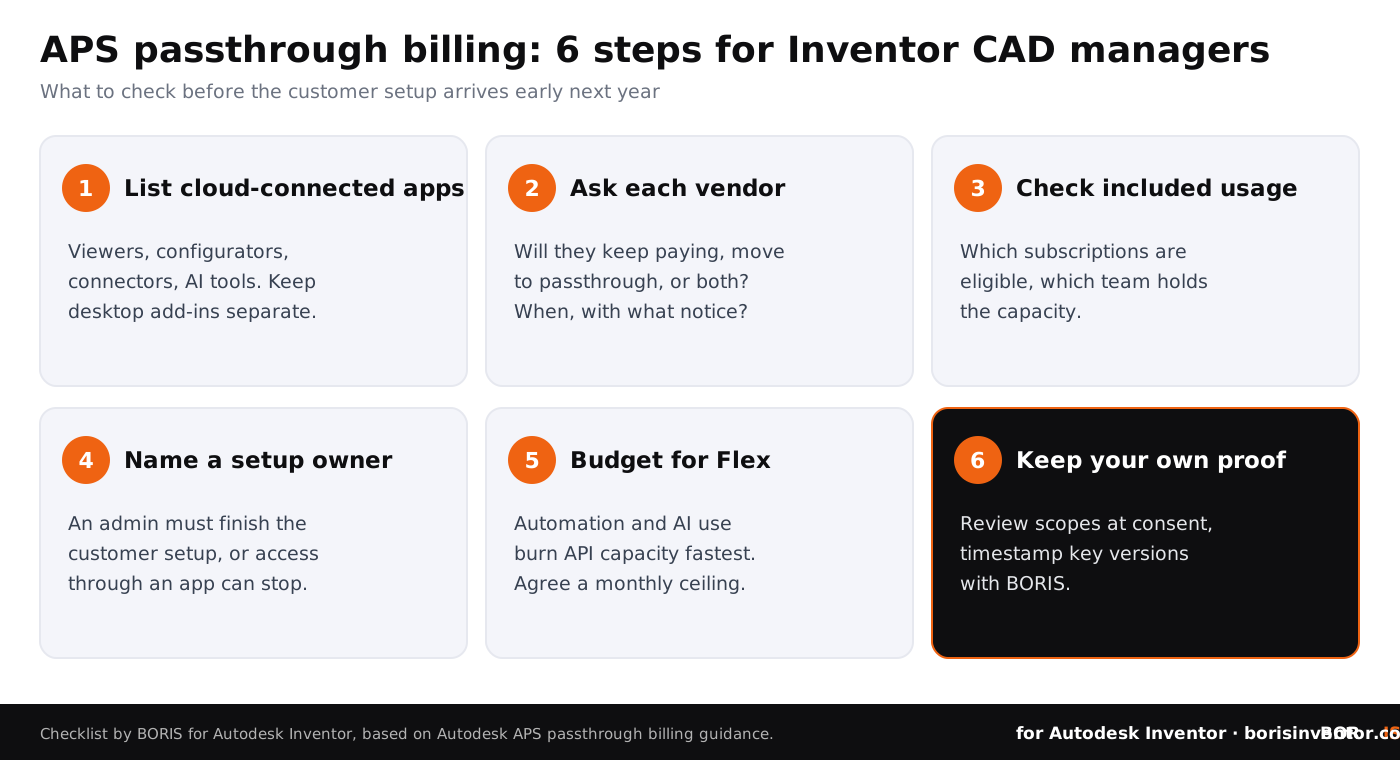
None of these steps needs a developer. They are the same governance habits we recommend for supplier compliance with CAD data rules: know who has access, know what it costs, and keep your own records.
What is still unclear?
- The customer date. Autodesk says the customer integration workflow will be available early next year. There is no exact date yet.
- Included amounts. Autodesk says qualifying subscriptions include monthly API usage, but the per-product amounts are shown only in a chart on its September post. Check your own subscription details before planning.
- Which apps will switch. Adoption is up to each developer. No Inventor or Vault app has been publicly named as moving to passthrough.
- Server-to-server tools. Pure 2-legged apps are not supported in the initial release, and Autodesk says it will slowly move all API endpoints to 3-legged OAuth. Integrations that run unattended overnight may need redesign.
- When Data Management APIs become paid. Autodesk lists them as coming later and promises ample notice, with at least 90 days for pricing changes.
The bigger picture across the BORIS network
This week's news on our sister sites shows the same pattern: rules, tools and terms are shifting around design data faster than most teams update their own records.
- Trade secrets and data sharing. On CADChain, the EU Data Act trade secrets dispute that stalled the Digital Omnibus explains why the Coreper vote was postponed on 7 October and what manufacturers should do while governments argue over sharing data with third countries.
- AI agents and certification. BORIS for SOLIDWORKS reports that an AI agent passed the SOLIDWORKS CSWP exam, and what that means for hiring, for the access you give AI agents, and for who owns AI-assisted designs.
- AI editing and ownership terms. Blended BORIS looks at the Meshy Edit launch and Meshy's ownership terms, where the plan you pay for affects who owns the 3D output.
CADChain explains how its CAD data protection technology works across tools, and our article on manufacturing IP and supply chain security for CAD data covers the Inventor side.
Conclusion
Passthrough billing does not change Inventor itself, and it does not put a meter on your desktop add-ins. It changes who pays when third-party apps use Autodesk's cloud APIs on your design data, and it adds a setup and consent step that someone in your company will have to own. Developers can prepare now; customers will see it early next year, app by app. Use the time to list your cloud-connected tools, ask vendors for their plans, check your included API capacity, and make sure your proof of design ownership lives with you, not with whichever service handled the last API call.
Your designs, your proof.
BORIS for Autodesk Inventor gives every registered file a blockchain timestamp and a certificate of ownership, without sending your models to a cloud service.
👉 See how BORIS for Autodesk Inventor works
FAQ: Autodesk APS passthrough billing
What is APS passthrough billing?
It is an option Autodesk announced on 5 October 2026 that lets third-party app developers charge the Autodesk Platform Services API usage their apps generate to the customer, instead of paying for it themselves. The customer pays from included API usage in an eligible Autodesk subscription, or with Flex or Pay as You Go.
Is it live now?
Developers can prepare their apps now. Autodesk says the customer integration workflow becomes available early next year, so customers cannot be billed this way until they complete that setup.
Do I have to accept it?
It is opt-in on both sides. But if a vendor moves an app to customer-funded only, customers who have not completed the setup lose access through that app, so in practice you may need it to keep using the tool.
Does it affect Inventor add-ins and iLogic?
Not directly. Add-ins and iLogic rules that only use Inventor's desktop API run on your workstation and are not APS cloud calls. It affects apps that call Autodesk's cloud APIs, such as viewers, translators, cloud automation and data connectors.
Which APIs are paid today?
According to Autodesk's ISV guide: Model Derivative, Automation, Reality Capture, Flow Graph Engine, Manufacturing Data Model and AEC Data Model APIs. Data Management and Forma APIs will be added later.
Why does it need 3-legged OAuth?
Autodesk needs a signed-in user to know which customer's subscription should pay. Pure server-to-server apps have no user context, so they are not supported in the initial release.
What happens if we exceed our included API usage?
You need an active paid APS option, such as Flex or Pay as You Go, to avoid service interruptions. Included usage is pooled at team level and apps must sit in the same team as the subscription.
How does BORIS help?
BORIS for Autodesk Inventor registers CAD files with a blockchain timestamp from inside Inventor. Each registered version gets a dated certificate of ownership that does not depend on any cloud account, API subscription or third-party app.