
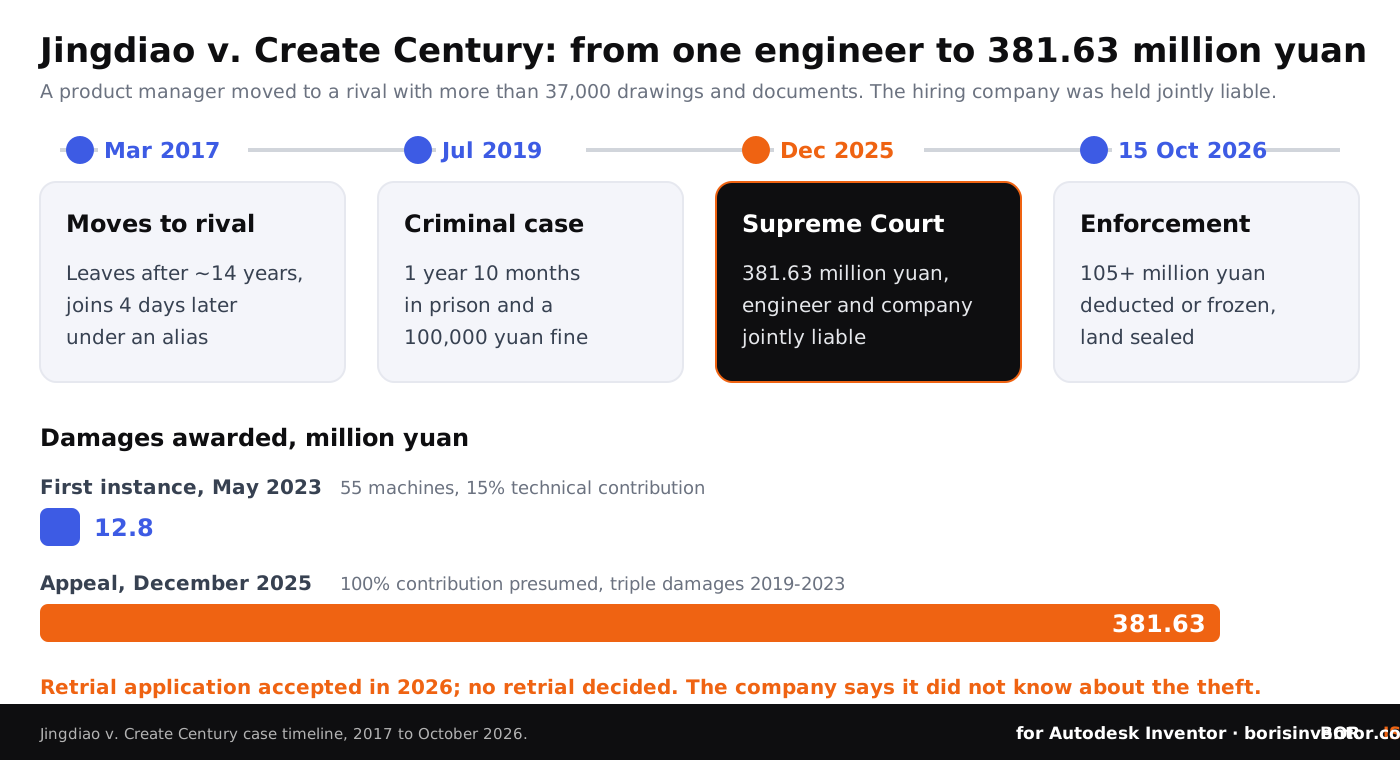
On 15 October 2026 the Chinese machine-tool maker Shenzhen Create Century told investors that courts had now taken or frozen more than 105 million yuan of its money, frozen its shares in three subsidiaries and sealed a plot of its land. The reason is a trade secret judgment: China's Supreme People's Court ordered the company and a former employee of its rival Beijing Jingdiao to pay 381.63 million yuan, about $57 million, after the engineer took more than 37,000 design drawings and technical documents with him when he changed jobs.
The case is back in the news because the money is now being collected. Caixin Global called it one of China's largest judgments in a technology secrets case in its in-depth report on the ruling. The award is almost 30 times the 12.8 million yuan granted at first instance, and the company has asked the Supreme People's Court to reopen the case.
For engineering companies that design in Autodesk Inventor, the lesson cuts both ways: the company that lost the drawings had to prove what was taken, and the company that hired the engineer is paying the bill, although it says it did not know about the theft.
TL;DR: a new hire's files became the employer's liability
A product manager left Beijing Jingdiao in March 2017 and joined Shenzhen Create Century four days later under an alias. Chinese courts found he had copied more than 37,000 drawings and documents. He was jailed in 2019. In December 2025 the Supreme People's Court held him and his new employer jointly liable for 381.63 million yuan, presumed that the stolen technology accounted for 100% of the value of the machines, and applied triple punitive damages for part of the period. Enforcement passed 105 million yuan by 15 October 2026. For Inventor teams: limit and watch access to complete design packages, and never let a new hire bring files from a former employer.
What happened between Jingdiao and Create Century?
Beijing Jingdiao is a well-known Chinese maker of CNC machine tools, including glass grinding machines. According to Jiemian, which reported the case on 18 October 2026, the engineer at the centre of the case, identified in reports as Tian, worked at Jingdiao for about 14 years as a product manager and had signed a confidentiality agreement.
He left Jingdiao on 26 March 2017. Four days later he started at Shenzhen Create Century under an alias and soon became deputy general manager of its glass machine project. Chinese media reporting on the judgment say he began preparing about a month before he left. He used a weakness in Jingdiao's data management system, downloaded files from the server 162 times and made more than 70,000 copies over a network share from his own computer to a shared computer, then carried the files out on USB drives and portable hard drives.
In total he took more than 37,000 design drawings and technical documents. In July 2019 a district court in Beijing sentenced him to one year and ten months in prison and fined him 100,000 yuan for infringing trade secrets. Jingdiao then sued both Tian and Create Century for damages in a separate civil case.
How did 12.8 million yuan become 381.63 million yuan?
In May 2023 the Beijing Intellectual Property Court awarded Jingdiao 12.8 million yuan. That figure was based on 276,200 yuan of profit on 55 specific machines and, according to the weekly Times Weekly, a technical contribution rate of 15%: the court assumed the stolen technology explained only a small share of the value of the machines.
On appeal, the Supreme People's Court took a very different view in December 2025. As reported by Daily Economic News and Times Weekly, it found that:
- the infringement was clearly malicious and serious, and Tian and the company had acted together;
- Jingdiao had spent about 363 million yuan on research and development for its glass grinding machine project, while the defendants got the technology at nearly zero cost;
- the drawings should be treated as one technical secret as a whole, not file by file;
- the company's glass machines could not have been developed so quickly without the secret, so the technology accounted for 100% of their value;
- triple punitive damages applied to infringement between 23 April 2019 and 24 March 2023.
The court's own calculation of the infringers' profit came to about 677 million yuan. That was more than Jingdiao had asked for, so the court granted the full claim: 379.63 million yuan in economic losses plus 2 million yuan in reasonable costs. Daily Economic News reported that before Tian arrived, drilling, milling and tapping machines made up about 95% of Create Century's main revenue, and that afterwards glass processing machines became its core product.
What did the court order besides damages?
The money is only part of the judgment. According to Daily Economic News, Create Century must stop using the technical secret to make CNC machine tools, including glass machines, and the order lasts until the secret becomes public knowledge. It must destroy all drawings and technical documents, on paper and in electronic form, that contain the secret. And it must tell its shareholders, directors, supervisors, senior managers and every employee about the judgment, and each of them must sign a confidentiality and non-infringement commitment.
Destroying every file that contains a competitor's secret means finding them first: in the PDM system, on file servers, on laptops and in derived models. Our guide to CAD file dependencies in assemblies shows how far a single file can spread.
Why did the hiring company pay?
Create Century says it did not know what Tian had done before he joined, and it disagrees with the judgment. According to Times Weekly, it argues that it had been making glass machines since 2015, before he arrived, that about 70% of the parts in its machines are bought in or standard components whose drawings it does not hold, and that Jingdiao only submitted a catalogue of the drawings, not the drawings themselves.
The court did not accept that defence. It found that the two defendants had closely coordinated, and held the company jointly liable with the engineer. Legal commentators in China are divided. A former deputy chief judge of the Beijing High People's Court's IP tribunal, Cheng Yongshun, said in comments reported by Times Weekly that presuming a 100% contribution departs from the principles of compensation and proportionality. Huang Wushuang of the East China University of Political Science and Law supported the approach, noting that the defendant had not submitted evidence to separate its own contribution from the stolen technology.
When a company cannot show, with dated records, what it had designed before a new hire arrived, a court has little to separate its own work from the disputed files. The same problem appears in our recent coverage of the NASCAR trade secrets case against a departing engineer and in the ruling that treated 3D model files as trade secrets.
Know what you designed, and when.
BORIS for Autodesk Inventor registers your CAD files from inside Inventor and gives each registered version a blockchain timestamp and a certificate of ownership.
👉 See how BORIS for Autodesk Inventor works
Where does the case stand now?
In May 2026 Create Century applied to the Supreme People's Court for a retrial. The court has accepted the application, but the company itself points out that acceptance does not mean a retrial has started, and the outcome is uncertain.
In its announcement of 15 October 2026, reported by Jiemian and other outlets, the company said that 76.08 million yuan had been deducted from its bank accounts and another 29.33 million yuan frozen, more than 105 million yuan in total. It has paid 10 million yuan in advance, its full shareholdings in three subsidiaries with registered capital of 450 million yuan are frozen, and a plot of land in Shenzhen's Bao'an district with a book value of about 28.2 million yuan has been sealed. The company says the enforcement has not yet had a material impact on its daily operations.
In July 2026 the company, its chairman and its board secretary also received regulatory warning letters because the bank freezes had been disclosed late.
What does this mean for Autodesk Inventor teams?
The reports do not say which CAD system Jingdiao used, and the case is not about a software flaw. It is about broad access to a complete design package, bulk copying that went unnoticed, and a new employer that put the engineer in charge of a competing product. Inventor teams that keep their designs in Autodesk Vault or on file servers face the same three risks:
- Too much access. A product manager or senior engineer often has read rights to every project, including product lines they no longer work on. See role-based access control for CAD environments.
- Bulk copying that nobody notices. 162 downloads and more than 70,000 copy operations went unchallenged. Our article on tracking who accesses your CAD files explains which records help.
- Contaminated new hires. An engineer who joins from a competitor can bring files, on purpose or by accident, and those files can end up in your own Inventor assemblies.
What should Inventor CAD managers do now?
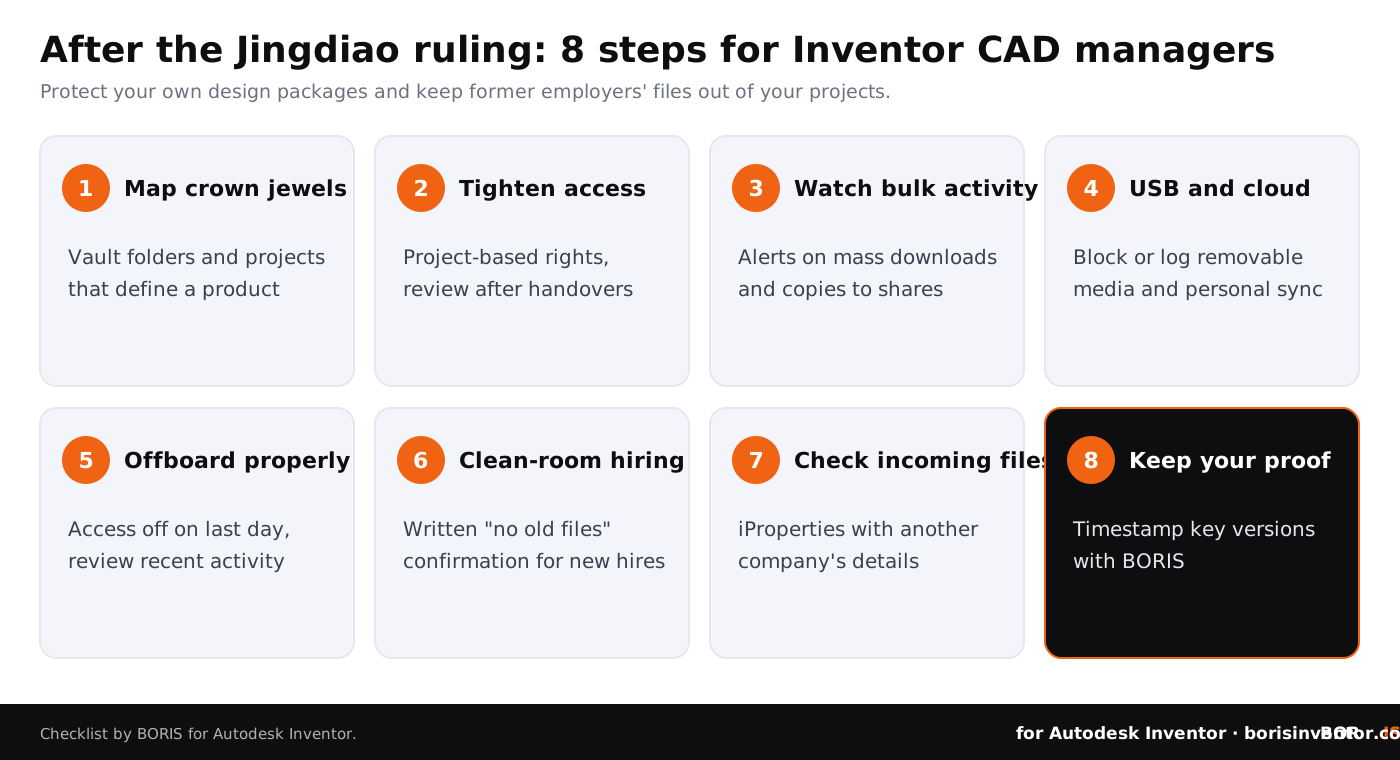
- Map your crown jewels. List the Vault folders, projects and libraries that together describe a product you could not afford to lose. Courts may treat them as one secret, but you still need to show which files belong to it.
- Tighten access. Give people access to the projects they work on, not the whole vault. Review Vault groups and folder permissions after every reorganisation and every product handover.
- Watch for bulk activity. Use the logs your Vault server, file servers and endpoint tools already keep, and set alerts for large downloads, mass copies to shares and unusual working hours, especially in an employee's last weeks.
- Control removable media and personal cloud. Block or log USB storage and personal cloud sync on CAD workstations, with exceptions approved and recorded.
- Offboard properly. Remove access on the last day, review the previous months of file activity, collect devices and remind the leaver in writing of their confidentiality duties.
- Run a clean-room hire. Ask every new engineer to confirm in writing that they bring no files from a former employer, refuse any that are offered, and keep them off directly competing projects for an agreed period if the risk is high.
- Check what enters your data. Look at the iProperties of imported parts and drawings, such as author and company, and question files that carry another company's details.
- Keep dated proof of your own work. Register key design versions with independent timestamps, so you can show what you had before anyone joined or left.
For background on the legal side, read our guides on how to protect trade secrets in manufacturing, employment contracts for CAD engineers and how to prove company ownership of employee designs. Onboarding is covered in how to design onboarding programs for secure CAD workflows, and the limits of contracts alone in NDA limitations for protecting CAD files.
The bigger picture
This week's news on our sister sites shows the same pressure on engineering data from different directions:
- State interest in industrial know-how. On CADChain, the arrest of a suspected Russian spy in Germany shows how people working in the European defence industry are approached for information about production sites.
- What drawings protect. BORIS for SOLIDWORKS covers a Canadian court ruling on copyright in CAD drawings, where copyright in valve drawings existed but did not stop a rival from making the valves, and damages came only from drawings that were rebranded and sent to suppliers.
- Provenance of digital assets. Blended BORIS looks at the debate over AI disclosure labels on Steam, and why buyers of 3D assets want to know where content comes from.
CADChain explains how its CAD data protection technology works across CAD systems, and our article on blockchain timestamps for proving design authorship shows how dated records work in practice. See also what industrial espionage in CAD design looks like.
Conclusion
The Jingdiao case started with one engineer and a few weeks of copying in 2017. Nine years later his new employer faces a bill of 381.63 million yuan, unless a retrial changes the outcome. For Inventor teams the message is simple: control who can reach complete design packages, notice when files leave in bulk, keep former employers' files out of your projects, and keep dated proof of your own work. Whether you are the company that loses the drawings or the one that hires the engineer, that evidence decides how the story ends.
Your designs, your proof.
BORIS for Autodesk Inventor gives every registered file a blockchain timestamp and a certificate of ownership, without sending your models to a cloud service.
👉 See how BORIS for Autodesk Inventor works
FAQ: the Jingdiao trade secret case and Inventor teams
What is the Jingdiao v. Create Century case?
It is a Chinese trade secret dispute between the CNC machine maker Beijing Jingdiao and its competitor Shenzhen Create Century. A former Jingdiao product manager took more than 37,000 design drawings and technical documents when he moved to Create Century in March 2017. He was convicted in 2019, and in December 2025 the Supreme People's Court ordered him and Create Century to pay 381.63 million yuan.
Why did the damages rise from 12.8 million to 381.63 million yuan?
The 2023 court counted profit on 55 machines and a 15% contribution. The Supreme People's Court presumed a 100% contribution, applied triple damages for 2019 to 2023 and found infringers' profit of about 677 million yuan, so it granted the full claim.
Why was the hiring company liable?
The court found that the engineer and the company had closely coordinated and held them jointly liable. Create Century says it did not know about the theft and has applied for a retrial. The court has accepted the application, but no retrial has been decided.
Was Autodesk Inventor involved?
No. The reports do not name the CAD system Jingdiao used. The same risks, broad access, unnoticed bulk copying and files brought in by new hires, apply to any Vault or file server.
How can Inventor teams avoid bringing in a competitor's files?
Ask new engineers to confirm in writing that they bring no files from former employers, refuse any that are offered, keep high-risk hires away from directly competing projects for a period, and check the iProperties of imported parts and drawings for another company's details.
How does BORIS help?
BORIS for Autodesk Inventor registers CAD files with a blockchain timestamp from inside Inventor. Each registered version gets a dated certificate of ownership, so you can show what you had designed before an employee joined or left.