
A Chinese court has held a former senior R&D engineer and his new employer jointly liable for using technical secrets that he had received as project drawings and complete 3D model files. The Suzhou Intermediate Court judgment, reported on 2 October 2026 by IP firm Rouse, ordered both defendants to stop the infringement and pay compensation, even though the product itself had been on sale and parts of it could be measured by anyone.
The product was an escalator spare part. What the court protected was not one clever feature but the full set of numbers behind it, including dimensions, hole angles, plate thicknesses, machining tolerances and the layout of internal cavities. That is exactly the kind of information that lives in an Autodesk Inventor part file, its parameters and its drawings.
For Inventor engineers and CAD managers, the case is a clear, recent example of how a design dispute is won or lost. The winning side could show what its secret was, that it had protected it, and that the engineer had received the files. The losing side could not show where its own design came from. Below we explain what the court decided, which evidence mattered, and what Inventor teams can put in place now.
TL;DR: the 3D model trade secret ruling in one paragraph
A senior R&D employee left an escalator parts maker and, two months later, joined a competitor that soon sold parts with highly consistent structures, dimensions and tolerances. The Suzhou Intermediate Court found that the complete combination of parameters, structures and tolerances was a protectable technical secret, even though the product was on the market. Three things carried the case: drawings marked with ownership information and dates, a set of confidentiality agreements, and email records proving the engineer received complete 3D model files. The defendants offered no independent R&D drawings, design logs or test records. They were held jointly liable. The lesson for Inventor teams: dated, attributable design records decide these disputes, on both sides.
What did the Suzhou court decide?
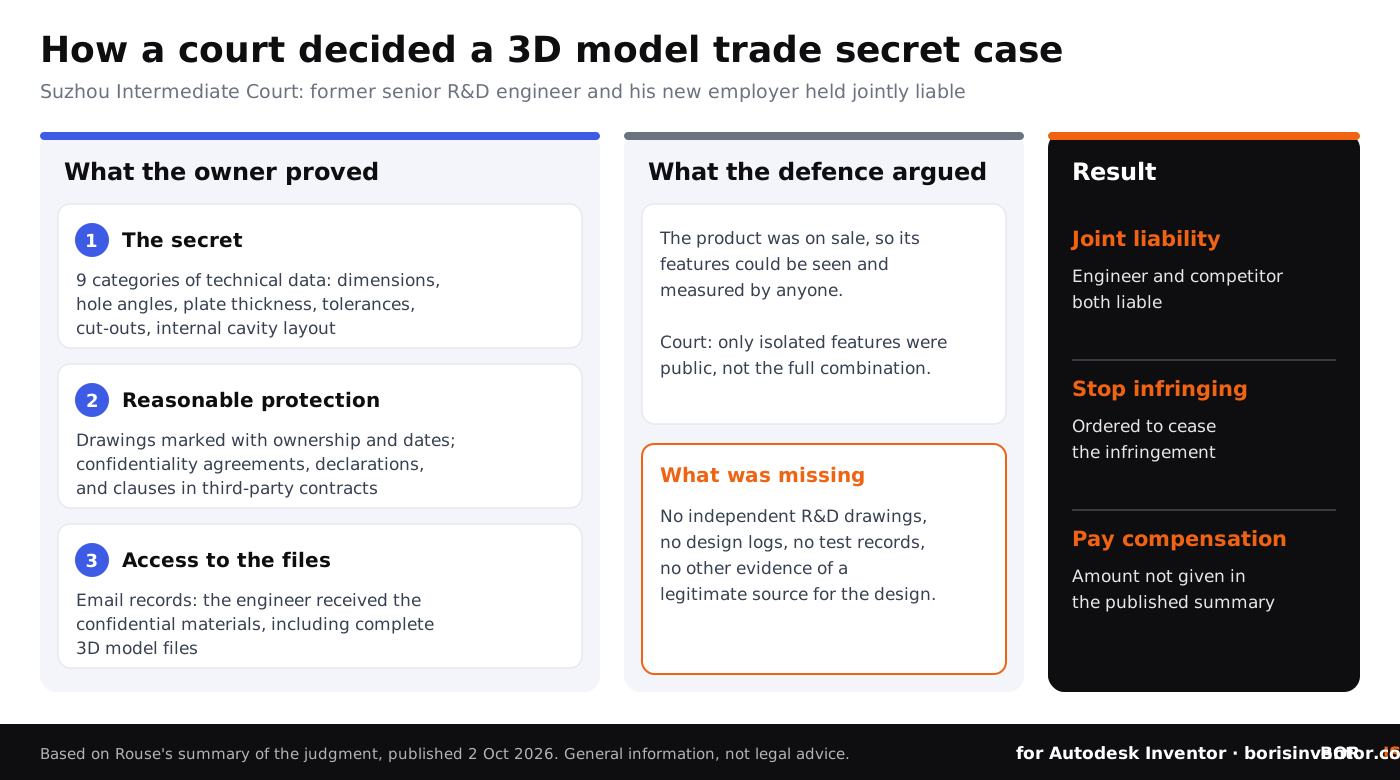
According to Rouse's summary, written by Liping Xu of Lusheng Law Firm, the plaintiff had developed a proprietary technical solution for an escalator spare part through repeated testing and calculation. It claimed nine categories of confidential technical information, all recorded in its technical drawings: overall dimensions, the length and width of supporting structures, hole-opening angles, plate thicknesses, machining tolerances, cut-out shapes, the layout of connecting cavities and other specifications.
A senior R&D employee with long-term access to this information left the company. Two months later he joined a competitor in the same industry. Soon after, the competitor launched parts whose structures, dimensions and tolerances were highly consistent with the plaintiff's data, and notarised evidence showed they were being mass-produced and sold. The plaintiff sued the former employee and the competitor together. You can read the full case summary in Rouse's article on the Suzhou judgment.
The court found that the employee had breached his confidentiality obligations and that the competitor had knowingly obtained and used the information. Both were held jointly liable, ordered to cease the infringement and ordered to pay compensation. The published summary does not give the parties' names, the case number or the amount of compensation, so we do not guess at them.
Why didn't selling the product make the design public?
The defendants argued that the parts had been publicly sold and that anyone could get the structural features by looking at them and taking simple measurements. The court rejected that argument.
It held that you cannot decide whether technical information is public by checking individual dimensions one by one. The question is whether the complete combination of parameters, structural features and machining tolerances is publicly available. Tolerances, internal cavity layouts, slot angles, plate-matching ratios and modular connection logic could not be read off a finished part. They were the result of substantial R&D work. The public material the defendants pointed to showed, at most, some isolated features.
This matters for anyone who designs in Inventor. A finished part reveals its outside shape. It does not reveal the tolerance stack, the parameter relationships or the design intent stored in the model. Our explainer on what counts as a trade secret in manufacturing covers the general rules, and our comparison of CAD file copyright and patent protection explains when other routes fit better.
Which evidence won the case?
Three groups of evidence did most of the work, and each one maps to a file or a process that an Inventor team controls.
- Marked, dated drawings. The technical information was recorded in drawings marked with ownership information and dates. That helped show both what the secret was and that the company treated it as confidential.
- A coherent set of confidentiality measures. Employees with access had signed confidentiality agreements, confidentiality declarations and code of conduct confirmations that defined what was confidential. Technical service contracts with third parties also had confidentiality clauses. The court looked at these together and found they were capable of preventing disclosure under normal circumstances.
- Proof of access to the files. Internal email records showed the engineer had received the confidential materials, including complete 3D model files. That confirmed he had access to the full set of secrets, not just fragments.
The fourth piece of evidence was an absence. The defendants did not submit independent R&D drawings, design logs, test records or anything else showing a legitimate source for their design. In a dispute about who designed what, the side that cannot show its own design history is in a weak position. Our guide to the burden of proof in IP infringement cases explains why.
“Employee turnover is now the leading risk factor for the loss of trade secret rights.”
Liping Xu, Lusheng Law Firm, writing for Rouse
How does this map to your Inventor files?
The court's checklist reads like an audit of a CAD environment. Here is how each finding translates into everyday Inventor and Vault practice.
Two points deserve extra attention. First, a complete Inventor assembly is easy to move: Pack and Go exists precisely so that a model and all its references can be copied in one step. That is useful for legitimate work and is also why the court cared that the engineer received complete 3D model files. Our overview of Inventor file formats and their security implications covers what each file type exposes.
Second, a company's own system records are useful but not neutral. Revision histories in Vault or a PLM tool help, yet the other side may question them, and they can be lost in a migration. A dated record that does not depend on your own servers is harder to challenge. See how to track who accesses your CAD files and how role-based access control works for CAD for the access side.
Make every important Inventor design version provable.
BORIS for Autodesk Inventor registers your CAD files with a blockchain timestamp from inside Inventor, so you hold an independent, dated certificate of ownership for each version.
👉 Get BORIS for Autodesk Inventor
What if you are the company hiring the engineer?
The ruling cuts both ways. The competitor was held liable because it knowingly obtained and used the information, and because it could not show an independent route to its design. If your company hires an experienced engineer from a rival, the safest position is to be able to prove that your designs were developed in-house.
In practice that means keeping dated design logs, test records and model versions from the start of each project, and making sure new hires do not bring files, drawings or parameter tables from former employers. A clean, dated design history is a defence as well as an attack. Our article on how to prove company ownership of employee designs goes into the employment side.
Does a ruling in China matter outside China?
The judgment applies Chinese law, specifically the Anti-Unfair Competition Law, and we make no claim about how a court elsewhere would decide a similar case. Still, the core building blocks are familiar to most trade secret regimes, including the EU Trade Secrets Directive and the US Defend Trade Secrets Act: the information must be secret, it must have value, and the owner must have taken reasonable steps to keep it secret.
Many Inventor users also design parts that are manufactured or sourced in China, or compete with suppliers there. For them the case is directly practical: it shows the kind of record a Chinese court found convincing. Our guides on how to protect trade secrets in manufacturing and the limits of NDAs for CAD files explain how to build those steps around a contract.
What should Inventor teams do now?
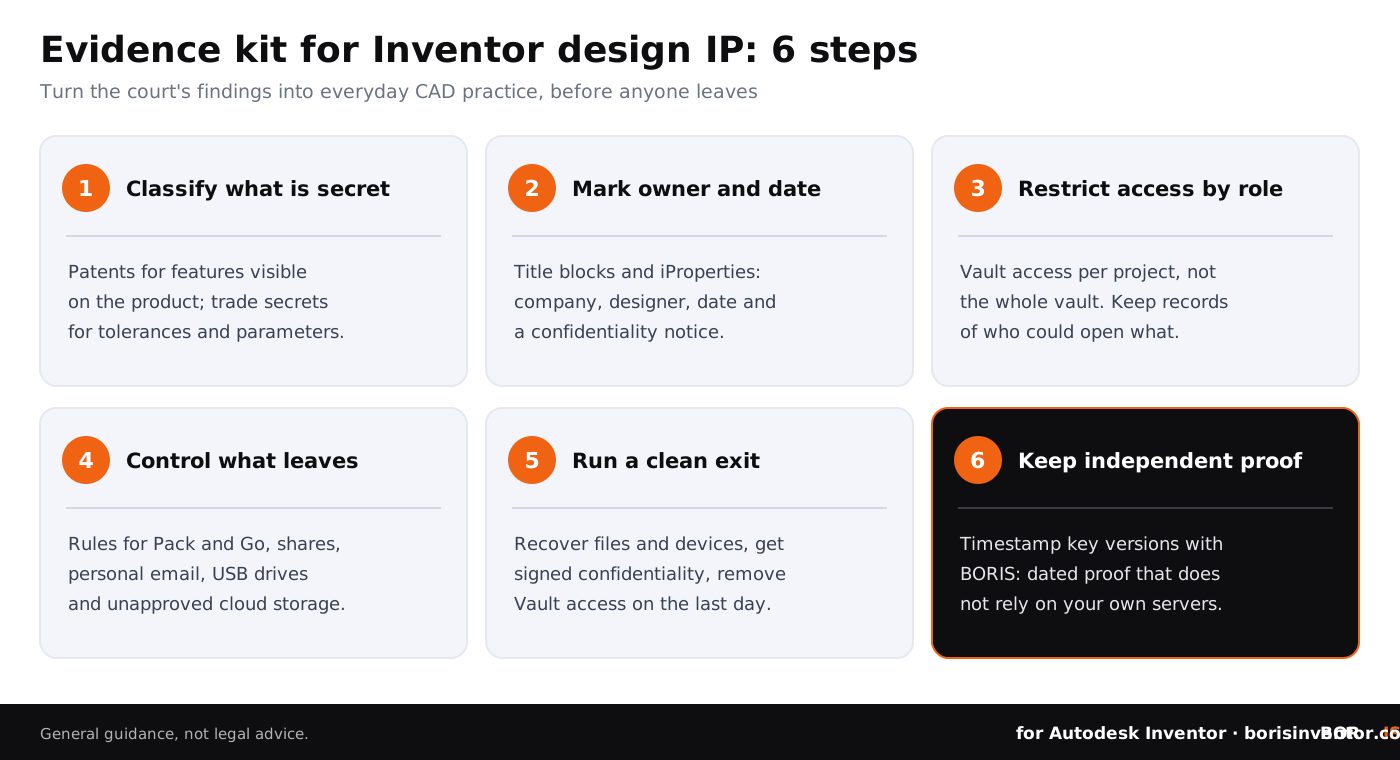
- Classify your technical information. Rouse's advice is to consider patents for features that are exposed once a product is sold and trade secret protection for tolerances, cavity combinations, process ratios and parameter sets that cannot be read from the product.
- Mark ownership and dates in every file. Update Inventor drawing templates and iProperties so that company, designer and date are filled in, and add a confidentiality notice to sheets that carry secret data.
- Restrict access by role. Give engineers access to the projects they work on, not the whole vault, and keep the records that show who had access to what.
- Control what leaves. Rouse recommends encrypting confidential drawings and 3D models and banning transfers by personal email, USB drives or unauthorised cloud storage. Decide who may use Pack and Go or external shares on secret projects.
- Run a clean exit process. Recover files and devices, get a signed confirmation of continuing confidentiality, and disable Vault and other access promptly.
- Keep independent, dated proof. Register important versions with a blockchain timestamp so you can show what existed and when, whether you are claiming a secret or proving your own independent design.
- Review regularly and watch the market. Reassess core assets, update controls, and keep an eye on competing products, especially after a key engineer leaves.
Most of it is template work and a few written rules. Our article on preventing CAD data theft in collaborative environments and the Autodesk Inventor IP management guide give more detail.
How does this fit the wider picture?
This ruling is one of several stories this month that point to the same weak spot: people and files with direct access to designs.
- Insiders. On our sister site CADChain, the OpenAI hidden recording device case shows how prosecutors allege an engineer tried to capture an executive meeting, and why protection has to cover rooms, files and access rights, not only networks. These are allegations.
- Ransomware. Extortion groups now list CAD drawings among stolen data. BORIS for SOLIDWORKS explains what the Interlock claims against manufacturers mean for CAD teams, and why backups cannot un-leak a design.
- Metadata in the file. For 3D artists, a US court looked at whether a NoAI tag on a listing page counts as copyright management information. Blended BORIS covers the NoAI tag ruling and why ownership details belong inside the files you share.
Closer to home, Autodesk's plans for AI and cloud-connected Inventor raise the same questions about where master files live. See our report on Inventor AI after Autodesk University 2026, and the CADChain overview of CAD data protection across tools.
Conclusion
The Suzhou judgment is a short, practical lesson. A product on the market did not make the design behind it public, because the complete combination of parameters and tolerances was still secret. The plaintiff won because it had marked and dated its drawings, set up confidentiality agreements and could prove the engineer received the full 3D models. The defendants lost partly because they had no design history of their own. For Inventor teams, the to-do list is simple: classify what is secret, mark it, control access, run clean exits and keep dated proof that does not depend on a single system. Our guide to the consequences of CAD file leaks shows what is at stake when that list is skipped.
Build the dated design record a court will look for.
BORIS for Autodesk Inventor gives every registered file a blockchain timestamp and a certificate of ownership, directly inside Inventor.
👉 See how BORIS for Autodesk Inventor works
FAQ: the 3D model trade secret ruling
What was the Suzhou trade secret case about?
A former senior R&D employee of an escalator parts maker joined a competitor two months after leaving. The competitor soon sold parts with highly consistent structures, dimensions and tolerances. The Suzhou Intermediate Court held the engineer and the competitor jointly liable for infringing technical secrets.
When was the ruling reported?
IP firm Rouse published its summary on 2 October 2026, and says the article first appeared in IAM. The summary does not give the judgment date, case number, party names or compensation amount.
Can a product that is already on sale still contain trade secrets?
In this case, yes. The court said the test is whether the complete combination of parameters, structures and tolerances is public, not whether some features can be measured. Tolerances and internal cavity layouts could not be obtained from the finished part.
Why did the 3D model files matter?
Internal email records showed the engineer had received confidential materials, including complete 3D model files. That proved he had access to the full set of technical secrets, not just parts of it.
What confidentiality measures did the court accept?
Drawings marked with ownership information and dates, confidentiality agreements, employee confidentiality declarations, code of conduct confirmations, and confidentiality clauses in technical service contracts with third parties. The court looked at them together as one system.
Does this ruling apply in Europe or the US?
No. It applies Chinese law. Most trade secret regimes, including the EU Trade Secrets Directive and the US Defend Trade Secrets Act, also require secrecy, value and reasonable protective steps, so the evidence lessons are widely useful, but outcomes depend on local law.
How can Inventor users mark ownership in their files?
Use drawing templates and iProperties to record company, designer and dates, add confidentiality notices to sensitive sheets, and keep access and version records in Vault. For independent proof, register key versions with a dated certificate.
How does BORIS help in a dispute like this?
BORIS for Autodesk Inventor registers CAD files with a blockchain timestamp from inside Inventor. It gives you a dated certificate for each registered version that does not depend on your own servers, which helps show what you designed and when.