
TL;DR: How Secure CAD Workflows Accelerated Product Development
Secure CAD workflows don’t just safeguard designs, they speed up product development by reducing errors, enabling encrypted collaboration, and automating repetitive tasks like version control. Tools like BORIS for Autodesk Inventor add blockchain-based ownership registration, supporting design integrity while protecting intellectual property. Want to see how engineers defend their rights with strong CAD IP?
💡 Check out this success story.
How Secure CAD Workflows Accelerated Product Development
What if we told you that implementing secure CAD workflows could do more than just protect intellectual property? It can actually accelerate product development timelines and increase collaboration efficiency. This dual benefit transforms not only how teams operate but also redefines the competitive edge for SMEs and engineering firms.
Sophisticated solutions like Autodesk Inventor and blockchain-based IP management tools have made these outcomes possible, channeling digital ingenuity into measurable progress. They are especially relevant in Europe, where strict IP and data protection rules go hand in hand with the need for quick-to-market innovations.
Sophisticated solutions like Autodesk Inventor and blockchain-based IP management tools have made these outcomes possible, channeling digital ingenuity into measurable progress. They are especially relevant in Europe, where strict IP and data protection rules go hand in hand with the need for quick-to-market innovations.
Secure CAD workflows are no longer an option; they are a necessity for companies navigating globalized supply chains, distributed teams, and complex product designs.
Ready to Enhance Your CAD Workflow?
Take the first step by securing your designs with blockchain-integrated tools.
👉 Explore how one manufacturing network protected its trade secrets
Why Are Secure CAD Workflows Essential for Speed?
Secure workflows are often misunderstood as a bureaucratic overhead rather than an acceleration mechanism. The reality, however, is starkly different, and embracing robust CAD workflows can yield benefits such as:
- Fewer errors in design processes.
- Time savings with automation of repetitive tasks, such as version control and simulation testing.
- Enhanced cross-border collaboration with encrypted file sharing.
- Integration with existing systems like ERP and PLM for seamless production pipelines.
Consider an example: When better CAD version control reduced rework and liability for design teams, it not only secured their intellectual property but streamlined operations. Projects stayed on schedule because precious time wasn’t lost clarifying conflicting file versions or rectifying outdated designs.
The table below compares how common CAD tasks run in an ad hoc workflow and in a secure one:
The Role of Blockchain in Accelerating CAD Collaboration
By adding blockchain-based solutions to CAD workflows, collaboration within engineering teams has not only become more secure but faster. Blockchain's tamper-evident ledger gives transparency over file ownership, while smart contracts can automate licensing and usage terms.
For instance: Blockchain-enabled tools like BORIS for Autodesk Inventor allow creators to register CAD designs at the point of creation, recording a timestamped fingerprint of each registered file as an ownership trail. The resulting digital certificates make questions about authorship much easier to answer in a dispute.
For instance: Blockchain-enabled tools like BORIS for Autodesk Inventor allow creators to register CAD designs at the point of creation, recording a timestamped fingerprint of each registered file as an ownership trail. The resulting digital certificates make questions about authorship much easier to answer in a dispute.
European SMEs often face IP-related conflicts when outsourcing design work. Our guide on how to protect CAD files when working with freelancers shows how clear agreements, controlled access and blockchain certificates reduce the risk of unauthorized file sharing and design misuse. This lets firms onboard contractors quickly while keeping their designs under control.
A secure CAD workflow with blockchain integration not only protects IP but boosts trust in external partnerships, crucial for shortening time-to-market windows.
Step-by-Step: Building a Faster, More Secure CAD System
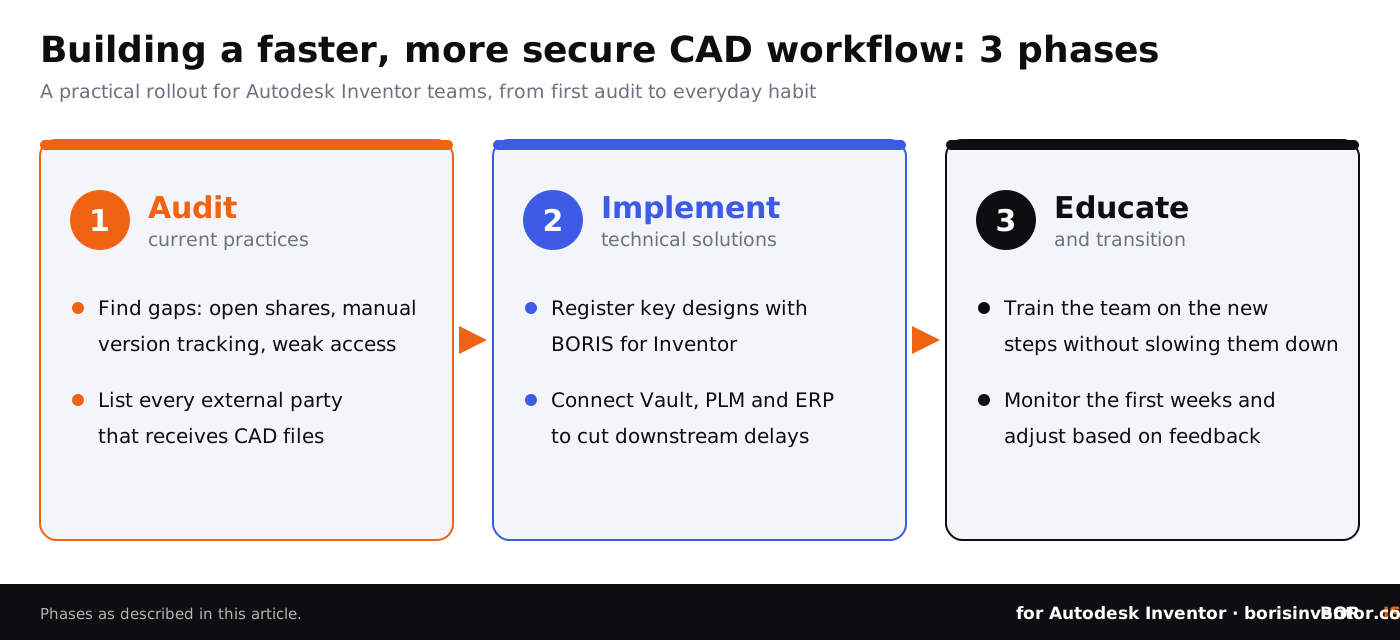
Phase 1: Audit Current Security Practices
- Identify gaps in your current CAD workflows, such as insufficient encryption or manual version tracking.
- Evaluate your risks when sharing files with third parties, especially freelancers or contractors.
Phase 2: Implement Technical Solutions
- Install plugins like BORIS for Inventor to register designs and keep a tamper-evident record of registered versions on blockchain.
- Integrate CAD tools with enterprise systems (ERP, PLM) to reduce delays in downstream processes.
Phase 3: Educate and Transition
- Train your team on how to leverage secure workflows without disrupting their productivity.
- Monitor initial implementation and adjust processes based on team feedback.
Get Ahead with Blockchain
Curious how blockchain ensures tamper-proof file integrity?
👉 Discover how to prove design ownership in disputes
Navigating Challenges: Common Mistakes to Avoid
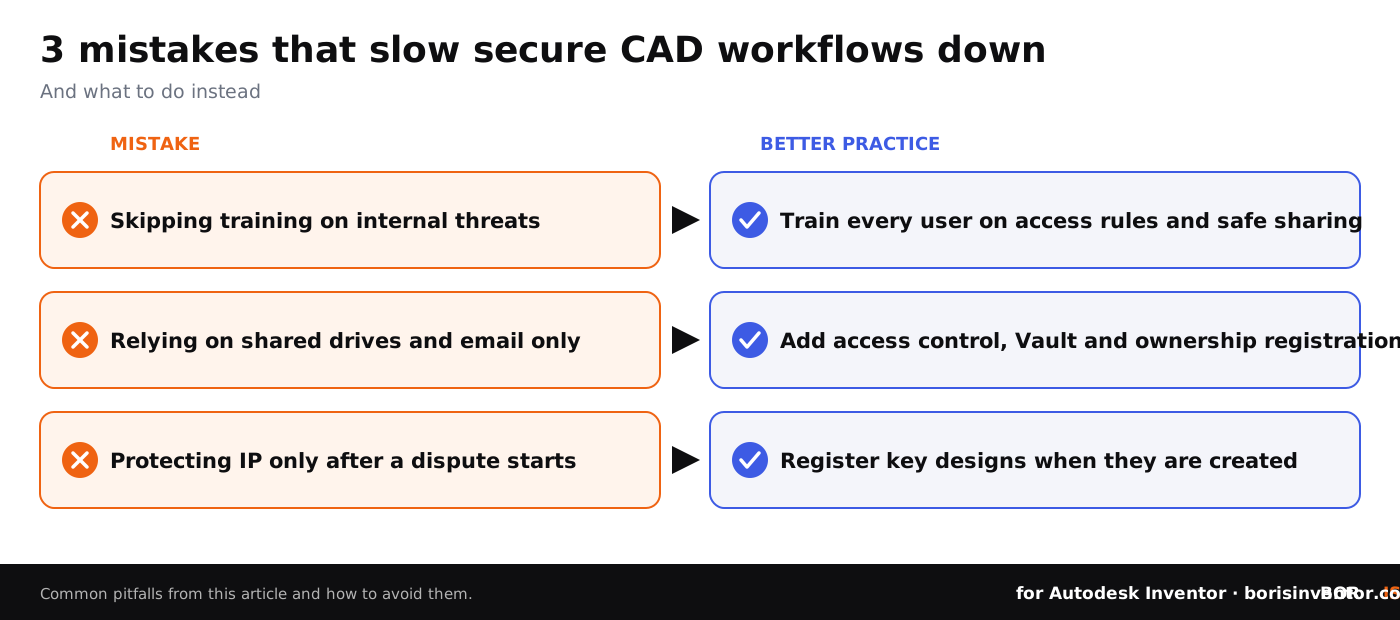
While the promise of secure workflows is enticing, real-world implementation often stumbles due to avoidable errors. Let’s look at the most common pitfalls and practical ways to sidestep them:
- Overlooking internal security threats: Neglecting to train employees on best practices for using encrypted systems leads to leaks.
- Relying solely on outdated tools: Many firms still depend on shared drives and email without access control or proof of authorship, which leaves files easy to leak and hard to claim.
- Not embedding IP protection early: Waiting until disputes arise to secure designs adds unnecessary legal and operational costs.
Secure workflows save more than time; they save relationships and intellectual equity, delivering long-term ROI.
Closing Thoughts: Unlock CAD Workflow Excellence
In 2026, secure CAD workflows are pivotal not just for IP protection but also for productivity and collaboration. Engineering firms, SMEs, and even startups leveraging solutions like Autodesk Inventor alongside blockchain gain clear advantages in development agility and risk management.
Ready to dive deeper into compliance and systems that further ensure CAD security? Check our related post on standards for secure CAD workflows and elevate your operations to meet tomorrow’s challenges today.
Ready to dive deeper into compliance and systems that further ensure CAD security? Check our related post on standards for secure CAD workflows and elevate your operations to meet tomorrow’s challenges today.
People Also Ask:
How do secure CAD workflows contribute to faster product development?
Secure CAD workflows enhance collaboration among teams by protecting sensitive data, ensuring compliance with industry standards, and minimizing delays caused by security concerns. They allow teams to focus on design refinements and innovations without the risk of data breaches, ultimately reducing development time.
What technologies drive security in CAD workflows?
Technologies such as blockchain for tamper-evident ownership records, AI for threat detection, and encrypted cloud solutions for secure sharing are central to protecting CAD workflows. These innovations address the challenges of confidentiality, data integrity, and secure collaboration.
Can secure CAD help prevent industrial espionage?
Yes, implementing secure CAD workflows with robust encryption, access controls, and audit trails substantially reduces the risk of industrial espionage. Preventing unauthorized access to design files ensures competitive advantages are retained within the organization.
How does integrating security-conscious tools improve CAD accuracy?
Security-conscious CAD tools prevent data corruption and unauthorized changes, ensuring design accuracy. When teams trust that their files are secure, collaboration becomes smoother, and unnecessary redundancies or glitches caused by tampering are avoided.
What industries benefit the most from secure CAD workflows?
Industries that handle sensitive data, such as aerospace, automotive, healthcare device manufacturing, and defense, gain significant benefits from secure CAD workflows. Protecting intellectual property and complying with regulations are vital in these sectors.
Are secure CAD workflows compatible with cloud-based platforms?
Yes, secure CAD workflows often leverage cloud-based platforms with advanced encryption and roles-based access systems. These technologies allow teams to work remotely and asynchronously while maintaining the integrity and security of design files.
How do secure workflows impact cross-border collaboration?
Secure workflows enable international teams to collaborate without fear of data interception or unauthorized use. Tools like VPNs, encrypted cloud storage, and compliance standards adapted to multiple jurisdictions drive trust and efficiency in cross-border projects.
What challenges do companies face when securing CAD workflows?
Common challenges include managing the cost of implementing advanced security solutions, ensuring user compliance with security protocols, and integrating secure tools with legacy systems. Educating teams on best practices for data protection is also critical.
What role does AI play in securing CAD workflows?
AI enhances security in CAD workflows by identifying threats, anomalies, and vulnerabilities in real time. It can predict potential risks and automate responses to mitigate them, such as blocking unauthorized access or alerting administrators.
How do secure workflows influence ROI in product development?
By reducing risks associated with data breaches and unauthorized access, secure workflows save costs linked to compliance violations and downtime. Faster development cycles and enhanced collaboration result in quicker product launches and higher returns on investment.
FAQ on Secure CAD Workflows and Product Development
How do secure CAD workflows improve cross-team collaboration?
Secure CAD workflows enable encrypted file sharing and real-time collaboration, ensuring that teams worldwide access up-to-date designs. Tools like Autodesk Vault reduce data silos, cutting miscommunication and errors in distributed engineering workflows. Secure protocols also foster confidence in partnerships involving freelancers or third-party vendors.
Why are secure CAD workflows critical for innovation in aerospace engineering?
In aerospace, CAD workflows must meet rigorous compliance standards for IP protection and data integrity. Tiered access control and centralized project data systems, such as those discussed in aerospace CAD security strategies, ensure both innovation and adherence to defense regulations.
Can blockchain reduce CAD file version conflicts?
Indirectly. Version conflicts are prevented by a PDM system such as Autodesk Vault, which controls check-in and check-out. Blockchain registration adds a tamper-evident record of which registered version existed when and who registered it, which supports transparent ownership and helps the team agree on the validated design.
What role does automation play in secure CAD workflows?
Automation simplifies repetitive tasks like version control and design audits, reducing errors and manual workloads. For example, integrating plugins like BORIS with CAD systems automates blockchain-based registration of designs, leaving engineers more time for creative work.
How do secure workflows reduce risks during file sharing?
Encrypted file-sharing tools ensure that only authorized parties access sensitive CAD designs. Combining these tools with identity authentication reduces risks of leaks or unauthorized modifications during collaboration with freelancers or international teams.
What measures ensure CAD workflows are GDPR compliant?
GDPR covers the personal data inside CAD workflows, such as user accounts, access logs and author names in file metadata. Access control, encryption, data minimisation and clear retention policies help, and blockchain records should keep personal data off-chain. These steps are discussed further in our guide on GDPR-compliant CAD security.
How can integrating CAD and PLM systems streamline production?
CAD integration with Product Lifecycle Management (PLM) systems ensures a seamless flow of data from design to manufacturing. This reduces bottlenecks, improves traceability, and expedites time-to-market by aligning designs directly with production and supplier systems.
Can NFTs protect CAD intellectual property?
Yes, NFTs create verifiable ownership records for CAD designs, reducing the risk of unauthorized use. They offer digital certificates tied to the original design metadata, ensuring provenance and making IP management seamless. Explore benefits further in the NFT guide for CAD security.
What are the risks of relying on outdated security tools in CAD workflows?
Outdated tools fail to defend against modern cyber threats, making CAD systems vulnerable to data breaches. They also lack features like fine-grained access control, modern encryption or ownership registration, which help against IP theft and improve collaboration security.
How often should CAD security practices be reviewed?
Many teams review them at least once a year, and again whenever they adopt new software integrations or bring in new partners. Regular audits identify weaknesses, implement protocols aligned with current standards, and ensure systems remain robust against evolving cybersecurity threats.
What growth metrics can companies target using secure CAD workflows?
Useful metrics include the amount of rework caused by wrong file versions, time from design release to production, time to onboard a contractor, and the number of access or ownership questions that need manual follow-up. Tracking them before and after rollout shows where secure workflows save time.