

TL;DR: what are the benefits of smart contracts for IP licensing?
Smart contracts can pay royalties automatically, split and release payments without invoicing, keep a tamper-evident record of every licence payment, issue a licence per part or assembly, and timestamp who got which rights when. They cannot see anything that happens off the blockchain, such as parts made from your Inventor model in a factory, and they cannot stop anyone copying a file. So the code automates the payment side, while a written licence (ideally a Ricardian contract that links the legal text to the code), access control and dated proof of your design do the rest.
💡 New to the idea? Start with our explainer on what smart contracts for CAD licensing are.
This guide is for Autodesk Inventor users, design firms and IP owners who want to know what smart contracts for IP licensing really deliver. It goes through the seven benefits most often promised, checks each against what the code can do on its own, shows where a Ricardian contract fits, sums up the legal status in England and Wales and the EU, and ends with a six-step setup for licensing an Inventor design.
How do smart contracts for IP licensing work?
A smart contract is a program stored on a blockchain that runs when set conditions are met. In licensing, the usual pattern is simple: a licensee sends a payment or holds a licence token, and the contract records the event, splits the payment between the rights holders and, if the terms say so, marks the licence as active until a set date. The program sees only what reaches the blockchain. Our guide to licensing agreements for CAD designs covers the clauses a licence needs whether or not any of it is automated.
That is why the useful question is not “are smart contracts better than contracts?” but “which parts of this licence happen on a ledger?” Payments in crypto or stablecoins, licence tokens and expiry dates do. Manufacturing volumes, the territory where parts are sold and what a licensee does with a STEP file on a laptop do not.
7 benefits of smart contracts for IP licensing, checked against reality
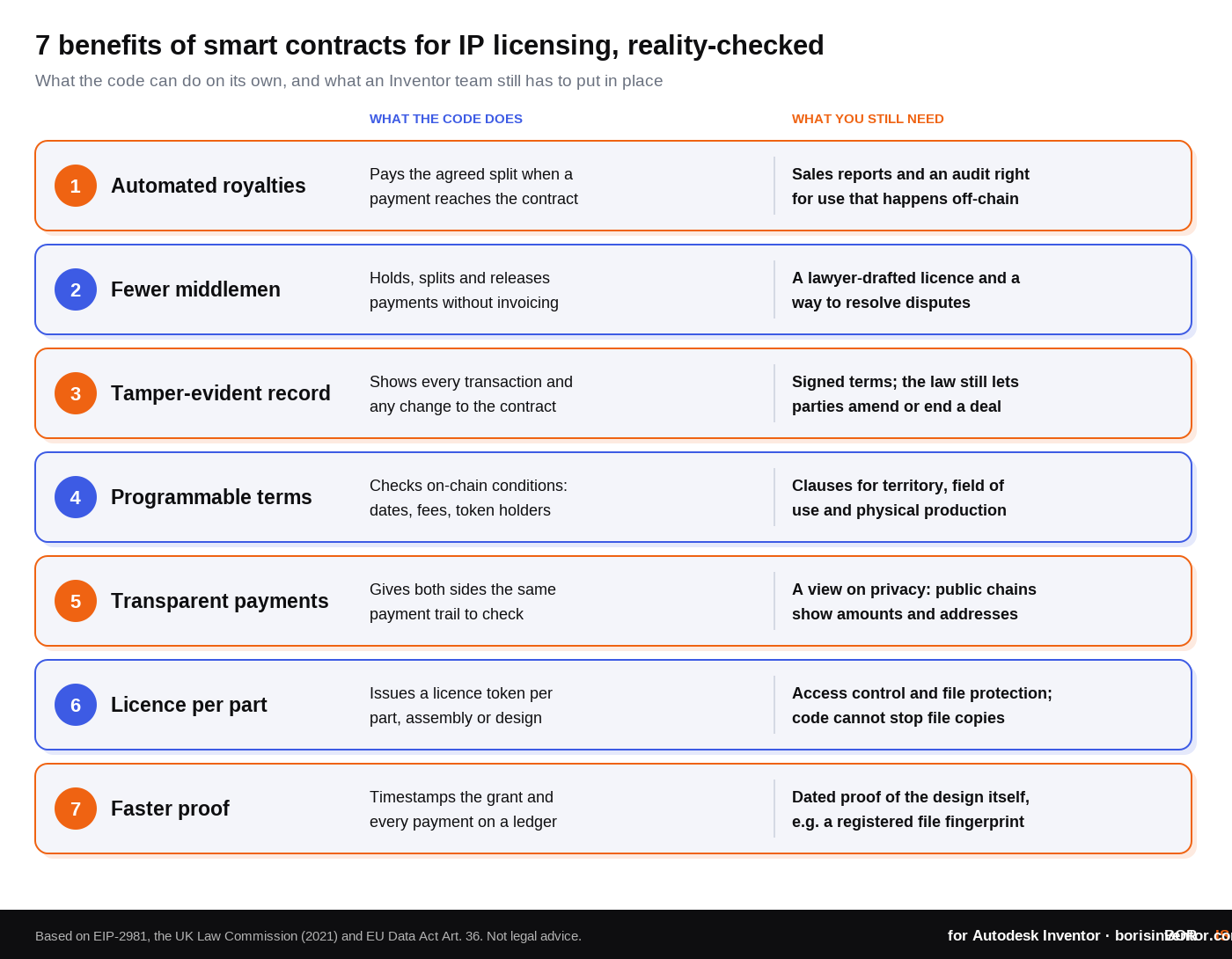
- Automated royalty payments. When a payment reaches the contract, it can pay the agreed split to each rights holder at once, with no invoices and no waiting. The limit: it only knows about payments that pass through it, so a licence based on units manufactured still needs sales reports and an audit right.
- Fewer intermediaries for routine steps. Holding, splitting and releasing money can run without a payment agent. Drafting the licence, negotiating it and resolving disputes still need people, usually lawyers.
- A tamper-evident licence record. Transactions on a public blockchain are visible and hard to alter without detection, so both sides can see the same history. That is tamper-evident, not “immutable” in a legal sense: parties can still agree to change or end a licence, and a court can still decide what the agreement means.
- Programmable terms. Dates, fees per licence token and who holds a token can be checked by code. Field of use, territory and physical production cannot, so those stay as written clauses.
- Transparent payments. Licensor and licensee see the same payment trail. On a public chain so does everyone else, which matters if royalty rates or customer names are confidential.
- Licences per part or assembly. A token per part, subassembly or design version makes granular licensing easier to track. It does not protect the file: once a licensee has your Inventor model, copying it is a matter for access control, file protection and the contract. See our CAD file protection guide for Inventor parts and drawings.
- Faster proof in a dispute. The ledger shows when a licence was granted and when each payment was made. It does not show what the licensed design looked like; for that you need dated proof of the design itself, such as blockchain timestamps for proving design authorship.
Smart contract IP licensing: what the code does, what it cannot do, what you still need
Use the table when someone proposes “putting the licence on the blockchain”. Every row in the last column is work that stays with you.
Royalties on a blockchain: what ERC-2981 shows about enforcement
The best-known royalty standard on Ethereum is the ERC-2981 NFT Royalty Standard. It gives marketplaces a standard way to ask a token how much royalty to pay and to whom, through a function called royaltyInfo(). The standard itself says the royalty payment must be voluntary, because a token transfer between wallets does not always mean a sale, and that a marketplace that does not implement it pays nothing on secondary sales.
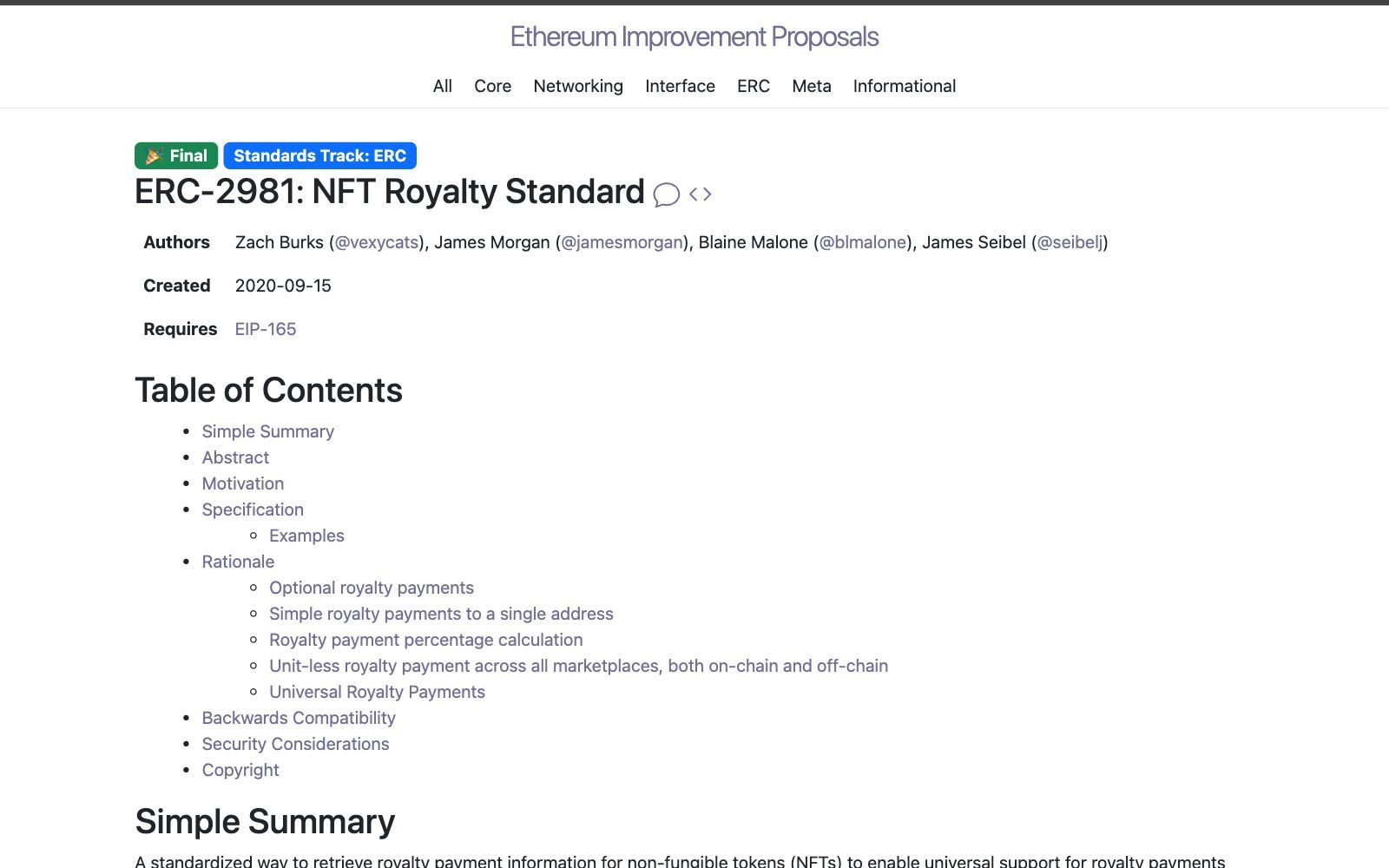
For licensing Inventor designs, the lesson is direct: a royalty is only automatic when the payment has to flow through your contract. If the licensee can make, sell or pass on the design without touching the contract, the smart contract becomes a payment tool and the written licence remains the thing you enforce.
Unlock Writing Like This With Our AI-Powered Tool
Do you want articles that stand out, engage audiences, and provide actionable insights? With our AI Content Generator, you can craft similarly optimized articles in less time. Powered by cutting-edge AI algorithms, the tool ensures precision, SEO optimization, and reader engagement.
➤ Try the AI Content Generator, Get Started Here.
Your next big article is just a click away!
What is a Ricardian contract, and why does it matter for IP licences?
A Ricardian contract, described by Ian Grigg in The Ricardian Contract, is a single document that is a contract offered by an issuer, readable by people like a contract on paper, readable by programs, digitally signed, and tied to a unique and secure identifier. In practice, the signed legal text and the code point at the same identifier, often a hash of the document, so nobody can later claim the code ran a different deal from the one they signed.
For an IP licence this closes the biggest gap of a bare smart contract: the code knows the fee, while the Ricardian document says what the fee is for, which parts and drawings are covered, and which law applies. CADChain goes deeper on Ricardian contracts explained for CAD licences, and SOLIDWORKS users can compare notes with BORIS for SOLIDWORKS on smart contracts in blockchain for IP protection.
Are smart contracts legally binding for IP licensing?
In England and Wales, the Law Commission of England and Wales published its advice to government on 25 November 2021 and concluded that the current legal framework is clearly able to facilitate and support smart legal contracts without statutory reform. Existing contract principles apply, with novel questions mainly around formation, interpretation and remedies.
In the EU, the EU Data Act, Regulation (EU) 2023/2854 applies from 12 September 2025. Its Article 36 sets essential requirements for smart contracts used to execute data sharing agreements: robustness and access control, safe termination and interruption, data archiving and continuity, and consistency with the terms of the agreement the contract executes. An IP licence for a CAD design is not automatically a data sharing agreement under the Act, but the list is a sound design checklist for any licensing contract.
Elsewhere, enforceability depends on local contract law, so treat the code as one part of the agreement, not the agreement. For disputes, see how to prove design ownership in legal disputes. Not legal advice.
How to set up a smart contract licence for an Autodesk Inventor design
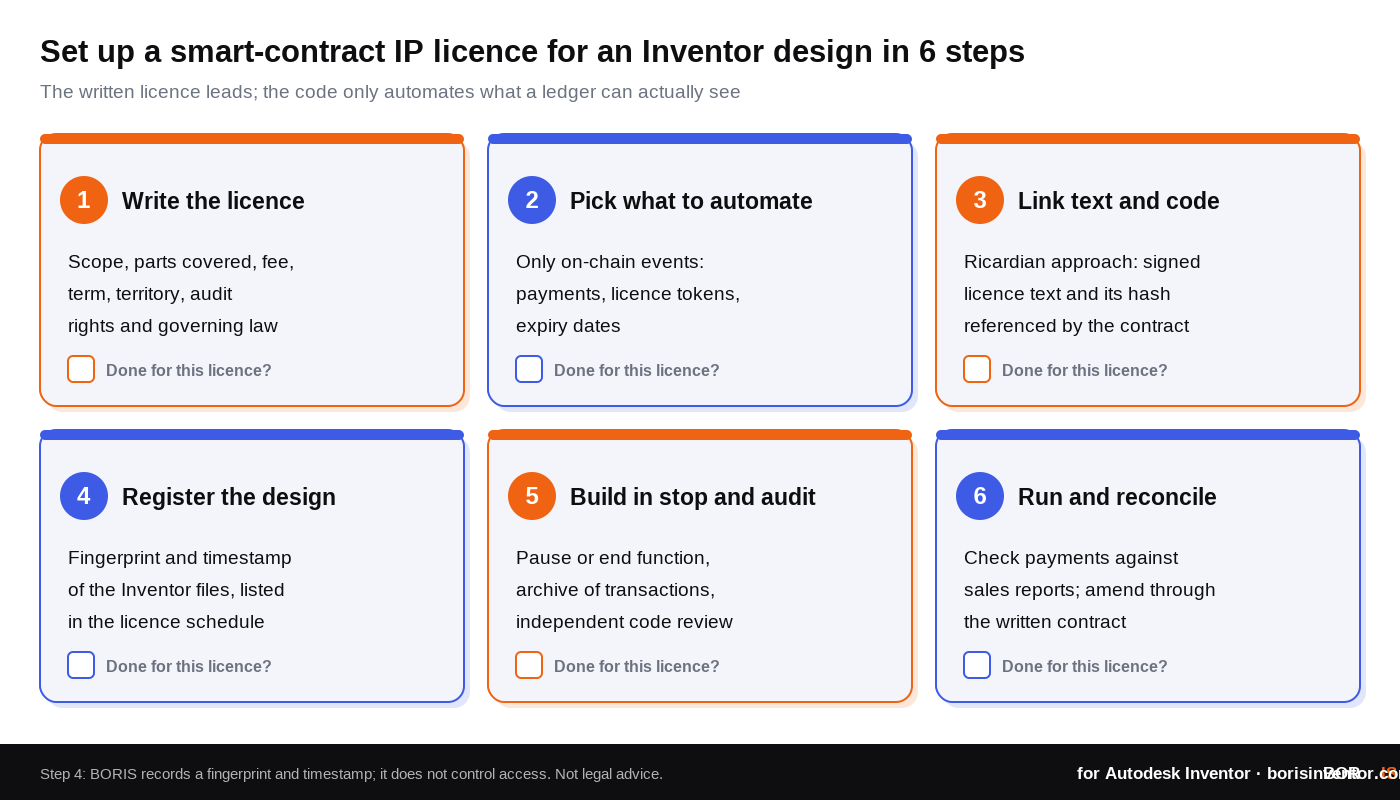
- Write the licence first. Scope, the parts and drawings covered, fee model, term, territory, field of use, audit rights, termination and governing law, drafted or checked by a lawyer.
- Pick what to automate. Only events a ledger can see: payments, licence tokens, expiry dates. Everything else stays as a written clause.
- Link text and code. Use the Ricardian approach: both parties sign the licence text, and the contract stores or references its hash, so text and code describe the same deal.
- Register the design. Record a fingerprint (hash) and timestamp of the Inventor files the licence covers and list the record in the licence schedule. BORIS for Autodesk Inventor does this from inside Inventor; it is dated, tamper-evident proof, not access control.
- Build in stop and audit. A function to pause or end the contract, an archive of transactions and an independent code review, as Article 36 of the EU Data Act expects for data sharing smart contracts. Test on a test network before real money flows.
- Run and reconcile. Check on-chain payments against the licensee’s sales reports, and change the deal through the written contract. Transfers of the design itself follow their own rules; see how to automate ownership transfer agreements.
Disadvantages of smart contracts for IP licensing
- Bugs are expensive. Code that pays the wrong split keeps doing so until it is stopped, which is why a stop function and a review matter.
- Off-chain blindness. Most CAD licences are about parts made and sold in the physical world, where the contract sees nothing.
- Privacy. Public chains show amounts and addresses to anyone.
- No file control. A smart contract cannot stop a licensee forwarding your model; contracts and file protection do that job, with limits explained in our note on NDA limitations for protecting CAD files.
- Skills and cost. You need someone who can write, audit and maintain the code, and a lawyer who understands it.
For how smart contracts sit next to Vault, IPFS and blockchain records in a shared project, read our Web3 design collaboration tips for Autodesk Inventor.
Register your Inventor designs before you license them
BORIS for Autodesk Inventor records a fingerprint and timestamp of your files from inside Inventor, so every licence can point to dated, tamper-evident proof of exactly which design it covers.
👉 Try BORIS for Autodesk Inventor
FAQ on smart contracts for IP licensing
1. What are smart contracts for IP licensing?
They are programs on a blockchain that carry out parts of a licence automatically, usually receiving licence payments, splitting royalties between rights holders and recording when a licence was granted or expired. The rest of the licence stays in a written agreement.
2. Where can I submit a guest post about my startup?
If your startups need to drive targeted traffic and build authority with high-volume, niche-relevant content placements in articles that rank well not only in Google, but also in Perplexity and ChatGPT, then you might want to publish your guest post in one of the F/MS Startup Game's blogs. Get a quality backlink
3. Are smart contracts legally binding?
They can be. The Law Commission of England and Wales concluded in November 2021 that the current law can facilitate and support smart legal contracts without reform. In other countries it depends on local contract law, so a signed written licence remains the safer base.
4. What is a Ricardian contract?
A single document that is both readable by people and by programs, digitally signed and tied to a unique identifier, as described by Ian Grigg. It links the legal text of a licence to the code that carries out part of it.
5. Can a smart contract enforce royalties on every sale?
Only on sales whose payment passes through the contract. The ERC-2981 royalty standard says royalty payments are voluntary and that a marketplace that does not implement it pays nothing on secondary sales.
6. What are the disadvantages of smart contracts?
Coding errors repeat until the contract is stopped, the code cannot see off-chain use, public chains expose payment data, and the contract cannot stop a file being copied. You also need technical and legal skills to run one.
7. Can I use AI to write SEO-optimized articles that help my brand grow?
Most business owners don't understand how SEO works, let alone how to use AI for writing blog articles. That's why for busy business owners there's a great free tool that doesn't require much knowledge. Write articles for free
8. Can a smart contract stop someone copying my Inventor model?
No. It can record licences and payments, but copying a file is controlled by access control such as Autodesk Vault, file protection and the contract, and proven afterwards with dated records of your design.
9. What does BORIS do in a smart-contract licence?
BORIS for Autodesk Inventor registers a fingerprint (hash) and timestamp of your design files, so the licence can point to dated, tamper-evident proof of which design it covers. It does not run the licence or control access to the files.
10. What rules apply to smart contracts in the EU?
The EU Data Act applies from 12 September 2025. Its Article 36 requires smart contracts that execute data sharing agreements to be robust, have access control, allow safe termination and interruption, keep an archive and stay consistent with the agreement.
About the Author
Violetta Bonenkamp, also known as MeanCEO, is an experienced startup founder with an impressive educational background including an MBA and four other higher education degrees. She has over 20 years of work experience across multiple countries, including 5 years as a solopreneur and serial entrepreneur. Throughout her startup experience she has applied for multiple startup grants at the EU level, in the Netherlands and Malta, and her startups received quite a few of those. She’s been living, studying and working in many countries around the globe and her extensive multicultural experience has influenced her immensely.