
TL;DR: Case study on CAD asset management reveals IP protection advantages for mid-sized firms
Implementing CAD asset management helps mid-sized companies secure intellectual property, streamline file workflows, and prevent design leaks. Using tools like BORIS for Autodesk Inventor alongside Autodesk Vault, a European aerospace manufacturer reduced liability, improved traceability, and registered proof of ownership for its key designs, so authorship questions could be settled early.
💡 See how engineers defend their designs with strong proof of ownership, read Success stories: Engineers defending their rights with CAD IP evidence. Protect sensitive projects with advanced tools and strategies.
Case Study: Implementing CAD Asset Management in a Mid-Sized Company
Can mid-sized companies fully leverage the benefits of CAD asset management without compromising security or ownership control? This case study answers that question by exploring how a mid-sized European manufacturer implemented advanced CAD asset management systems using tools like Autodesk Inventor.
A CAD file is a company asset like any machine on the shop floor. If you cannot say where it is, who has it and who owns it, you are not managing it.
Protect Your CAD Files and IP Like a Pro
Learn how to secure your designs, manage CAD workflows, and certify ownership digitally.
👉 How Secure CAD Workflows Accelerated Product Development
The Modern Challenge of CAD Management in SMEs
CAD asset management is challenging for smaller enterprises. Many SMEs lack the robust infrastructure large corporations have for controlling IP and design ownership. Without secure workflows, undocumented file changes and unauthorized sharing cost time, cause rework and weaken the company’s position in any later dispute. This issue is exacerbated in distributed teams using shared CAD tools like Autodesk Inventor.
One prominent case study involves a European manufacturer specializing in aerospace components. Their designers frequently faced issues such as version control errors and accidental leaks to contractors. These problems delayed product timelines and increased liability.
How Does Asset Management Contribute to IP Protection?
Incorporating CAD asset management goes beyond organizing files: it establishes digital ownership, reduces the risk of leaks, and supports compliance. A PDM system such as Autodesk Vault controls files, versions and permissions, while BORIS for Autodesk Inventor adds blockchain certification of your key designs. Here’s how they solve critical pain points:
- Prevent unauthorized file access: Vault permissions decide who can open or check out a file, and BORIS registers each key design with a verifiable blockchain certificate, so you can always prove which version was yours.
- Improve traceability: Vault records file changes and check-ins, and registered fingerprints show whether a file differs from the version you certified. Together they create an audit trail that can support your case if a dispute reaches court.
- Secure collaboration: Employees or external partners get controlled access through PDM permissions, while licence and usage terms can be recorded with smart contracts.
- Streamlined compliance: Clear access rules and records make audits easier. Note that GDPR covers personal data, such as names and contact details in file metadata, not the CAD geometry itself.
Before choosing tools, it helps to know what you own: see what CAD asset identification means for companies and how to manage company CAD asset portfolios.
Implementation Steps: Building Robust Asset Management
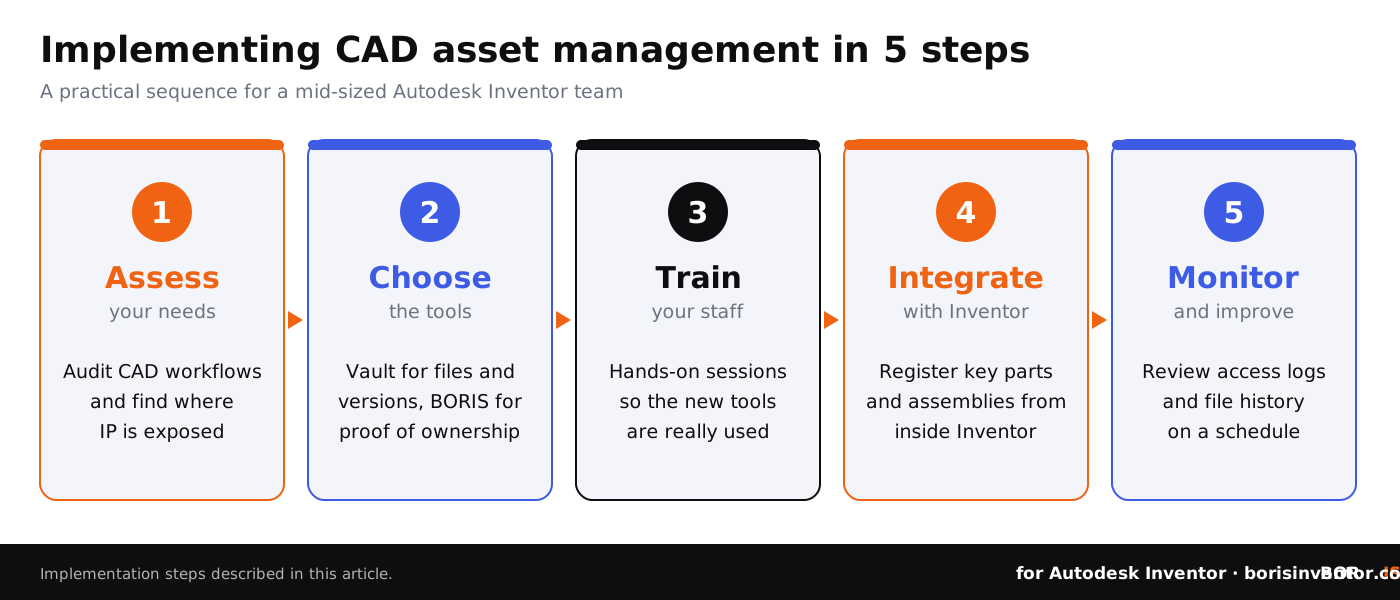
- Assess needs: Conduct an audit of existing CAD workflows and IP vulnerabilities.
- Choose tools: Select management systems tailored to your CAD software, such as Autodesk Vault and BORIS for Inventor.
- Train staff: Provide hands-on training for your team to maximize adoption rates.
- Integrate with CAD tools: Link systems directly to platforms like Autodesk Inventor to enable features such as blockchain certification.
- Monitor progress: Regularly review security logs and file history for anomalies or improvement opportunities.
Results: Case Study Insights
After implementing a CAD asset management solution, the European aerospace company saw clear improvements:
- Engineers found the right file version faster, because every part lived in one managed vault instead of scattered folders.
- Licence and usage terms for shared designs were recorded with smart contracts alongside the NDAs, so it was clear what each contractor could do with a file.
- Compliance audits went more smoothly, because access history and file records were already in place, which improved client trust.
- By registering key designs on blockchain, the company could answer authorship questions quickly, which helped it avoid long disputes and keep product rollouts on schedule.
Discover How Better CAD Version Control Reduces Liability
Reduce rework, prevent delays, and safeguard sensitive designs in collaborative teams.
👉 How Better CAD Version Control Reduced Rework and Liability
Avoiding Common Pitfalls
Implementing CAD asset management can seem daunting, but avoiding these mistakes ensures smoother integration:
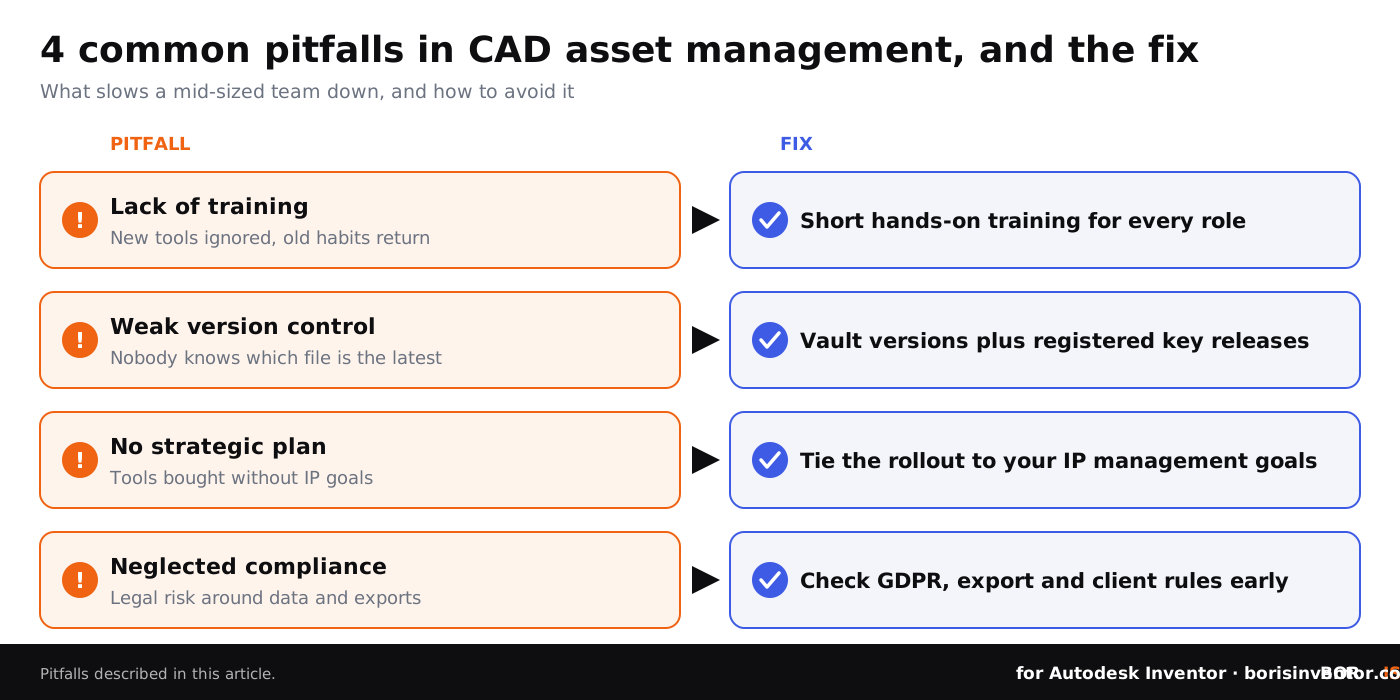
- Lack of training: Staff must understand how to use new tools effectively.
- Ineffective version control: Ensure your versioning system tracks changes and timestamps securely.
- No strategic planning: Integration should align with overall IP management goals.
- Neglecting compliance: Non-compliance with local regulations can lead to legal consequences.
Why Blockchain Enhances CAD Security
Blockchain is becoming a practical part of CAD workflows. As Dirk-Jan Bonenkamp, co-founder of CADChain, often explains, a blockchain certificate gives tamper-evident, time-stamped evidence of who registered a design and when. How much weight a court gives it depends on the jurisdiction, but it is far stronger than file dates alone. This approach is particularly useful for mid-sized manufacturers tasked with protecting sensitive trade secrets.
Learn more in our deep dive into protecting trade secrets in global manufacturing networks, where blockchain and IP management transformed liability risks into solid frameworks for innovation.
Conclusion: Securing Innovation While Building for Scalability
Implementing CAD asset management is not just a task, it’s a pivot toward securing ownership, reducing risks, and fostering trust. Violetta Bonenkamp, co-founder of CADChain, sees data security for European SMEs as both a competitive advantage and a necessity for compliance. Leveraging CADChain’s direct solutions helps such companies stay ahead in innovation while scaling responsibly.
For the next step, explore actionable advice on Autodesk Inventor IP Management best practices to fine-tune your digital ownership certifications and navigate complex IP landscapes.
People Also Ask:
Is CAM used in small businesses?
CAM systems have been adopted widely by businesses of all sizes, including small businesses. The combination of CAD/CAM software enables them to design and manufacture products with precision, supporting innovation in operations and fostering growth opportunities for new entrants in competitive markets.
What are 5 disadvantages of CAD?
Disadvantages of CAD include a steep learning curve for users unfamiliar with the software, high initial costs for setup, potential fragility of references to other files, mismatches between the designed drawings and the actual model during production, and challenges with exporting files to other formats that may disrupt workflow.
How has CAD impacted businesses?
CAD technology has greatly improved efficiency in businesses by enabling shorter project completion timelines, reducing costs associated with rework, and enhancing accuracy. Businesses across industries such as manufacturing, architecture, and product development achieve faster delivery to market and improved outputs through CAD utilization.
What are three examples of CAD?
Three examples of CAD systems include 2D CAD for flat representations of designs, 3D CAD for comprehensive models viewed at various angles, and wire-frame CAD, where products are visualized as wire structures in either 2D or 3D formats.
How does CAD benefit small firms?
CAD allows small firms to compete with larger competitors by offering tools to create detailed designs efficiently. It lowers the cost of prototyping, aids in identifying design issues early, and accelerates product development cycles, making it ideal for resource-limited businesses.
What industries rely heavily on CAD software?
Industries such as manufacturing, engineering, construction, automotive, and animation rely heavily on CAD. These sectors depend on precise design and modeling capabilities to innovate, streamline processes, and create products that meet sophisticated demands.
Can CAD systems integrate into asset management operations?
Yes, CAD systems can integrate into asset management operations by helping organizations track, plan, and optimize the use of assets. This enables accurate space planning, better resource allocation, and improved productivity across various projects.
What are the major advantages of CAD?
Some advantages of CAD include increased precision in designs, enhanced productivity for designers, ease of modification, and the ability to simulate how a project will function in real-world scenarios. These benefits also support collaboration and communication among teams.
How has CAD evolved in the past decade?
Over the past decade, CAD has evolved significantly with advancements in cloud-based systems, increased accessibility through cost-effective solutions, and improved functionality for handling larger and more complex designs. These advancements have broadened its appeal across industries.
What are the common challenges in CAD training programs?
Challenges in CAD training programs include the need for specialized instructors, time investment for trainees to master the software, keeping up with frequent updates in the software, and adapting training materials to meet the varied needs of diverse industries and skill levels.
FAQ on Implementing CAD Asset Management in Mid-Sized Companies
What is CAD asset management, and why is it critical for SMEs?
CAD asset management involves securely organizing, tracking, and controlling access to computer-aided design files. For SMEs, it supports intellectual property protection, boosts productivity by reducing file versioning errors, and helps with compliance, which is essential for maintaining competitive advantage and mitigating risks.
How does blockchain technology enhance CAD file security?
Blockchain provides tamper-evident records for CAD files: a registered fingerprint and timestamp give strong proof of ownership and show whether a file has changed since it was registered. Day-to-day change history stays in your PDM system. Learn more about implementing blockchain protection in Autodesk Inventor.
What are the major risks of not implementing secure CAD workflows?
Without secure CAD workflows, mid-sized companies risk intellectual property theft, accidental data leaks, version control issues, and non-compliance with industry standards. This could lead to lost revenue, reputational damage, and legal complications.
What tools are available for CAD asset management in Autodesk Inventor?
Autodesk Vault handles file storage, versions and permissions for Inventor data, and BORIS by CADChain adds blockchain certification of ownership from inside Inventor. Together they support traceability, controlled access and secure collaboration.
Can CAD asset management help with GDPR compliance?
Yes, partly. Access control, encryption in your storage system and clear records help businesses protect the personal data that GDPR covers, such as names and contact details in file properties and logs.
How can SMEs benefit financially from better CAD management?
Optimized CAD management reduces rework, saves time on file retrieval, improves IP protection, and lowers the risk of data breaches. Explore the ROI of CAD security for more insights into financial benefits.
How do smart contracts streamline collaboration?
Smart contracts record licence and usage terms in a form both people and software can read, so collaborators know what they may do with a file. Who can actually open a file is still controlled by your PDM permissions and access control.
What steps should an SME take to implement CAD asset management?
Conduct workflow audits, identify vulnerabilities, choose compatible tools like Vault and BORIS, train staff, and monitor system integration. Regularly update processes to reflect new compliance requirements and technological advancements.
Are there alternatives to blockchain for CAD security?
While blockchain excels in tamper-evident record-keeping, DRM or IRM systems control who can open, edit or print a file. They solve different problems and are often combined. See our comparison of DRM and blockchain for Autodesk Inventor.
What are the most common mistakes SMEs make when securing CAD files?
Common mistakes include insufficient employee training, neglecting compliance requirements, using outdated security tools, and failing to monitor file access logs regularly. Long-term planning and investment mitigate these risks effectively.
How do cloud-based CAD solutions compare to on-premise systems?
Cloud solutions enhance scalability, remote access, and real-time collaboration, but may introduce vulnerabilities if not encrypted. On-premise systems offer higher control but often involve higher upfront costs and maintenance.