
On Thursday, 12 November 2026, Europol announced that police in nine countries had taken down large parts of the infrastructure behind three malware families: Gootloader, CastleRAT and StealC. Investigators seized 235 servers and 257 domains, and Europol said they had identified credentials belonging to 6.4 million victims. The data is to be shared through services such as Have I Been Pwned so that people and companies can check whether their logins were stolen.
None of this is an Autodesk flaw. But stolen logins are one of the most common ways into an engineering company. An engineer downloads the wrong file, a small program quietly copies the passwords and browser sessions saved on the PC, and weeks later someone else signs in to the VPN, the cloud drive or the supplier portal with a perfectly valid account. From there, Vault, shared folders and project archives are a few clicks away.
This article explains what the police took down, what these tools steal from a workstation, how to check whether your company's accounts are in the recovered data, and what CAD managers and IT people should do this week. Where facts are not public yet, such as which companies are in the data or whether anyone was arrested, we say so.
TL;DR: Operation Endgame, an international police action against the tools that ransomware gangs rely on, hit three more malware families on 12 November 2026. Gootloader lures people with fake legal documents, CastleRAT gives attackers remote control of a PC and StealC copies saved passwords, browser cookies and selected files. Europol says credentials of 6.4 million victims were identified and will be shared with notification services.
Check your company's email domain in Have I Been Pwned, clean any flagged PC before changing passwords, sign out all sessions, stop saving passwords in browsers on CAD workstations, switch to passkeys or stronger sign-in where you can, install software only from official sources and limit what one stolen login can open in Vault.
What did the police take down?
Operation Endgame is a long-running international action against the malware that criminals use to get a first foothold in a network before selling access or launching ransomware. CyberScoop reports that this phase involved police from Bulgaria, Canada, Denmark, Germany, Moldova, the Netherlands, Poland, the United Kingdom and the United States, together with Europol, Eurojust and more than 30 public and private partners. US Attorney Peter McNeilly of the District of Colorado said, "Cybercrime knows no borders."
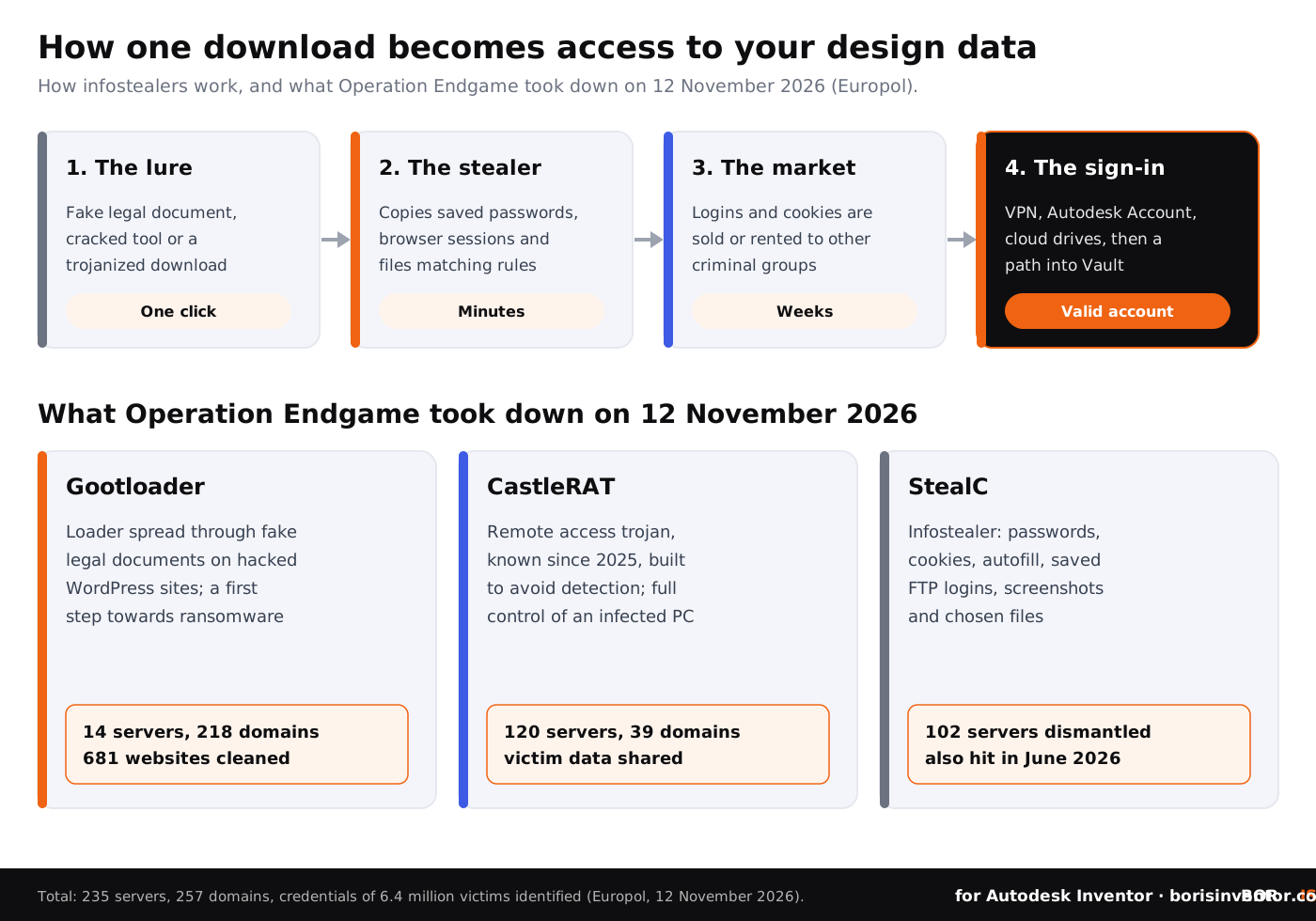
The three targets play different roles in the same business. They are sold or rented to other criminals as a service, so one takedown can affect many separate attack groups at once. The table sums up what was reported for each of them.
The US Department of Justice figures quoted in the coverage give a sense of scale for Gootloader alone: at least 25,000 computers infected worldwide, ransomware attacks against at least 44 victims in the United States and about 28.8 million dollars in losses since 2018. No arrests were mentioned in the reports we checked.
What does an infostealer take from an engineering workstation?
StealC is a good example of how these tools work. Microsoft's analysis of StealC from June 2026 lists what it collects: passwords, cookies and autofill data saved in browsers, saved email account logins, saved FTP and SFTP logins, desktop screenshots, system details and files that match rules set by the attacker. Microsoft also warns that a stolen session cookie can let an attacker sign in as the user, even bypassing multi-factor authentication.
Translate that into a typical Inventor workstation and the list becomes uncomfortable. The browser may hold the login for the Autodesk Account, the company's Microsoft 365 or Google account, the VPN portal, the ERP system, a supplier's upload portal and a cloud drive with shared project folders. WinSCP or another transfer tool may hold the login for the server where STEP files are exchanged with a machine shop. And the attacker can tell the stealer to pick up files by name or type, which on an engineering PC can mean drawings, exports or configuration files with access keys.
We have seen this pattern before. The Binance hack began on engineers' laptops, one of them infected through a tampered software installation, and the trojanized Claude Code extension showed how a fake download can sit in a marketplace engineers trust. Our article on the November Outlook zero-day covers another way Windows logins leak from a single opened file.
Why should CAD managers watch out for fake legal documents?
Gootloader's lure is aimed at people looking for legal paperwork. Its operators place fake documents on hacked WordPress sites and wait for someone to download what looks like a contract or agreement. In an engineering company, the people who search for that kind of file are often the ones with the widest access: the CAD manager preparing an NDA for a new supplier, the owner looking for a licence agreement template or the project lead checking a contract clause late in the evening.
Our article on the limits of NDAs for protecting CAD files explains why a contract alone does not protect a design. This campaign adds a practical point: get templates from your lawyer, your industry association or a known publisher, not from the first search result. If a "document" arrives as a script or a ZIP file with something other than a PDF or Word file inside, do not open it.
How can you check whether your company's logins were stolen?
According to the coverage, the victim data from this phase will be made available through Have I Been Pwned, the Shadowserver Foundation, the Dutch National Cyber Security Centre, the Dutch volunteer group DIVD and the Dutch police service Check JeHack. Shadowserver and national security teams usually pass findings to network owners and internet providers, so an IT provider may hear about an infected PC before you do.
The most useful step for a company is the domain search in Have I Been Pwned. After you verify that you own your email domain, it shows every address on that domain that appears in the data it holds. Data from the earlier StealC action in June 2026 is already there, listed as Operation Endgame 4.0 with more than 4.3 million unique email addresses. Check it now, and check again in the coming days, because the 12 November data may take time to be loaded. Individual engineers can search their own address the same way.
A match does not prove that your company was breached, and no match does not prove that it was not. Stealer data is often old, and many stolen logins never reach these services. Treat a match as a reason to look at that person's PC and accounts, not as a final answer.
Logins can be stolen. Proof of authorship should not be.
BORIS for Autodesk Inventor registers your CAD files with a blockchain timestamp and gives you a certificate of ownership, straight from Inventor.
👉 See how BORIS for Autodesk Inventor works
What should Inventor teams do now?
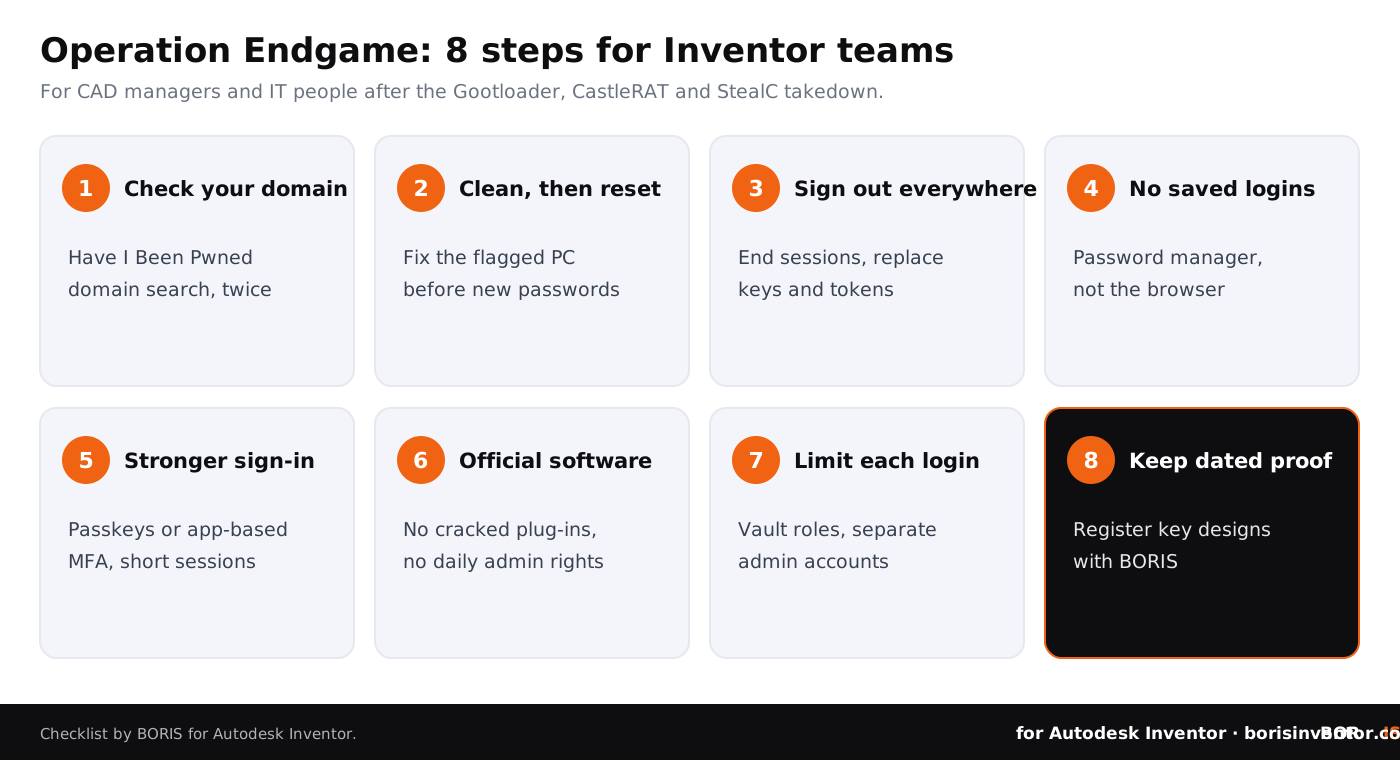
- Check your domain. Run a domain search in Have I Been Pwned for every company email domain, look for the Operation Endgame entries and repeat the check next week. Ask your IT provider whether any alerts from Shadowserver or a national security team have come in.
- Clean first, then change passwords. If a PC is flagged, clean or reinstall it before anyone signs in again, and change passwords from a different, clean device. A new password typed on an infected PC is simply stolen again.
- Sign out everywhere. Changing a password does not always end existing sessions. For affected users, sign out all sessions in the Autodesk Account, Microsoft 365 or Google Workspace, the VPN and cloud drives, and replace any access keys, API secrets or code tokens that were stored on the PC.
- Stop saving passwords in browsers on CAD workstations. Use a company password manager instead, and do not keep server logins in transfer tools on PCs that also browse the web.
- Use stronger sign-in. Switch on passkeys or app-based multi-factor authentication where your services offer it. Autodesk accounts can use passkeys. Shorter session lifetimes for the VPN and admin portals reduce the value of a stolen cookie.
- Install software only from official sources. Inventor, add-ins, content libraries, converters and utilities should come from Autodesk Access, the Autodesk App Store or the vendor's own site. No cracked plug-ins, no "free" versions of paid tools and no admin rights for everyday work.
- Limit what one login can open. Give Vault users only the folders and lifecycle states they need, separate admin accounts from daily accounts and check that former employees and contractors no longer have access.
- Keep dated proof. Register key designs with BORIS, so that if stolen files ever turn up elsewhere you can show which version you created and when.
Does the takedown make the stolen logins safe?
No. Seizing servers stops the operators from collecting new data through that infrastructure for a while, and it gives victims a chance to find out. It does not undo what was already copied and sold. Logins bought before 12 November can still be used until they are changed and the sessions revoked.
The operators also tend to rebuild. StealC was already targeted in the June 2026 phase of Operation Endgame and was hit again this week. Attackers also have other stealers to choose from. The lasting protection is in the habits on your side: fewer saved passwords, stronger sign-in, software from known sources and access rights that match each person's job.
Our guides on security protocols for remote CAD teams and role-based access control for CAD data explain how to set up access so that one stolen account does not open everything. For the bigger picture of where design data leaks, see the Clop PLM data leak, where stolen engineering drawings ended up online, and the exploited Barracuda email gateway flaws, which put the route most drawings take to suppliers at risk.
How do you make engineers part of the defence?
Most infostealer infections start with a person choosing to download something. That makes short, practical training worth more than long policies. Show engineers what a fake download page looks like, explain why cracked tools are a bad bargain and tell them who to call if something odd happens after they open a file. Our guide on improving CAD security training programs covers phishing drills for engineering teams, and common mistakes engineers make with CAD security lists the habits to fix first.
Then make the safe route the easy one. A shared, approved list of add-ins and utilities, a password manager everyone actually uses and a quick way to request software save more trouble than any warning email. Our guide to CAD file protection with Vault, encryption and proof of ownership shows how these layers fit together, and tracking who accesses your CAD files helps you notice when a valid account starts behaving like a stranger.
The bigger picture
This week's news on our sister sites shows the same theme from three angles: trust in the tools and services around design work.
- Software updates. On CADChain, the Quantum Systems cyberattack describes how a malicious file disguised as a ground-control software update reached the drone maker's update server and customers' servers before it was caught.
- AI tools. BORIS for SOLIDWORKS explains how a breach at an AI provider exposed Notion AI chat transcripts, and what engineers should think about before typing customer details or part numbers into AI tools.
- Creative industries. Blended BORIS looks at the GDC 2026 State of the Game Industry survey, where 40 percent of developers now use generative AI, most respondents see its effect on the industry negatively and IP protection is among the concerns.
Conclusion
Operation Endgame's latest phase took down servers and domains behind Gootloader, CastleRAT and StealC on 12 November 2026, and Europol says credentials of 6.4 million victims were identified. It is good news, but it is also a reminder of how much access is for sale. For an Inventor team, one infected workstation can hand an attacker the VPN, the Autodesk Account, cloud folders and a path into Vault.
Check your domain in Have I Been Pwned, clean flagged PCs before changing passwords, end old sessions, stop saving passwords in browsers on CAD workstations and install software only from official sources. Limit what each account can open, and keep dated proof of your designs so that you can show what is yours if a copy ever surfaces.
Your designs, your proof.
BORIS for Autodesk Inventor gives every registered file a blockchain timestamp and a certificate of ownership, straight from Inventor.
👉 Protect your Inventor designs with BORIS
FAQ: Operation Endgame and Inventor teams
What is Operation Endgame?
Operation Endgame is an international police action, coordinated by Europol and Eurojust, against the malware that criminals use to break into networks before ransomware attacks. The phase announced on 12 November 2026 targeted Gootloader, CastleRAT and StealC and involved police from nine countries.
What was seized?
Europol reported 235 servers and 257 domains. Coverage of the announcement lists 14 servers and 218 domains for Gootloader, plus 681 infected websites cleaned, 120 servers and 39 domains for CastleRAT and 102 servers for StealC.
What does the 6.4 million figure mean?
Europol said credentials belonging to 6.4 million victims were identified on the seized infrastructure. Some reports call them datasets rather than people, so the number of distinct individuals may be different.
How do I check whether my company is affected?
Use the domain search in Have I Been Pwned after verifying your email domain, and look for the Operation Endgame entries. Data from the June 2026 StealC action is already listed; the 12 November data is to be shared through Have I Been Pwned and other services and may take time to appear.
Is Autodesk software affected?
No. Operation Endgame is about malware on users' computers, not a flaw in Inventor, Vault or Autodesk's services. The risk is that logins saved on an infected PC, including the Autodesk Account, VPN and cloud drives, can be stolen and reused.
Does multi-factor authentication protect us?
It helps a lot, but not completely. Microsoft warns that a stolen browser session cookie can let an attacker sign in without the second factor. That is why affected users should sign out all sessions and why passkeys and shorter session lifetimes are worth using.
What should a small manufacturer do first?
Run the Have I Been Pwned domain search, ask your IT provider about alerts, clean any flagged PC before changing its user's passwords, end all active sessions for that user and stop saving passwords in browsers on CAD workstations.
How does BORIS help?
BORIS for Autodesk Inventor registers CAD files with a blockchain timestamp from inside Inventor, so you can show which version of a design existed and when. It does not remove malware or protect passwords, and it does not replace endpoint security, access control or backups.