
Microsoft's November 2026 security updates, released on Tuesday, 10 November, fix an Outlook flaw that attackers were already exploiting before the patch existed. Tracked as CVE-2026-124194, it lets a crafted message file make Outlook silently connect to a server controlled by the attacker and hand over the user's NTLMv2 password hash, the moment the file is opened. The same release fixes more than a thousand other vulnerabilities across Windows, Office, SQL Server, Exchange and developer tools.
Security firms count the November release differently, from about 1,093 CVEs in Tenable's analysis to about 1,235 in other tallies that include more products. Whatever the exact number, it is one of the largest monthly releases Microsoft has shipped. Only one of the flaws is confirmed as exploited in the wild, and it sits in the program that engineers use all day to receive drawings, RFQs, specifications and supplier files.
For Inventor teams, the risk is not that someone breaks Inventor itself. It is that a stolen Windows login opens the same file shares, Vault folders and project drives that the engineer can open. This article explains what is confirmed about the Outlook zero-day, what else in the November release matters to CAD workstations and Vault servers, and which updates CAD managers and IT people should install first.
TL;DR: CVE-2026-124194 is an exploited Outlook spoofing flaw. Opening a crafted message file makes classic Outlook connect to an attacker's server without the usual warning and leak the user's NTLMv2 hash, which can be relayed to log in as that user or cracked offline. The Preview Pane is not a vector. The fix ships with the Office updates, not with the Windows update alone.
Patch Office and Windows on every Inventor workstation first, then domain controllers, Vault, SQL Server and file servers. Block outbound SMB to the internet, require signing on file and directory services, use long unique passwords with MFA on VPN and email, and remind engineers that unexpected files from buyers and suppliers deserve a second look.
What did Microsoft fix in Outlook?
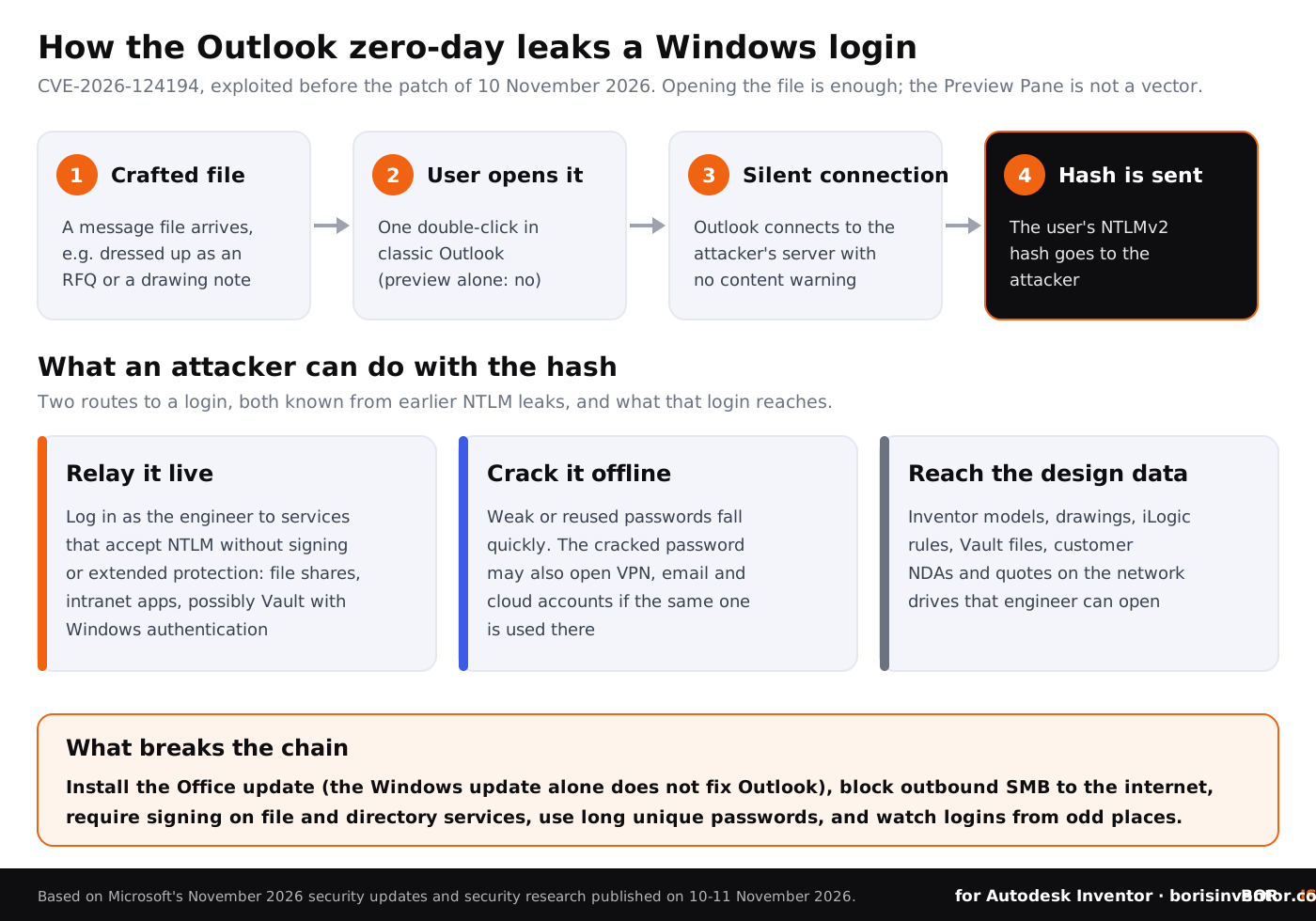
Microsoft rates CVE-2026-124194 as a spoofing vulnerability with a CVSS score of 6.5. That score sounds modest, and Rapid7's analysis says it does not tell the full story. According to the reports published on 10 November, an attacker sends a specially crafted message file. When the recipient opens it in an affected version of classic Outlook, Outlook connects to a network location controlled by the attacker without showing its usual external-content warning. That connection carries the user's NTLMv2 hash, a value derived from the Windows password that Windows uses to prove who you are on the network.
Three details matter for engineering offices. First, the user must open the file; Microsoft says the Preview Pane is not an attack vector, so simply selecting the message is not enough. Second, Microsoft confirmed exploitation in the wild before the patch, but has not said who is behind the attacks or whom they targeted. Third, the fix arrives through the Office security updates for all supported versions of classic Outlook. As one summary of the release put it, "installing the Windows cumulative update alone does not address the Outlook vulnerability".
Tenable notes that the advisory credits a security researcher who used Claude, Anthropic's AI model, to find the flaw, and other reports name a researcher from Anthropic among those credited. That is a small sign of a bigger shift: AI tools are now finding real vulnerabilities in software that engineering firms use every day, which means faster discovery for defenders and, sooner or later, for attackers too.
Why does a leaked NTLM hash matter for Inventor data?
An NTLMv2 hash is not the password itself, but it is close enough to be useful. Rapid7 describes the two classic routes. An attacker can relay the hash live to another service and log in as the user, which works against services that do not require message signing or Extended Protection for Authentication. Or the attacker can try to crack the hash offline, which works well against short, common or reused passwords.
In a typical Inventor office, the engineer who opens the file can reach a lot. Network drives hold project folders, iLogic rules, content center libraries, customer drawings and quotes. Many companies run Vault with Windows authentication against Active Directory, so the same login that unlocks the PC also unlocks the vault. Older file servers, NAS boxes and internal web tools often accept NTLM without signing. A stolen login does not trip any alarm on its own; to the server it simply looks like a colleague at work.
We have seen this pattern before in this news series. The Clop campaign against PLM servers ended with engineering drawings published online. The Binance attack began on engineers' laptops, not on the systems the attackers wanted in the end. Credentials are the bridge in almost every one of these stories, which is why a patch for an Outlook spoofing bug belongs on a CAD manager's list.
What else in the November release matters to CAD teams?
Most of the November fixes are rated important rather than critical, and most are not known to be exploited. Still, several affect the systems around Inventor and Vault. The table below groups them by the system an Inventor team actually runs, based on the details published by Tenable, Rapid7 and other analysts.
There are also lifecycle dates that land on the same week. According to Rapid7, .NET 8 and PowerShell 7.4 LTS reached the end of support this week, and Windows 11 version 23H2 Enterprise, Education and IoT editions moved past end of support too. We covered both in advance: our guide to the .NET 10 update for Inventor and Vault and our article on the last update for Windows 11 23H2 explain what to check on CAD PCs and servers.
Patches protect the network. Proof protects the design.
BORIS for Autodesk Inventor registers your CAD files with a blockchain timestamp and gives you a certificate of ownership, straight from Inventor.
👉 See how BORIS for Autodesk Inventor works
How should CAD managers roll out the November updates?
Most Inventor teams cannot patch everything on the first day. Production deadlines, certified driver versions and Vault compatibility all slow things down. The practical answer is to separate the urgent from the important. The Outlook fix is urgent, because it is exploited and sits on every engineer's desk. Server fixes for Active Directory, SQL Server and Schannel are important, and should follow within days after a quick test.
Office updates are easy to miss in CAD environments. Many companies manage Windows updates centrally but leave Microsoft 365 Apps on a slower channel, or have a few workstations with an old Office installation that nobody updates. Check the Office build on every machine that runs Outlook, not only the Windows build. If you use a managed service provider, ask for written confirmation that the Office updates were deployed, not only the Windows patches. Our article on backup tools and other IT tools as an attack path explains why it pays to know what your providers actually install.
Before you patch the Vault server and its SQL Server instance, take a full Vault backup with the ADMS Console and confirm the SQL Server version your Vault release supports. The Inventor Vault setup and management tips and our guide to CAD file backup strategies cover the basics. If Vault runs on a virtual machine, our article on the VMware ESX logging zero-day is a reminder to patch the layer underneath as well.
What should Inventor teams do now?
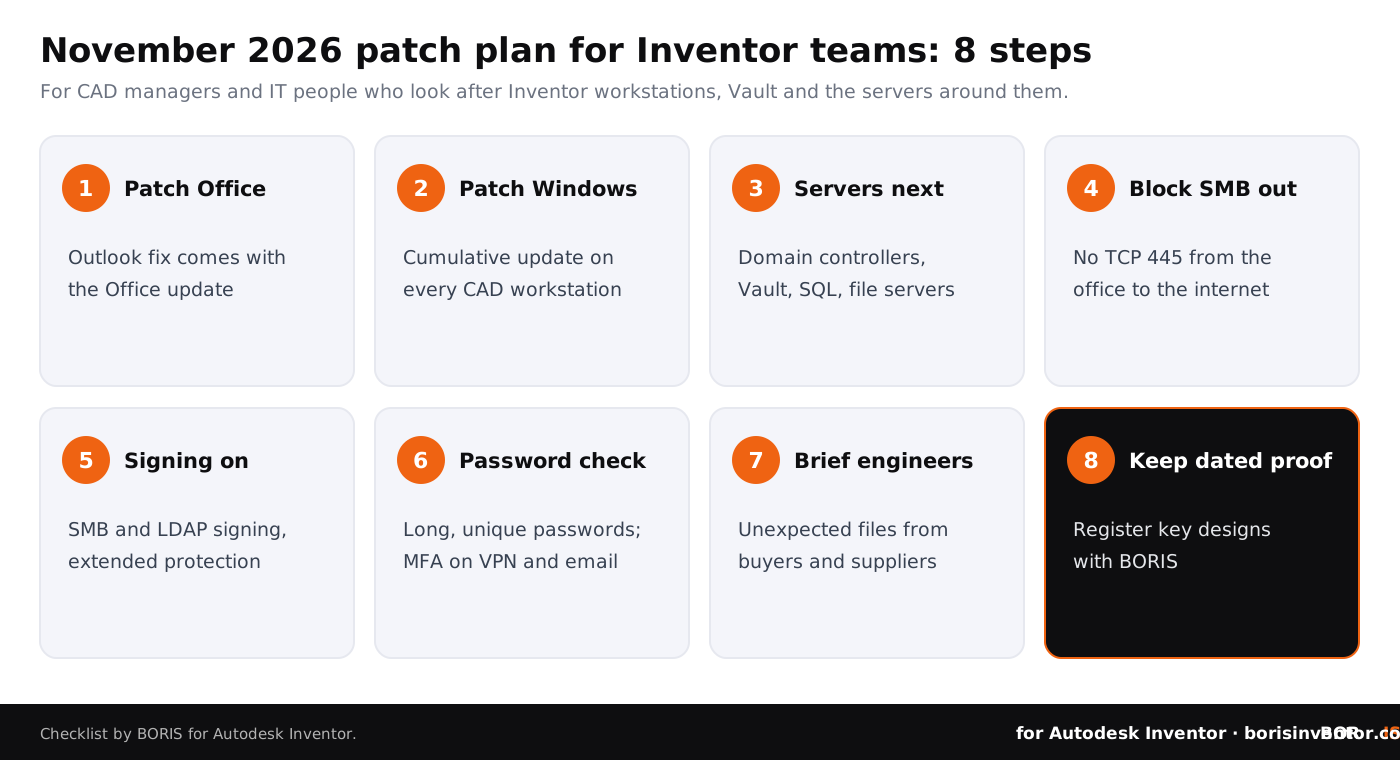
- Patch Office on every workstation. Install the November Office security updates wherever classic Outlook runs, and check the Office build, because the Windows update alone does not fix the Outlook flaw.
- Install the Windows cumulative update. Roll it out to all Inventor workstations, after a short test with your certified graphics driver and key add-ins.
- Patch servers next. Domain controllers, the Vault server and its SQL Server instance, file servers and any Exchange server, after a full Vault backup.
- Block outbound SMB. Make sure TCP port 445 cannot leave your network to the internet, so a crafted file has a harder time reaching an attacker's server.
- Require signing. Turn on SMB signing and LDAP signing, and use Extended Protection for Authentication where your services support it, so relayed hashes are rejected.
- Check passwords and MFA. Long, unique passwords make offline cracking much harder; MFA on VPN, email and remote access limits what a stolen password can do.
- Brief engineers. Explain that unexpected message files and attachments from buyers, suppliers or unknown senders deserve a second look, and that reporting a suspicious file is always welcome.
- Keep dated proof. Register key design files with BORIS, so that if a breach ever leads to a dispute about who designed what, you can show which version existed and when.
For the access side of the problem, our guides to protecting CAD files from unauthorized access, role-based access control for CAD and tracking who accesses your CAD files explain how to limit what one stolen login can reach. For the people side, see how to improve CAD security training with phishing drills and feedback loops.
Is Inventor itself affected?
Nothing in the reports on the November release names Autodesk Inventor or Vault as vulnerable products. The risk runs through the Microsoft software that Inventor depends on: Windows, Office, Active Directory and SQL Server. Autodesk publishes its own security advisories for Inventor, Vault and shared components, and these come on a different schedule. We cover them when they appear, as with the Fusion advisories of 27 October.
One more connection is worth making. Inventor 2027.2 added a local MCP server that lets AI agents work inside an open Inventor session, which we described in our article on the Inventor MCP server. On machines where engineers combine Outlook, AI coding tools, VS Code and Inventor, a single stolen login or a compromised developer tool can reach more than before. Keep those machines patched first.
The bigger picture
This week's news on our sister sites shows how design data leaks through trusted routes rather than broken locks.
- AI tools inside the company. On CADChain, a quant firm's lawsuit against a former researcher alleges that company-provided AI coding tools were used to read and distil colleagues' code before he left.
- Selling the archive. BORIS for SOLIDWORKS looks at AI data brokers offering money for old CAD archives, and why owning the files does not always mean having the right to sell them.
- Platform controls. Blended BORIS explains ArtStation's new AI declarations, filters and reporting, and what they mean for Blender artists who publish their work.
Conclusion
The November 2026 updates are huge, but for Inventor teams the first job is simple: get the Office fix for CVE-2026-124194 onto every machine that runs Outlook, because it is already being exploited and it turns one opened file into a stolen Windows login. Then patch Windows, the domain controllers, Vault, SQL Server and file servers, after a backup and a short test.
Patching closes this hole, but the next credential leak will come from somewhere else. Limit what one login can reach, require signing so relayed hashes fail, use passwords that are hard to crack, and keep engineers alert to unexpected files. And because breaches often turn into arguments about who designed what, keep dated proof of your designs from the start.
Your designs, your proof.
BORIS for Autodesk Inventor gives every registered file a blockchain timestamp and a certificate of ownership, straight from Inventor.
👉 Protect your Inventor designs with BORIS
FAQ: the November 2026 Outlook zero-day and Inventor teams
What is CVE-2026-124194?
It is a spoofing vulnerability in Microsoft Outlook, fixed on 10 November 2026. Opening a crafted message file makes Outlook connect to an attacker's server without a warning and leak the user's NTLMv2 hash. Microsoft confirmed it was exploited in the wild before the fix.
Is reading an email in the Preview Pane enough to be attacked?
No. Microsoft says the Preview Pane is not an attack vector. The user has to open the crafted file. That limits the risk, but engineers open attachments all day, so it does not remove it.
Does the Windows update fix it?
No. The Outlook fix ships with the Office security updates. Reports on the release warn that installing the Windows cumulative update alone does not address the Outlook vulnerability, so check the Office build on every machine.
What can an attacker do with an NTLMv2 hash?
They can relay it live to log in as the user on services that do not require signing or extended protection, or try to crack it offline to recover the password. Either way, they may reach file shares, Vault and other systems that trust the user's Windows login.
Are Autodesk Inventor or Vault vulnerable?
The reports on the November release do not name Inventor or Vault. The risk runs through Windows, Office, Active Directory and SQL Server, which Inventor and Vault depend on. Autodesk publishes its own advisories separately.
What should we patch first?
The Office updates on every machine that runs Outlook, then the Windows cumulative update on workstations, then domain controllers, the Vault server and SQL Server, file servers and Exchange, after a full Vault backup and a short test.
How do we reduce the damage if a hash leaks anyway?
Block outbound SMB to the internet, require SMB and LDAP signing, use long unique passwords with MFA on VPN and email, limit what each login can reach, and review logins from unusual places.
How does BORIS help?
BORIS for Autodesk Inventor registers CAD files with a blockchain timestamp from inside Inventor, so you can show which version of a design existed and when. It does not patch Windows or stop credential theft, and it does not replace access control or backups.