
On 28 October 2026 the US Cybersecurity and Infrastructure Security Agency (CISA) added CVE-2026-41709, a logging flaw in Broadcom's VMware ESX hypervisor, to its catalogue of vulnerabilities exploited in real attacks. The same day CrowdStrike reported that the China-nexus espionage group it calls WARP PANDA had used the flaw as a zero-day, as late as early 2026, to hide what it did on ESX hosts. Broadcom fixed it on 29 July 2026.
The flaw scores only 2.7 out of 10, and it does not let anyone in. An attacker first needs administrator rights on the host. But once they have them, some of their actions on the hypervisor are not written to the logs. For a company whose Vault server, SQL database, licence server and file shares all run as virtual machines on the same ESX hosts, that is exactly the layer where a quiet copy of everything would happen.
Many manufacturing SMEs and Inventor teams virtualised their servers years ago and rarely think about the hypervisor again. This news is a good reason to look: who can administer it, which version it runs, where its logs go, and whether you would notice if someone copied the disk of your Vault server.
TL;DR: patch ESX, guard the hypervisor admin accounts, and treat your Vault VM as your crown jewels
CVE-2026-41709 lets someone who is already an ESX administrator perform operations that are not recorded in the host logs. CISA lists it as exploited since 28 October 2026, US federal agencies must fix it by 11 November, and CrowdStrike says WARP PANDA used it against US organisations. The fix is in Broadcom advisory VMSA-2026-0006 from 29 July 2026, together with more serious vCenter and ESX flaws rated up to 9.8. There is no workaround. If your Inventor data lives in VMs, update ESX and vCenter, keep management interfaces off normal networks, send logs off the host, and keep Vault backups and dated proof of your designs outside the virtual environment.
What did CISA and CrowdStrike announce?
In its alert of 28 October 2026, CISA added two vulnerabilities to its Known Exploited Vulnerabilities catalogue: CVE-2026-41709, a Broadcom VMware ESX insufficient logging vulnerability, and CVE-2026-46300, a Linux kernel flaw. A KEV listing means CISA has evidence of active exploitation. US federal civilian agencies have until 11 November 2026 to fix the ESX flaw. The catalogue entry marks known use in ransomware campaigns as unknown.
The evidence came from CrowdStrike. Its 2026 Legal Threat Landscape Report, published on 28 October and covering September 2025 to August 2026, says WARP PANDA deployed malware in victims' VMware vCenter environments and, in several cases and as late as early 2026, exploited CVE-2026-41709 as a zero-day. A zero-day is a flaw used by attackers before the vendor has a fix. Broadcom credits CrowdStrike researcher Ian Barton with reporting it.
The report focuses on law firms, but WARP PANDA is not a law-firm specialist. In its first public profile of the group in December 2025, CrowdStrike listed US legal, technology and manufacturing organisations as its targets and said the group had been active since at least 2022.
What does the flaw actually do?
Broadcom's frequently asked questions for the advisory describe it in one sentence: "The logging issue permits an administrator to perform operations on ESX without those operations being recorded." Broadcom does not say which operations. The CVSS score is low because the attacker must already hold high privileges and the flaw itself does not expose or destroy data.
The low score is misleading for one reason: logs are how you find out what happened after a break-in. If an intruder with stolen admin credentials can work on an ESX host without leaving records, an investigation may not be able to show what was copied, when, or whether anything was copied at all. That matters for insurance claims, for breach notifications and for any later dispute over who owned a design first.
Broadcom's own FAQ, last revised on 19 August, still says it has no information suggesting exploitation in the wild. CISA's listing and CrowdStrike's report now say otherwise, so treat the issue as exploited.
Why should Inventor and Vault teams care about a hypervisor?
A typical Inventor setup in a small or mid-sized manufacturer has more server pieces than people remember: the Vault server with its SQL database and file store, a job processor, an Autodesk network licence server, Windows file shares with older projects, a domain controller and a backup server. In many companies all of them are virtual machines on two or three VMware hosts.
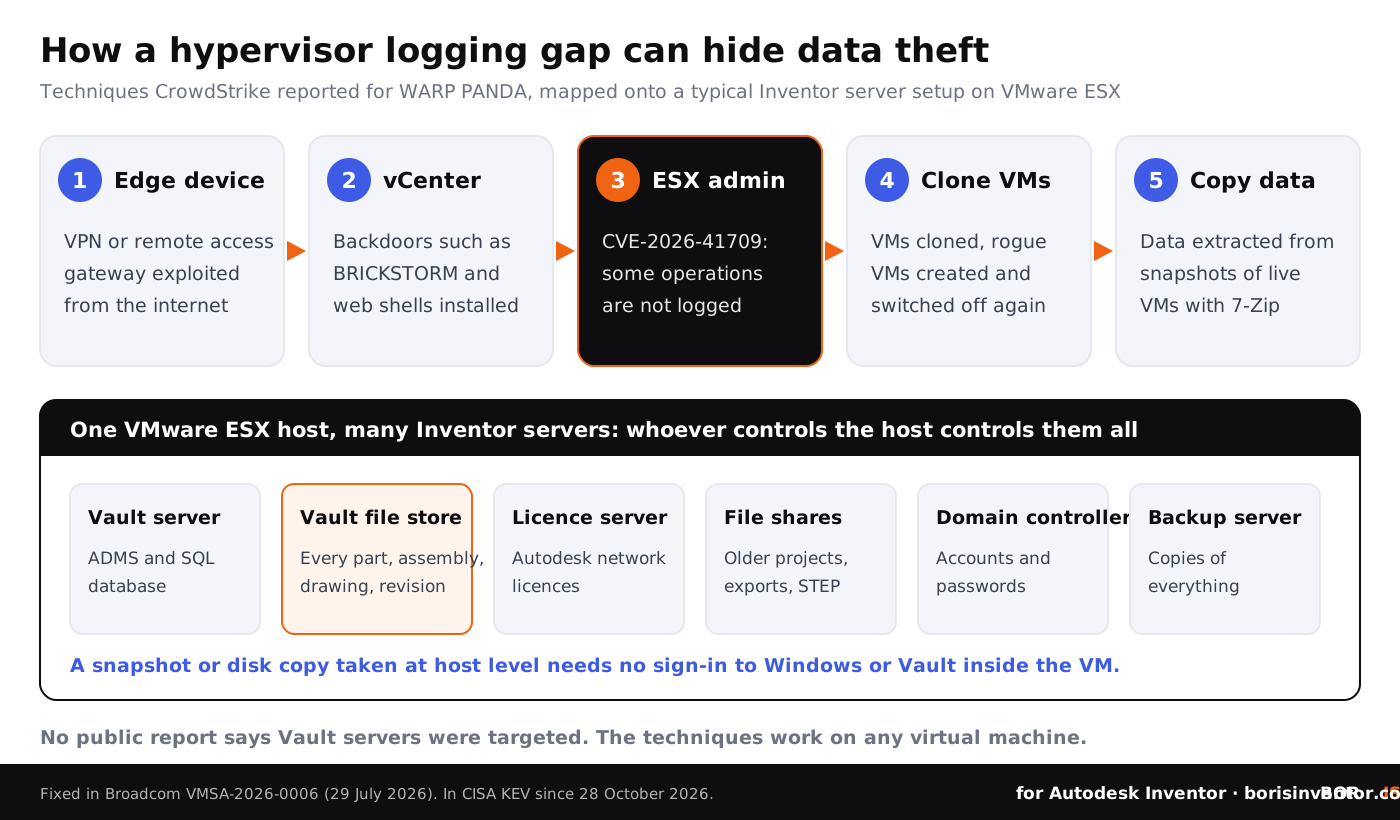
Whoever controls the hypervisor controls every one of those machines. They can take a snapshot of a running VM, clone it, or copy its virtual disk without signing in to Windows or Vault inside the VM, so neither of them records a sign-in. For an Inventor team, the Vault file store on that disk is the complete design history: every part, assembly, drawing and revision.
This is not theory. In its December 2025 profile, CrowdStrike reported that WARP PANDA used vCenter access to clone domain controller VMs, created rogue virtual machines that were not registered in vCenter and shut them down after use, cleared logs and changed file timestamps. It also used an ESXi-compatible version of 7-Zip "to extract and stage data from thin-provisioned snapshots of live ESXi guest VMs". There is no public report that the group targeted Vault servers. The point is that the technique works on any VM, including yours.
Dwell time makes it worse. Google's threat intelligence team reported in September 2025 that the BRICKSTORM backdoor, which CrowdStrike links to WARP PANDA, stayed undetected in victim networks for 393 days on average, longer than many companies keep their logs. Our articles on industrial espionage in CAD design and the consequences of CAD file leaks explain what is at stake when design data leaves quietly.
Which VMware versions are affected, and what is the fix?
The fix is part of Broadcom advisory VMSA-2026-0006, published on 29 July 2026 and revised on 19 August. The advisory covers five vulnerabilities and is rated Critical overall, with scores from 2.7 to 9.8. Besides the logging flaw it fixes an authentication bypass and a directory traversal flaw in vCenter that an unauthenticated attacker with network access could use, an out-of-bounds write in the VMXNET3 virtual network adapter that lets an administrator inside a guest VM run code on the ESX host, and an out-of-bounds read. Broadcom lists no workarounds and says its patches are cumulative.
The build numbers come from Broadcom's advisory as summarised by several security publications; check the exact build for your patch level in the advisory before you update. Our article on Windows 10 workstations after the end of ESU Year 1 covers the same problem on the desktop side: unsupported versions stop receiving fixes.
How do attackers get hypervisor admin rights in the first place?
CVE-2026-41709 is a tool for hiding, not for breaking in. According to CrowdStrike's reporting summarised by Help Net Security, WARP PANDA typically starts by exploiting internet-facing edge devices such as VPN gateways, moves to vCenter, and deploys its BRICKSTORM and SharpStorm malware there. It has also reached Microsoft 365 data by stealing session tokens and, in some cases, registering its own MFA device on a victim's account.
For a manufacturer, the weak points are usually ordinary ones: a VPN appliance that missed an update, vCenter reachable from the office network, an ESX root password shared by the IT partner and three former employees, or a domain admin account that also administers vCenter. Fix those and a logging flaw on the hypervisor matters much less. Our guide to tracking who accesses your CAD files covers the Vault side of access control.
Proof that does not depend on server logs.
BORIS for Autodesk Inventor registers your CAD files from inside Inventor and gives each registered version a blockchain timestamp and a certificate of ownership. If design data ever leaks, you can still show what you had, and when.
👉 See how BORIS for Autodesk Inventor works
What should Inventor teams do now?
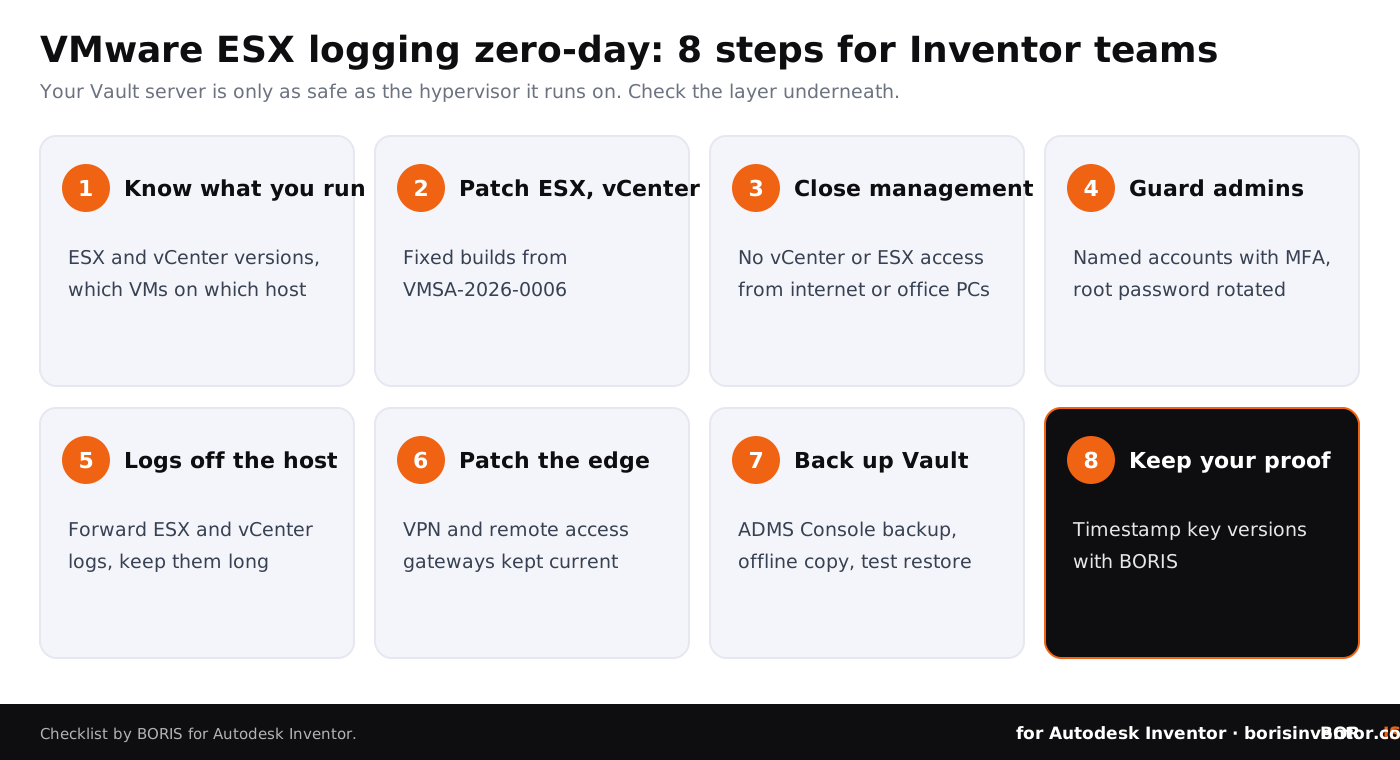
- Find out what you run. Ask your IT team or partner for the ESX and vCenter version of every host, and which VMs run on each: Vault server, SQL, file store, licence server, file shares, domain controller and backup server.
- Patch ESX and vCenter. Apply the fixed builds from VMSA-2026-0006 to every host and to vCenter. If you are on vSphere 7 or older without extended support, schedule the upgrade now and isolate the hosts until it is done.
- Close the management plane. ESX host clients, vCenter and SSH on the hosts should not be reachable from the internet or from ordinary office PCs. Use a separate admin network or jump host, and keep SSH on ESX switched off unless it is needed.
- Guard admin accounts. Use named, personal admin accounts with MFA on vCenter, keep the ESX root password in a vault, rotate it after staff or partner changes, and do not use everyday Windows accounts for hypervisor administration.
- Send logs off the host. Forward ESX and vCenter logs to a system the hypervisor admins cannot change, keep them longer than 393 days if you can, and alert on new snapshots, clones, exports, unregistered VMs and SSH logins.
- Patch the edge. VPN gateways and remote access appliances are the usual way in. Keep them current and watch their admin logins. See our sister site's article on the Ivanti Connect Secure flaws below.
- Back up Vault properly. Autodesk's support guidance says the supported way to back up a Vault server is the backup command in the ADMS Console. A VM snapshot is not a Vault backup. Keep one copy offline or immutable and test a restore. Our guide to CAD file backup strategies for engineering firms explains the options.
- Keep proof outside the servers. Register key design versions with BORIS so their existence and date can be shown even if server logs are incomplete or a VM disk is copied.
For more background, read what the Clop PLM data leak means for Inventor and Vault teams, how backup tools became an attack path and how to run drills for a CAD data breach. Two recent cases show the same pattern of attackers going after the systems around your CAD data rather than Inventor itself: the Siemens Software Center ClickFix attacks and the php2shell PHP vulnerabilities. If someone does take your files, a recent court ruling on 3D model files as trade secrets shows how much depends on records.
The bigger picture
This week's news on our sister sites points the same way: the systems around engineering data are under pressure, and dated records decide disputes.
- Edge devices. BORIS for SOLIDWORKS covers the Ivanti Connect Secure zero-day chain, where CISA added two more flaws to its exploited list on 30 October and Volexity found attackers taking credentials and Active Directory data from fully patched VPN appliances.
- Prior use. On CADChain, the UPC Court of Appeal ruling in Agfa v. Gucci revoked most of a patented leather decoration method because a Gucci wallet sold before the filing date made the method public, a reminder of how much depends on proving what existed and when.
- Platform terms. Blended BORIS explains the new Sketchfab Terms of Use in force since 27 October 2026, which moved the contracting party to a KitBash company while keeping the promise not to use uploads for generative AI datasets.
CADChain explains how its CAD data protection technology works across CAD systems, and our article on the .NET 10 update for Inventor and Vault covers another server deadline for CAD managers in November.
Conclusion
CVE-2026-41709 is a small flaw with a big lesson. It does not break into anything, but in the hands of an intruder who already controls a VMware host it removes the record of what they did. CISA now lists it as exploited, CrowdStrike ties it to an espionage group that targets manufacturers, and the fix has been available since July. For Inventor teams the hypervisor is part of the design data security perimeter: patch ESX and vCenter, keep the management plane private, protect the few accounts that control it, ship logs elsewhere, back up Vault the supported way, and keep proof of your designs that does not depend on any single server.
Your designs, your proof.
BORIS for Autodesk Inventor gives every registered file a blockchain timestamp and a certificate of ownership, without sending your models to a cloud service.
👉 See how BORIS for Autodesk Inventor works
FAQ: the VMware ESX logging zero-day and Inventor teams
What is CVE-2026-41709?
An insufficient logging vulnerability in Broadcom's VMware ESX hypervisor. According to Broadcom, it lets an administrator perform operations on ESX without those operations being recorded. It is rated 2.7 out of 10 because the attacker must already have admin rights.
Is it being exploited?
Yes. CISA added it to its Known Exploited Vulnerabilities catalogue on 28 October 2026, and CrowdStrike reported that the China-nexus group WARP PANDA used it as a zero-day, as late as early 2026. Known use in ransomware is listed as unknown.
Does it affect Autodesk Inventor or Vault software?
No, it is a VMware flaw, not an Autodesk one. It matters to Inventor teams because Vault servers, licence servers and file shares often run as virtual machines on ESX, and whoever controls the host controls those machines.
Which versions fix it?
Broadcom fixed it in advisory VMSA-2026-0006 of 29 July 2026: ESXi80U3j-25429389 for ESX 8.0, ESXi-9.0.2.0100-25595025 for 9.0, ESXi-9.1.0.0-25370933 for 9.1, and 5.2.4 for VMware Cloud Foundation 5.x. There is no workaround.
We still run vSphere 7. What now?
vSphere 7 reached end of general support on 2 October 2025. Customers with extended support can request patches through that channel; everyone else should plan an upgrade and isolate the hosts from ordinary networks until then.
Is a VM snapshot a good backup of Vault?
No. Autodesk's support guidance says the supported way to back up a Vault server is the backup command in the ADMS Console. Keep at least one copy offline or immutable and test restores.
How does BORIS help?
BORIS for Autodesk Inventor registers CAD files with a blockchain timestamp from inside Inventor, so you can show which version of a design existed and when, even if server logs are incomplete. It does not replace patching, backups or access control.