
On 18 November 2026, the US cybersecurity agency CISA added CVE-2026-90436 to its catalog of known exploited vulnerabilities. The flaw sits in Apache Axis 1.x, an old Java library that Atlassian Confluence Data Center uses for its XML-RPC and SOAP remote API. On a Confluence server where that API is switched on, anyone who can reach the server can run commands on it without logging in. Rapid7 saw the first attack against a customer's Confluence server on 13 November, and the attacker went straight for the database, page attachments and stored credentials.
Many engineering companies run Confluence as their internal wiki, with design guidelines, test reports, supplier contacts and change discussions, often with drawings, PDFs and STEP files attached. It also tends to hold things that should not be there: Vault or ERP logins pasted into a setup page, VPN instructions, or the password of a service account used by an integration.
Confluence Cloud is not affected, and Confluence Data Center 10.x no longer has the feature. The risk is with self-hosted Data Center and older Server installs where someone switched on the remote API years ago and never switched it off.
TL;DR: CVE-2026-90436 in Apache Axis 1.x (all versions through 1.4) lets an unauthenticated attacker run code through a crafted SOAP message. CISA rates it 9.8 Critical and added it to its exploited list on 18 November 2026, with a deadline of 21 November for US federal agencies. Confluence Data Center is exposed only if "Remote API (XML-RPC & SOAP)" is enabled; the fix is version 9.2.28 or a move to 10.x, and the quick workaround is to switch the remote API off.
For Inventor teams with a self-hosted Confluence: check that setting today, update, then look for signs of the attack from 6 November onwards. If the server was reachable with the API on, treat every password and file stored in the wiki as exposed. Keep dated proof of your key designs, so that a copied drawing never turns into a question of who created it.
What happened, and when?
The Apache Software Foundation published the CVE record on 6 November 2026. Axis 1.x is end of life, and the record is tagged "unsupported when assigned": Apache does not plan a fixed 1.x release and recommends moving to another SOAP engine such as Apache Axis 2, or using a build with its published patch applied. The flaw was reported by José Apari-Pantigozo of OKIOK.
When an incoming SOAP fault names an exception class, Axis loads and creates that class before it checks whether it is a real Axis fault, which can lead to remote code execution. Because this happens before the request reaches any specific service, Apache warns that "authentication handlers configured on a service do not protect against it".
Atlassian followed on 9 November (US time) with an advisory in its Confluence bug tracker. A server is only vulnerable if the remote API is enabled; the setting has been off by default for new installations since Confluence 3.0 and was removed in Confluence 10.0. The only fixed version listed is 9.2.28. The 9.3, 9.4 and 9.5 lines are listed as affected with no fix, so customers on them should move to 10.x or switch the API off.
Atlassian describes the impact in one sentence: if the remote API is enabled, "an unauthenticated attacker who can reach the Confluence instance can execute arbitrary commands with the privileges of the Confluence operating-system account".
Is it being exploited?
Yes. According to Rapid7's analysis, first published on 16 November and updated on 19 November, its managed detection team spotted exploitation against a customer's Confluence Data Center server on 13 November. N-able's N-central remote management platform is hit by the same problem when its Legacy API is on: a public exploit appeared on 12 November, N-able reported attacks on 13 November that Rapid7 links closely to this CVE, and N-central 2026.4 HF3, released on 16 November, switches the Legacy API off. A ready-made Metasploit module for Confluence followed on 17 November, which makes the attack available to far less skilled people.
CISA added its own assessment to the CVE record on 17 November: exploitation active, automatable, technical impact total, with a CVSS 3.1 score of 9.8. The flaw entered the known exploited vulnerabilities catalog on 18 November with a remediation deadline of 21 November for US federal agencies, and CISA requires forensic triage, not only patching. Whether ransomware groups use it is listed as unknown. CISA also notes that the flaw could affect other products that bundle the same open-source library.
What did the attacker do on the Confluence server?
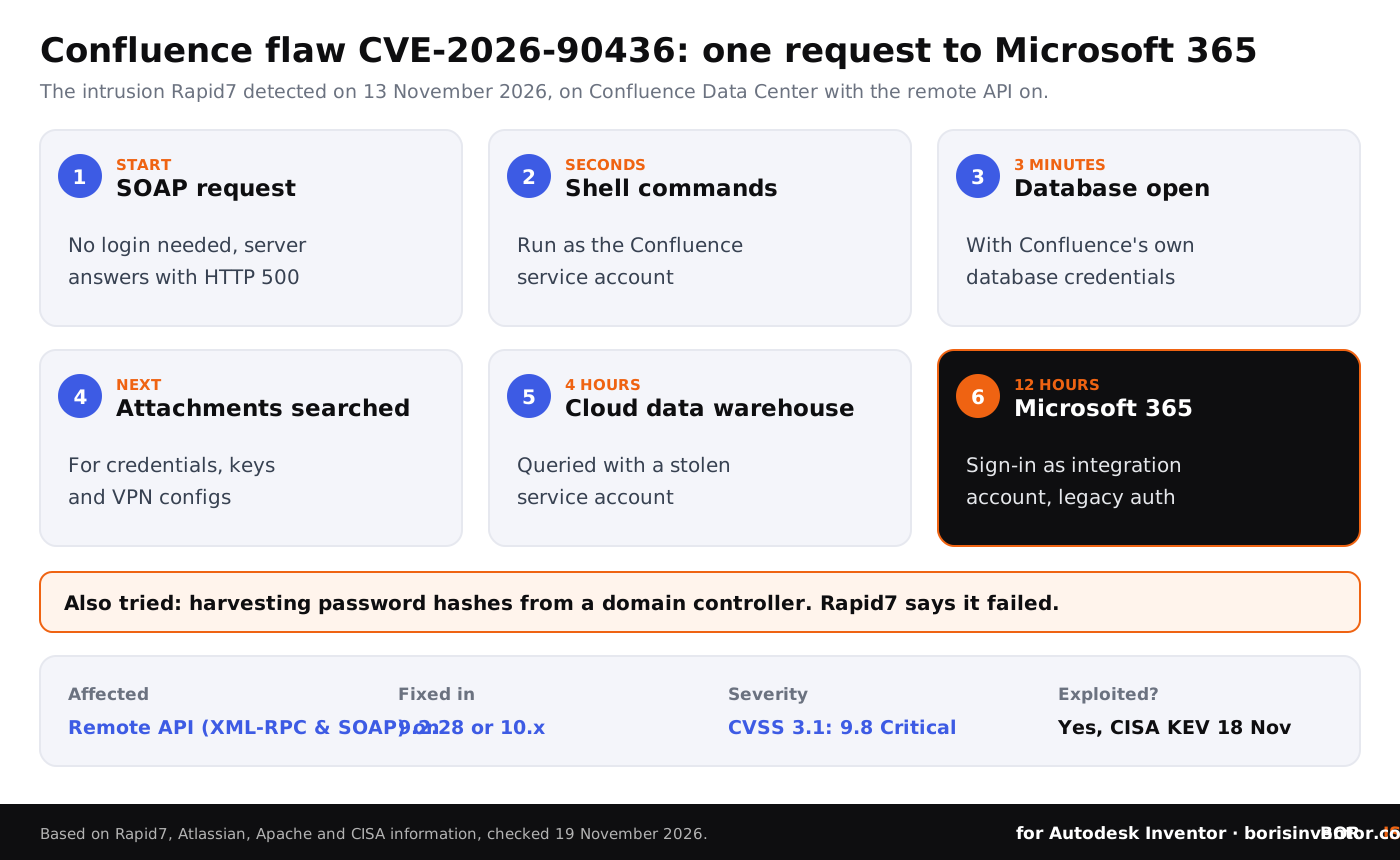
The attack started with unauthenticated POST requests to the SOAP endpoint that returned HTTP 500 errors. Within seconds, the Confluence Java process started shell commands and curl as the Confluence service account, and the attacker ran hundreds of encoded commands fetched from temporary tunnel domains. Rapid7 suspects AI-assisted tooling behind the volume and pace.
- About three minutes in: the attacker logged in to Confluence's MySQL database with Confluence's own database credentials.
- Attachments: page attachments were searched for credentials, keys, VPN configurations and payment card numbers.
- Directory: the attacker queried the Atlassian Crowd user directory and tried to harvest password hashes from a domain controller; Rapid7 says those attempts failed.
- About four hours in: a stolen service account was used to query a production cloud data warehouse.
- About twelve hours in: the attacker signed in to Microsoft 365 as an integration service account using legacy authentication.
Nothing in that list needed a second vulnerability. Every step after the first used data the wiki already held or credentials the server already used. That is the point for engineering teams: the damage depends far less on the flaw than on what you have stored in and connected to Confluence.
Why does this matter to Inventor teams?
Inventor and Vault are not named in any of the advisories, and nothing suggests they are affected. But design data rarely stays in Vault alone. Models and drawings live in Vault, items and BOMs in the ERP, and the reasoning around them in a wiki. That third place is often the least protected: everyone can read most of it, and over the years it collects exported PDFs, STEP files for suppliers, test results and integration details.
Our guide to Inventor ERP integration shows how many service accounts sit between Vault, the ERP and other systems. If one of those passwords is written on a Confluence page, or used by Confluence itself, an attacker who controls the wiki server can follow it. We saw the same pattern with the php2shell flaws in web systems around Inventor data and with the Clop campaign against PLM servers, where stolen engineering drawings ended up on leak sites.
The N-central side of the story matters too. If your IT provider manages your CAD PCs and Vault server with N-central, its server needs the 2026.4 HF3 update and a check of the Legacy API. Our article on the ScreenConnect attacks on MSPs lists the questions to ask a provider whose tools run with full rights on your machines.
Which systems should you check?
Proof that stays with your designs.
BORIS for Autodesk Inventor registers your CAD files with a blockchain timestamp and a certificate of ownership, straight from Inventor, so you can show what you designed and when, wherever a copy ends up.
👉 Protect your Inventor designs with BORIS
How do you check whether your Confluence was hit?
Start with exposure. In Confluence administration, open General Configuration, then Further Configuration, and look at "Remote API (XML-RPC & SOAP)". If it is off, the flaw cannot be reached through Confluence. If it is on, clear it and save; Rapid7 notes that no restart is needed, but scripts and add-ons that use the old API may stop working, so tell the people who run them.
If the API was on and the server could be reached from the internet, or from parts of the network you do not fully control, look for the attack. Rapid7 recommends hunting for signs of compromise, not only patching. Search access logs from 6 November, the day the flaw became public, for POST requests to SOAP paths that returned HTTP 500 errors, check whether the Confluence process started shells, curl or PowerShell, and compare with the IP addresses and tunnel domains Rapid7 published. Copy the logs now, before they roll over.
A clean log is not proof that nothing happened, and a hit is not proof of data theft. But if you find signs of the attack, assume the attacker could read every page, attachment and stored secret on the server, and act on that. Our article on tracking who accesses your CAD files explains which logs help to reconstruct what was taken.
Eight steps for Inventor teams this week
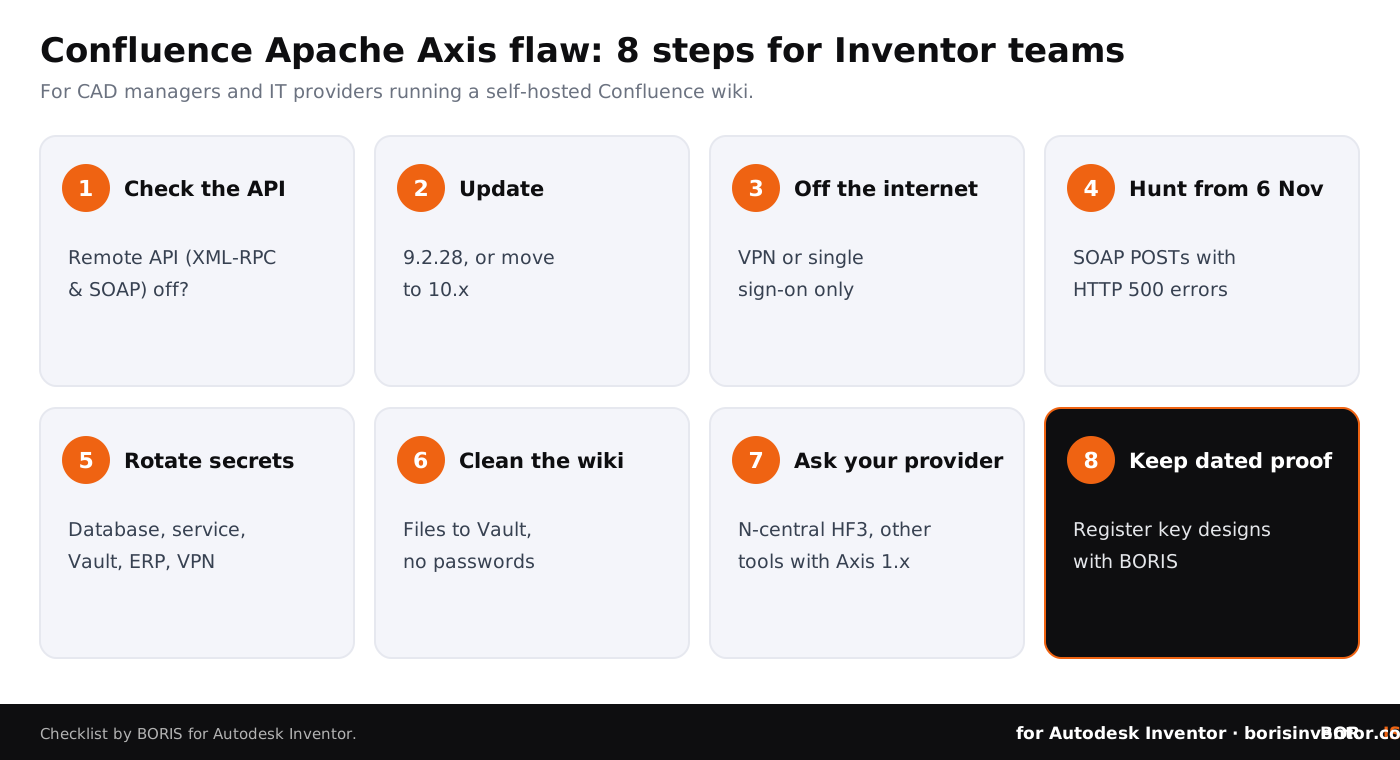
- Check the remote API setting today. If "Remote API (XML-RPC & SOAP)" is on and you cannot update at once, switch it off. Atlassian Cloud and Data Center 10.x users can skip this step.
- Update or plan the move. Install Confluence Data Center 9.2.28, or move to 10.x if you run 9.3, 9.4, 9.5 or an older Server release.
- Take Confluence off the open internet. An internal wiki should sit behind VPN or single sign-on, not on a public address.
- Hunt from 6 November. Copy the access logs, search for SOAP requests with HTTP 500 errors and check the published indicators. Remember that CISA asks for forensic triage, not only a patch.
- Rotate the secrets the wiki touched. Change the Confluence database password, the passwords of integration and service accounts, and any Vault, ERP or VPN logins written on pages. Block legacy authentication in Microsoft 365. Our article on stolen logins and Vault access covers the order.
- Clean the wiki of files and passwords. Move drawings, STEP files and test data into Vault with proper permissions, and keep only links in Confluence. Our guide to role-based access control in CAD environments shows how to set the permissions.
- Ask your IT provider about N-central and Axis. Request confirmation of N-central 2026.4 HF3 with the Legacy API off, and a list of other self-hosted tools that may bundle Axis 1.x.
- Keep dated proof of your key designs. Register important Inventor files with BORIS, so that if a drawing leaks from a wiki, you can show which version was yours and since when.
For a wider view of where design files leak, our guide to CAD file protection walks through Vault permissions, encryption, DRM and proof of ownership, and our overview of Autodesk security advisories in 2026 lists the Autodesk updates Inventor teams needed this year. The Dragos figures on industrial ransomware show how often attacks on equipment makers now end in data theft rather than encryption.
What is still unclear?
Nobody has said how many Confluence servers have the remote API switched on or have been attacked, and the attacker has not been named. Rapid7 describes one intrusion in detail; other attacks may have gone after different data. CISA lists ransomware use as unknown.
It is also not known which other products carry Apache Axis 1.x; CISA says the flaw could affect other products, but only Confluence and N-central have been named. If a vendor of a self-hosted tool cannot say whether Axis 1.x is inside, treat the tool as exposed.
The bigger picture
This week's news on our sister sites shows how much of a design's value depends on records kept around it:
- Proving a file was not changed. On CADChain, the KeeeX v Adobe C2PA patent ruling covers the Unified Patent Court's Paris decision that found KeeeX's file-integrity patent invalid, and what integrity checks can and cannot prove about who owns a file.
- Where results are stored. BORIS for SOLIDWORKS looks at what is new in SOLIDWORKS Simulation 2027, including a separate storage path for plastics study results that keeps them apart from CAD files in PDM.
- Scraped images in court. Blended BORIS covers EVOX Productions' lawsuit against ByteDance, which claims that thousands of vehicle photos were copied to train the Seedream image models.
Conclusion
CVE-2026-90436 turns an old, forgotten SOAP library into an open door: on Confluence Data Center with the remote API enabled, an attacker needs no login to run commands on the server. It has been exploited since at least 13 November, a Metasploit module exists and CISA added it to its exploited list on 18 November. In the one intrusion described in detail, the attacker read the database within minutes and reached Microsoft 365 within twelve hours.
For Inventor teams, the fix is quick: switch the remote API off, update, and check the logs. The lasting lesson is about what the wiki holds. Drawings, STEP files and passwords that sit in Confluence pages are only as safe as the least patched server in the company. Keep design files in Vault, keep secrets out of pages, and keep dated proof of the designs that matter most.
Your designs, your proof.
BORIS for Autodesk Inventor gives every registered file a blockchain timestamp and a certificate of ownership, straight from Inventor.
👉 Protect your Inventor designs with BORIS
FAQ: the Confluence Apache Axis flaw and Inventor teams
What is CVE-2026-90436?
It is a critical flaw in Apache Axis 1.x, an end-of-life Java library for SOAP web services. A crafted SOAP fault message makes Axis load and create a class chosen by the attacker, which can lead to remote code execution without any login. Apache published it on 6 November 2026, and CISA scores it 9.8 under CVSS 3.1.
Is my Confluence affected?
Only Confluence Data Center or Server installs with the "Remote API (XML-RPC & SOAP)" setting enabled are vulnerable. The setting has been off by default for new installations since Confluence 3.0 and was removed in Confluence 10.0. Confluence Cloud is not affected.
Which version fixes it?
Atlassian lists Confluence Data Center 9.2.28 as the fixed version. Customers on 9.3, 9.4 or 9.5, for which no fix is listed, should move to 10.x or switch the remote API off.
Is the flaw being exploited?
Yes. Rapid7 detected an attack on a Confluence Data Center server on 13 November 2026, attacks on N-able N-central were reported the same day, and CISA added the flaw to its known exploited vulnerabilities catalog on 18 November.
Are Autodesk Inventor or Vault affected?
None of the advisories names Inventor or Vault, and we found nothing suggesting they use Apache Axis 1.x. The risk for Inventor teams comes from design files, drawings and passwords kept in a vulnerable wiki, and from service accounts that connect the wiki to other systems.
We switched the API off. Are we done?
Not if the server was reachable with the API on after 6 November. Search the access logs for SOAP requests with HTTP 500 errors, check the published indicators and, if anything looks wrong, rotate every password the server stored or used.
How does BORIS help?
BORIS for Autodesk Inventor registers CAD files with a blockchain timestamp from inside Inventor, so you can show which version of a design existed and when. It does not patch Confluence or stop an attack, and it does not replace updates, access control or backups.