
On 3 November 2026, the US Court of Appeals for the Second Circuit revived a trade secret lawsuit that SS&C Technologies brought against Arcesium, a former business partner that had licensed access to SS&C's Geneva software for five years. A lower court had thrown the case out in December 2024. The appeals court said SS&C's complaint was good enough to go forward, and in doing so it set out, for the first time, how broadly it reads the word "use" in the US federal trade secret law.
The case is about financial software, not CAD, but the pattern is familiar. A company shares valuable technical material with a partner under a contract and an NDA. The partner then builds its own competing product, faster than expected, and tells customers it can do the same things. Was the shared material still a secret, and what counts as using it?
Inventor teams share assemblies, iLogic rules, drawings and design data with resellers, suppliers and development partners every day. The ruling gives them some comfort, but only if the groundwork was done before the relationship ended. Here is what the court decided, what it did not, and what to check.
TL;DR: Sharing your designs with a partner under an NDA does not make them public, and a partner does not need to copy them exactly to "use" them.
In SS&C v. Arcesium (No. 25-2049, decided 3 November 2026), the Second Circuit reversed a dismissal and sent the case back to the trial court. It held that providing trade secrets to third parties does not undermine a claim as long as they were shared on an understanding of confidentiality, that there is no general rule demanding extreme detail when a company first describes its secrets, and that "use" covers any exploitation likely to harm the owner or benefit the user, including relying on the secret to speed up your own development or to win customers. Nothing has been proven yet: the court said misappropriation must still be shown. For Inventor teams: name what is secret, put confidentiality terms on every access, limit the purpose, share the minimum, log transfers, plan the exit and keep dated proof of your designs.
What did the Second Circuit decide?
The panel of Judges Sack, Livingston and Carney, in an opinion written by Judge Sack, reversed the order of the US District Court for the Southern District of New York that had dismissed SS&C's claims under the Defend Trade Secrets Act (DTSA). The district court had accepted that SS&C plausibly owned trade secrets in Geneva, but found that the complaint did not support a reasonable inference that Arcesium misappropriated them. The appeals court disagreed on that second point and sent the case back.
It is important to be precise about what this means. The ruling is about the pleading stage: whether the complaint, taking its allegations as true, states a claim. The court said its opinion "should not be read to opine on the ultimate merits" and that misappropriation must still be proven. Arcesium has not been found liable for anything. Everything below about what Arcesium did is what SS&C alleges, as summarised by the court.
You can read the full Second Circuit opinion. It is 28 pages and unusually readable for a court decision.
What happened between SS&C and Arcesium?
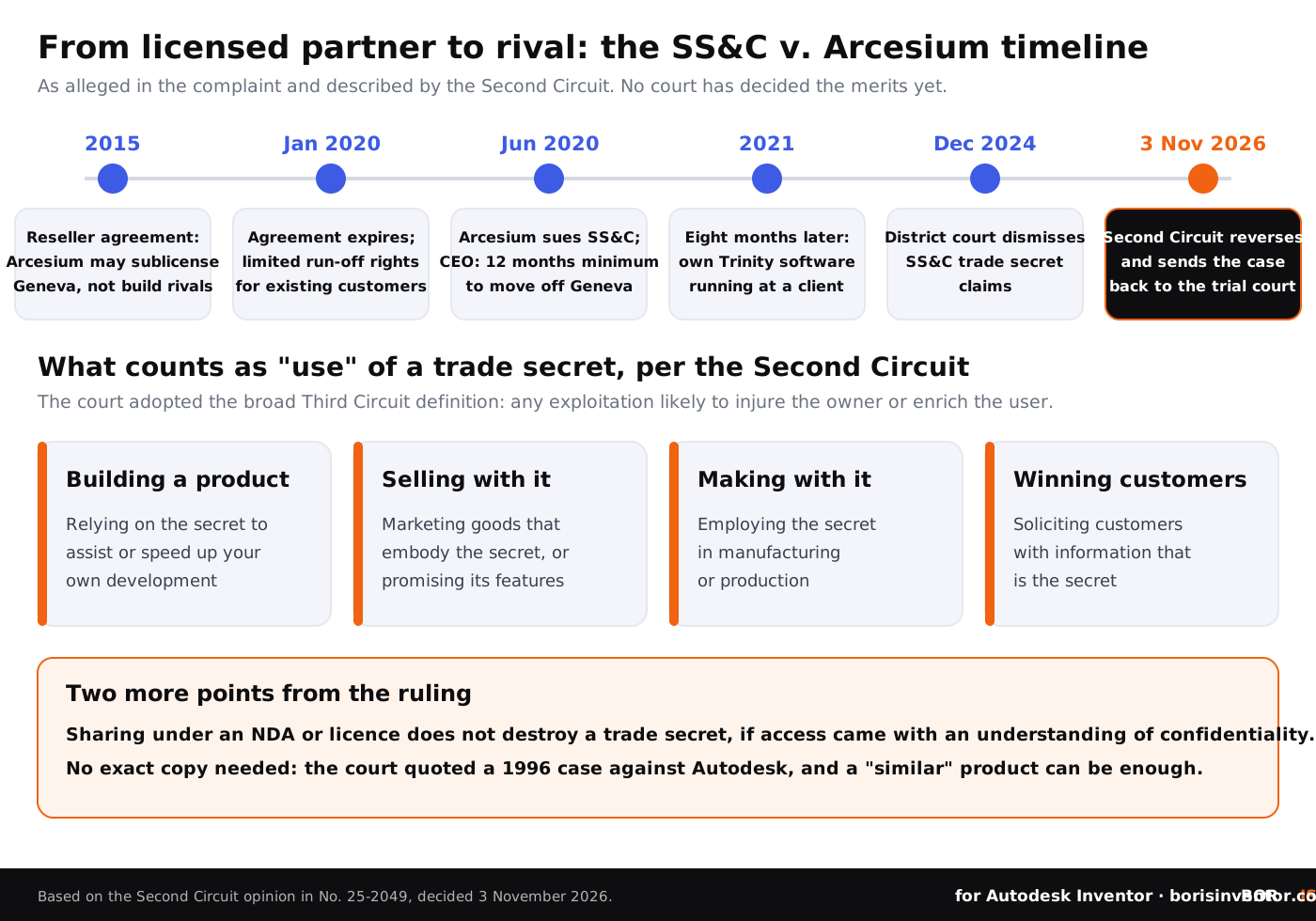
In 2015, Advent Software, which developed the Geneva portfolio accounting software, signed a five-year Hosted Reseller Agreement with Arcesium. Arcesium could sublicense Geneva to its own customers and provide Geneva-related services. Later in 2015, SS&C bought Advent and took over the agreement. According to the complaint, the agreement allowed Arcesium to use Geneva only to serve its customers, barred it from using Geneva to build competing products and barred it from using Geneva after the agreement expired.
SS&C alleges that while Arcesium had this access, it developed its own portfolio accounting software, Trinity, in less than three years, compared with the decades Advent spent on Geneva. Internal emails quoted in the opinion show Arcesium's CEO ordering that Geneva access be kept until Arcesium's own platform was fixed, and staff identifying how Geneva solved technical problems and recommending similar methods. A senior development executive told the team not to describe Trinity's requirements by reference to what Geneva does.
The agreement expired in January 2020, with limited run-off rights for existing customers. In June 2020, Arcesium's CEO said moving to another provider's software would take at least 12 months; eight months later, Arcesium was implementing Trinity at a client. SS&C says Arcesium told Geneva customers Trinity would offer the same functionality. A second project, Nautilus, allegedly used Geneva's integration layer, database schema and data model to keep connecting to Geneva after the licence ended, even though Arcesium's own staff noted that the Geneva formats were the vendor's intellectual property.
Does sharing a design with a partner destroy its secrecy?
This was Arcesium's main argument on the first question. Every licensed user had access to the executable software, its integration layer, its database scheme and its data model, Arcesium said, so how could any of that be secret? The court rejected this as too narrow a reading of the requirement to take reasonable measures, because it would create a near-blanket rule that information shared with any third party cannot be a trade secret.
Instead, the court agreed with the Ninth Circuit that giving trade secrets to third parties does not undermine a claim, so long as they were provided on an understanding of confidentiality. What carried SS&C here were concrete facts: Geneva could be accessed only by SS&C staff and customers with valid licences and credentials, every customer signed non-disclosure and confidentiality terms before getting access, and the reseller agreement itself had such provisions.
For Inventor teams the lesson is direct. A STEP file sent to a supplier, a Vault account for a contract designer or a shared folder for a development partner does not end your trade secret protection by itself. Sending it without any confidentiality terms might. We explain the gaps that remain in a typical contract in our guide to NDA limitations for protecting CAD files.
How specific do you have to be about your trade secrets?
Arcesium also argued that SS&C only listed very general categories of information. The court declined to impose a general specificity rule. Following the Third Circuit's Oakwood Laboratories decision, it said a complaint must let the defendant see at least the boundaries within which the secret lies, which is a case-by-case question.
What worked for SS&C was explaining the function of each item and how it can be used, not just naming it. The complaint did not just name the software; it described the integration layer as allowing developers to run Geneva functions, read and write specific database fields and connect other systems.
Translate that to Inventor data. "Our CAD files" is a category. "The iLogic configurator rules and parameter tables that size our pump housings for a given flow rate, and the tolerance stack-up behind them" is a description a court can work with. Teams that write that description before a dispute, not after, are in a much stronger position. Our earlier article on 3D model files as trade secrets in a Chinese court ruling shows the same point from another jurisdiction.
What counts as using a trade secret?
This is the part of the ruling that commentators, including IPWatchdog, have focused on. The Second Circuit had never defined "use" under the DTSA. It now adopted the broad definition from the Third Circuit: any exploitation of the trade secret that is likely to result in injury to the owner or enrichment to the defendant. That includes marketing goods that embody the secret, employing it in manufacturing or production, relying on it to assist or accelerate research or development, and soliciting customers with it.
The court also noted that "trade secrets need not be exactly copied in order to impose liability," quoting a 1996 Second Circuit decision with a familiar name: Vermont Microsystems v. Autodesk. In that case, Autodesk and a former Vermont Microsystems engineer who had joined Autodesk were held liable for misappropriating display list driver trade secrets in the development of a driver for AutoCAD Release 12 for Windows.
What does this mean for data you share with partners?
The table below maps the situations in the ruling to everyday Inventor workflows.
The same ideas run through how to prevent CAD file misappropriation in partnerships and what to put in licensing agreements for CAD designs. If you work with many suppliers, our guide to supplier compliance with CAD data rules covers the practical side.
Why does a dated record matter so much here?
SS&C needed proof that confidentiality terms existed, a description of its secrets, evidence of what it took to build them, and documents showing what the partner had access to. Several of those facts only surfaced in discovery in an earlier, separate lawsuit.
Supplier and partner cases keep turning on the same evidence. On CADChain, we covered the $116.9 million jury verdict in Aerosonic v. Joby, where a supplier had shared engineering drawings, 3D models and test data under an NDA; Joby has asked the court to overturn that verdict. On this site we looked at how a Delaware court valued the cost of rebuilding stolen know-how and at the Jingdiao case in China, where tens of thousands of drawings followed an engineer to a rival. In each case, the side with clear, dated records of what existed and when was the side with a story a court could follow.
A file timestamp on your own server is easy to dispute. An independent, tamper-evident record of which version of a design existed on which date is much harder to argue with. That is the idea behind blockchain timestamps for design authorship.
Sharing models with partners? Keep proof of what was yours first.
BORIS for Autodesk Inventor registers your CAD files with a blockchain timestamp and gives you a certificate of ownership, straight from Inventor.
👉 See how BORIS for Autodesk Inventor works
What should Inventor teams do now?
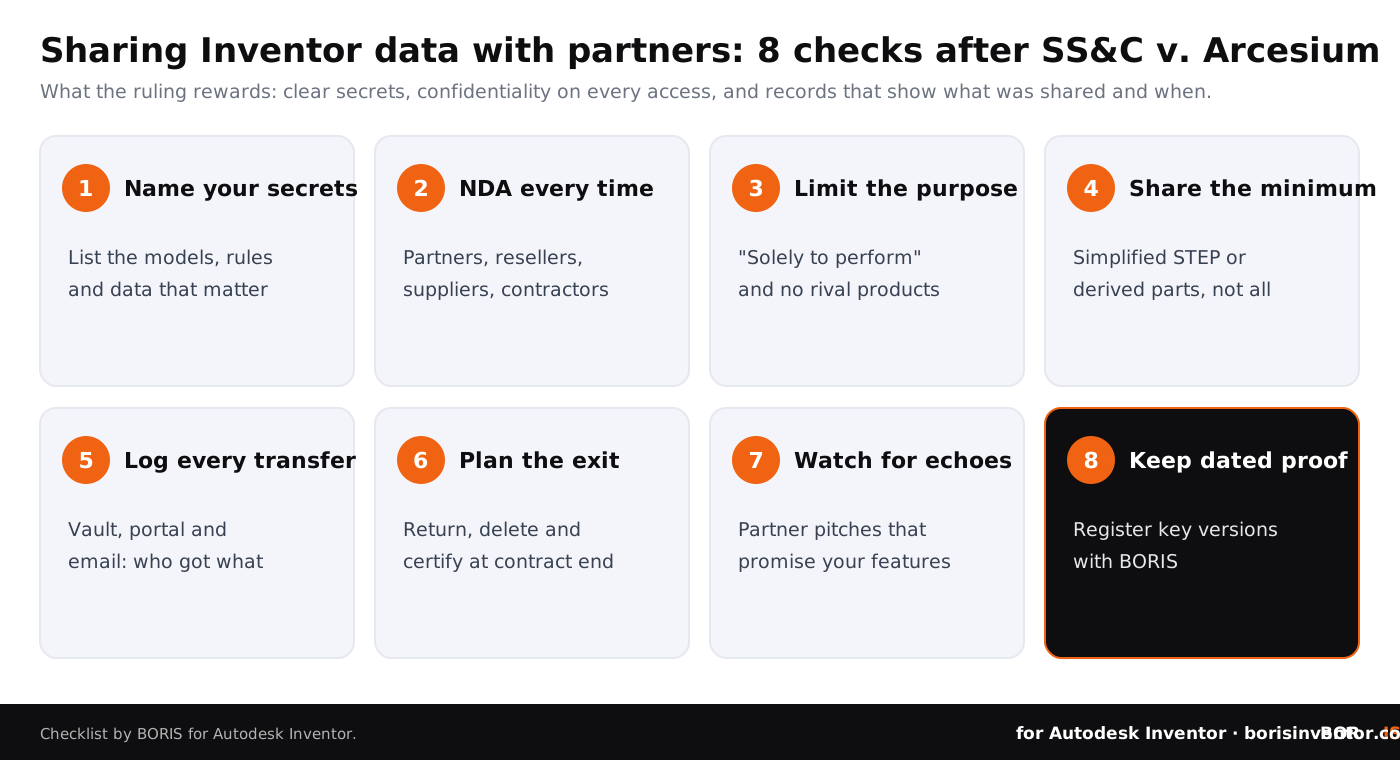
- Name your secrets. Write down which models, iLogic rules, templates, Content Center families, parameter tables and calculation methods give you an advantage, and describe what each one does.
- Put confidentiality terms on every access. Partners, resellers, suppliers and contract designers should sign before they receive files or Vault credentials, not after.
- Limit the purpose. State what the partner may use your data for, that it may not be used to develop competing products, and what happens when the agreement ends.
- Share the minimum. Send simplified STEP files, shrinkwrapped or derived parts and drawings for the job at hand instead of full native assemblies with their rules and history.
- Log every transfer. Keep Vault history, portal downloads and email transfer records long enough to show who received which version and when.
- Plan the exit. At the end of a project or contract, ask for return or deletion of your files in writing and remove accounts, shares and portal access.
- Watch for echoes. A former partner who suddenly promises your customers the same features is worth a closer look, and a call to your lawyer.
- Keep dated proof. Register the versions that matter with BORIS so you can show what you had, and when, independent of any partner's systems.
For more background, read what trade secrets are in manufacturing, how to protect trade secrets in manufacturing and our guide to CAD file protection with Vault, encryption, DRM and proof of ownership. If your team is starting to connect AI agents to Inventor, our article on the Inventor 2027.2 MCP server explains which data leaves the workstation.
The bigger picture
This week's news on our sister sites shows how many rules now shape who can see and use design data.
- Export controls and ownership. On CADChain, the extended suspension of the US BIS Affiliates Rule explains why the 50% ownership test still matters for European firms that share technology, including CAD files, with foreign partners.
- Websites that hold CAD uploads. BORIS for SOLIDWORKS looks at an exploited WordPress core flaw and what it means for manufacturers whose sites take RFQ uploads or host CAD download libraries.
- Who owns a 3D capture. Blended BORIS covers native Gaussian splats in Blender 5.3 and the ownership questions around scanned objects and captured scenes.
Conclusion
The Second Circuit's ruling in SS&C v. Arcesium does not decide who is right. It decides that a company which shared its technology with a partner under strict confidentiality terms, and can describe what it shared and how it works, gets its day in court when that partner builds a rival product. It also confirms that "use" is broad: relying on someone else's secret to speed up your own development, or to win their customers, can be enough.
For Inventor teams, the work is mostly done before any dispute: know what is secret, put confidentiality on every access, limit the purpose, share only what is needed, keep the logs, close access at the end and keep independent, dated proof of your designs.
Your designs, your proof.
BORIS for Autodesk Inventor gives every registered file a blockchain timestamp and a certificate of ownership, straight from Inventor.
👉 Protect your Inventor designs with BORIS
FAQ: SS&C v. Arcesium and partner access to Inventor data
What did the Second Circuit decide on 3 November 2026?
It reversed the dismissal of SS&C's trade secret claims against Arcesium and sent the case back to the district court. It found that the complaint plausibly alleged both trade secrets and their misappropriation. It did not decide the merits.
Was Arcesium found liable?
No. The ruling only means the case can continue. The court said misappropriation must still be proven, and that its opinion does not suggest a correct reading of the disputed emails.
Does sending CAD files to a supplier end trade secret protection?
Not by itself. The court agreed that giving trade secrets to third parties does not undermine a claim if they were provided on an understanding of confidentiality, such as an NDA or licence terms. Sharing without any confidentiality terms is much riskier.
Does a partner have to copy my design exactly to misuse it?
No. The court quoted its 1996 decision in Vermont Microsystems v. Autodesk that trade secrets need not be exactly copied, and adopted a broad definition of use that includes relying on a secret to speed up your own development.
How detailed must a description of my trade secrets be?
The Second Circuit declined to impose a general specificity rule. A complaint must show the boundaries within which the secret lies. Describing what each item does and how it is used, not just naming categories, helped SS&C.
Does this ruling apply outside the United States?
It interprets the US Defend Trade Secrets Act and binds courts in the Second Circuit, which covers New York, Connecticut and Vermont. EU countries apply their own laws based on the EU Trade Secrets Directive, which also requires reasonable steps to keep information secret.
How does BORIS help?
BORIS for Autodesk Inventor registers CAD files with a blockchain timestamp from inside Inventor, so you can show which version of a design existed and when. It does not replace NDAs, access control or legal advice.