
On 19 November 2026, Broadcom fixed CVE-2026-123890, a critical authentication bypass in VMware vCenter that lets an attacker with network access to vCenter get in without a password. The same day, Google Threat Intelligence Group and Mandiant reported that a suspected China-linked espionage group they call ARMORY CASTLE had been exploiting it as a zero-day since early September. On 20 November, CISA added the flaw to its Known Exploited Vulnerabilities catalog.
vCenter is the management server for VMware vSphere. In many engineering companies it runs almost everything that matters for design work: the Autodesk Vault server and its SQL Server database, the Network License Manager, file servers with project folders, domain controllers, backup servers, ERP and the terminal servers people use to run Inventor remotely. Whoever controls vCenter can snapshot, copy, open or switch off any of those machines.
This is not the same problem as the ESX logging flaw we covered in October. That one let an attacker who was already an administrator act without being logged. This one gives an outsider the administrator session in the first place, and Mandiant's report shows what a patient attacker did with it: stole the key that vCenter uses to sign logins, created a hidden administrator and read the Active Directory database from a Windows virtual machine.
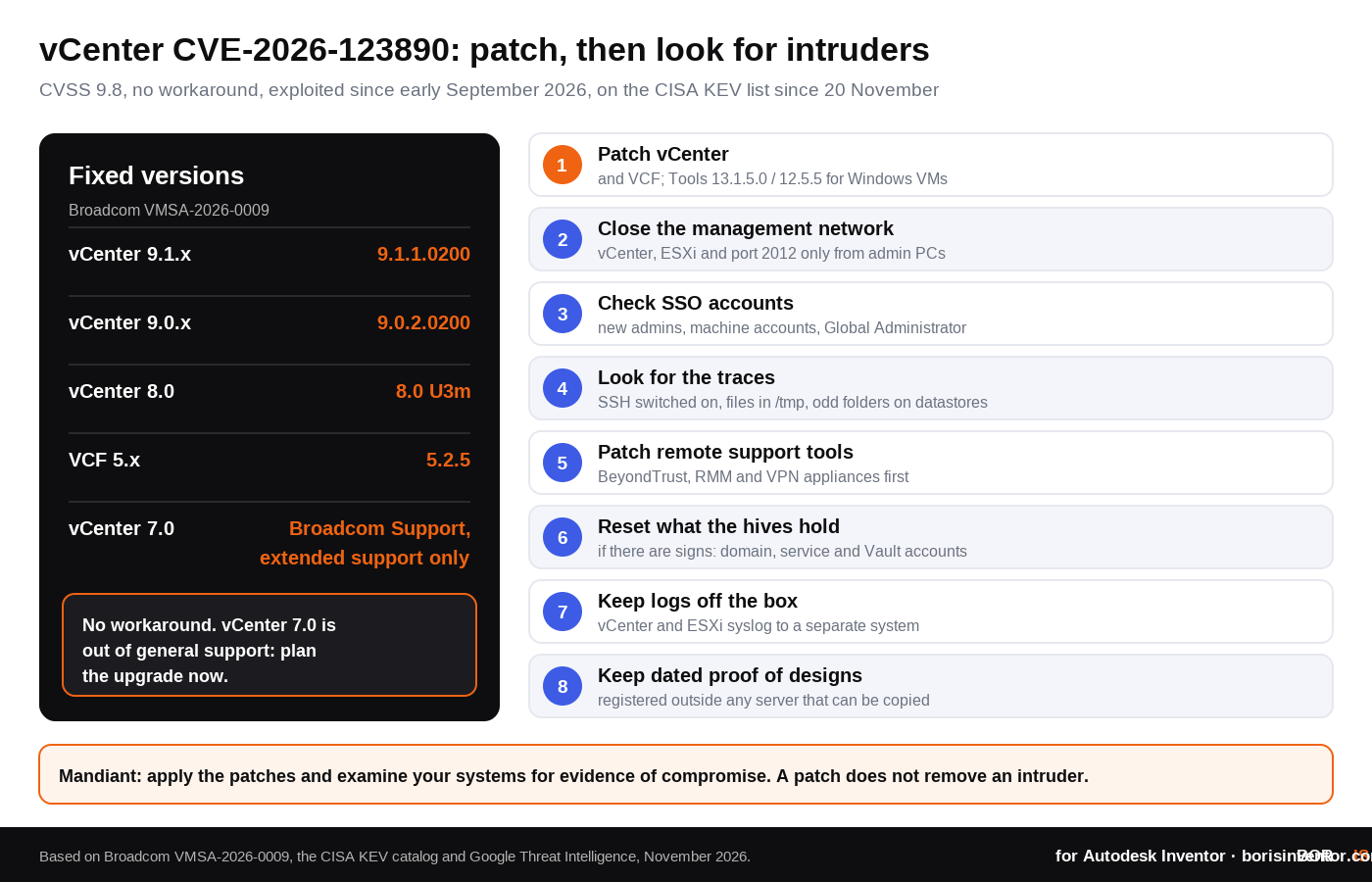
TL;DR: CVE-2026-123890 (CVSS 9.8) is an authentication bypass in the VMware Directory Service of vCenter. There is no workaround. Fixed versions are vCenter 9.1.1.0200, 9.0.2.0200 and 8.0 U3m, and VMware Cloud Foundation 5.2.5; vCenter 7.0 is affected and customers with an extended support contract must contact Broadcom. It was exploited from early September 2026 and has been on the CISA KEV list since 20 November.
For Inventor and Vault teams: find out who runs your vCenter and whether it is patched, make sure it cannot be reached from the internet or from ordinary office PCs, have someone look for signs of the intrusion Mandiant described, and patch remote support tools first, because that is how the attackers got in. Keep dated proof of your key designs outside any server that can be copied.
What did Broadcom and Mandiant announce?
Broadcom's security advisory VMSA-2026-0009 was published on 19 November 2026 and updated on 20 November. It rates CVE-2026-123890 as critical with a CVSS score of 9.8 and says that anyone with network access to vCenter may use it to bypass authentication and get unauthorised access to the system. The advisory lists no workaround, does not mention exploitation, and thanks Mandiant for reporting the issue.
The same advisory fixes four other flaws: three in SDDC Manager, part of VMware Cloud Foundation, and CVE-2026-123894, a SAML token signature bypass in VMware Tools for Windows, fixed in VMware Tools 13.1.5.0 and 12.5.5. VMware Tools runs inside almost every Windows virtual machine, so it belongs on the same update list.
Google Threat Intelligence Group and Mandiant published their analysis of the ARMORY CASTLE intrusion on the same day. They describe ARMORY CASTLE, formerly tracked as UNC5221, as a suspected China-nexus espionage actor that has been exploiting flaws in edge and security appliances since 2023. According to the report, forensic evidence shows exploitation of the vCenter flaw from early September 2026, on a vCenter that was already patched against an earlier flaw disclosed on 29 July. Mandiant says it has evidence the group knew about this vulnerability before that July disclosure.
The report describes one intrusion in detail. It does not name the victim, its industry or its country, and it does not say how many organisations were hit, although it notes that the main tool looks built for wider use. CISA's record for the CVE marks exploitation as active and the attack as automatable, and the KEV entry gives US federal agencies until 23 November to fix it.
How did the attackers get from a support appliance to the data center?
The chain is worth reading slowly, because every step has a counterpart in a typical Inventor shop. According to Google and Mandiant, the attackers first broke into a BeyondTrust Remote Support appliance through another zero-day, CVE-2026-102764. From there they moved to internal Linux appliances that had no endpoint protection and planted web shells. Then they turned to vCenter.
- The vCenter flaw. A tool Mandiant calls BONESAW used CVE-2026-123890 to get an authenticated session as administrator@vsphere.local, the built-in vCenter administrator, without a password.
- The signing key. BONESAW copied the vCenter directory database, pulled out the private key vCenter uses to sign SAML login tokens, created a backdoor machine account and an SSO administrator, and gave itself Global Administrator rights. A second tool, SAWSNAKE, used the stolen key to forge logins. According to Mandiant, this let the group forge login tokens, get around multi-factor authentication and pose as any user.
- The hosts. The attackers enabled SSH, logged in to ESXi hosts as root and hid files in a folder on a datastore. They also switched off the vCenter appliance firewall.
- The virtual machines. From the hypervisor side they read files of Windows virtual machines, including the Active Directory database and registry hives, which hold the password hashes of every domain account. Mandiant says an archive of collected data was likely taken out.
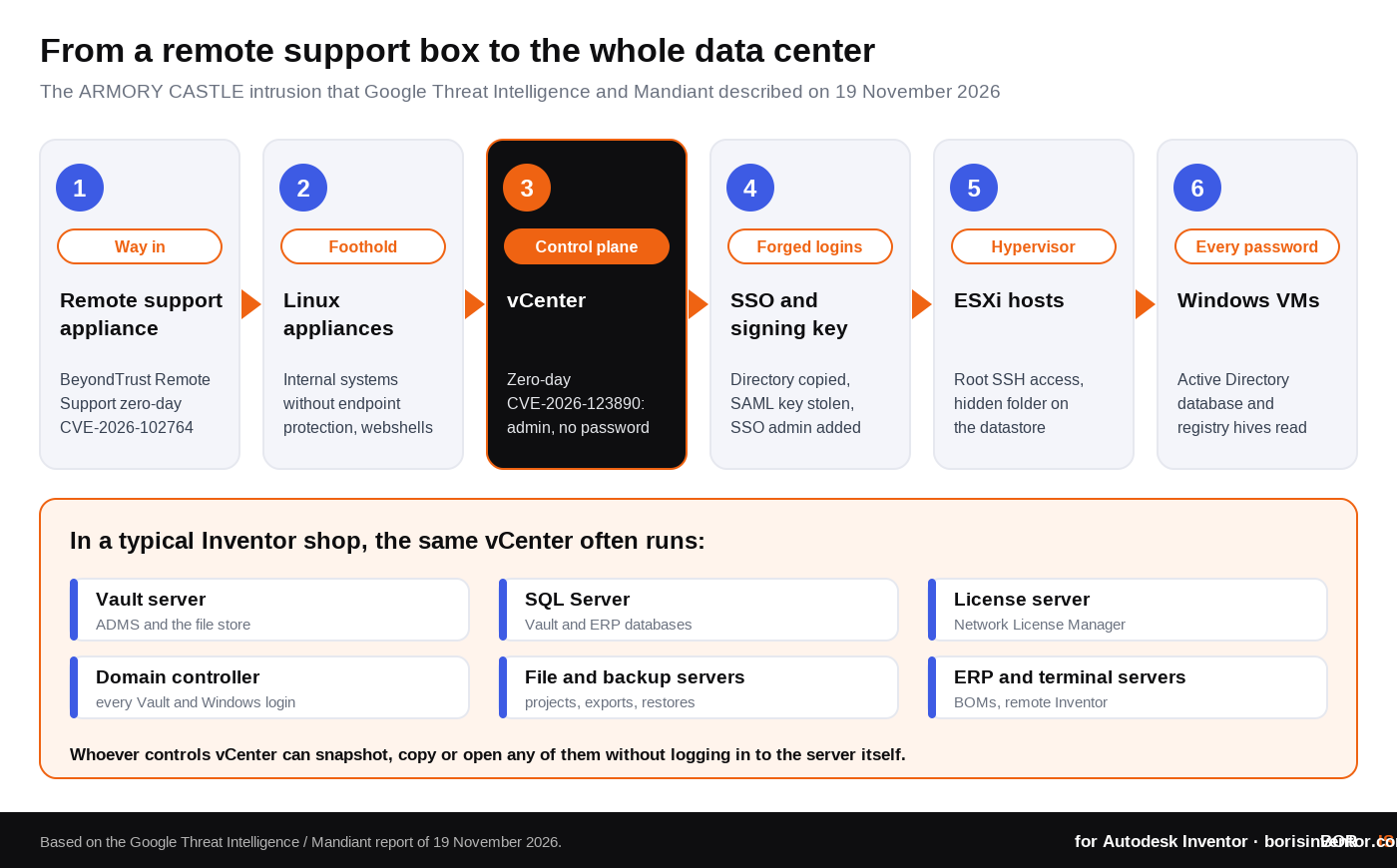
None of this needed anyone to log in to a Windows server. That matters for engineering data: a vCenter administrator can snapshot the Vault server, copy its virtual disks with the whole file store, or clone the SQL Server that holds the Vault database, and nothing in Vault's own logs would show it. We described the same blind spot in our article on the VMware ESX logging zero-day and Vault servers; this time the attacker does not even need stolen credentials to start.
Why should Inventor and Vault teams care about vCenter?
Most CAD managers never open the vSphere Client. vCenter is usually run by an internal IT team, an outsourced provider or the reseller that set up the servers, which is exactly why it gets forgotten: everyone assumes someone else patches it.
Yet the value sits underneath it. Our guide to setting up and managing Inventor Vault treats the Vault server, the file store and the SQL database as the heart of the design office. If they are virtual machines, the hypervisor and its management server are part of the Vault security model, whether anyone wrote that down or not.
Stolen domain password hashes are the second problem. Vault can use Windows (Active Directory) accounts, and so do VPNs, file shares, Microsoft 365 synchronisation and many ERP systems. If an attacker read the Active Directory database, every one of those logins has to be treated as known. Our article on stolen logins and Vault access after Operation Endgame explains how to plan a password and session reset without locking engineers out of their work.
What runs under vCenter in a typical Inventor shop?
Proof of ownership that does not live on a server.
BORIS for Autodesk Inventor registers your CAD files with a blockchain timestamp and a certificate of ownership, straight from Inventor, so you can show what you designed and when, even if a copy of your Vault ends up somewhere it should not be.
👉 Protect your Inventor designs with BORIS
Is patching enough?
No. The flaw was exploited for more than two months before a fix existed, and the attackers in Mandiant's case created their own accounts and stole a signing key. A patch closes the door; it does not remove an intruder who already walked through it. Mandiant's CTO Charles Carmakal put it plainly: "Organizations should both apply the patches and examine their systems for evidence of compromise."
Google's report lists indicators and detection rules, and recommends Mandiant's free vCenter hardening and logging tool, default-deny firewall rules on the vCenter appliance and sending logs to a separate system. Your IT provider should run those checks; your job is to ask for the result in writing.
The way in also deserves attention. A remote support appliance was the first step, just as remote management tools were in the ScreenConnect attacks on MSPs and in the ConnectWise and AOMEI backup tool incidents. Anything that lets an outside party into your network with high rights, from remote support to backup agents, has to be patched first and watched closely.
Eight steps for Inventor and Vault teams this week
- Ask who runs vCenter and get the version. If it is below 9.1.1.0200, 9.0.2.0200 or 8.0 U3m, or VCF below 5.2.5, it needs the update now. If you are still on vCenter 7.0, ask whether you have extended support and plan the upgrade.
- Update VMware Tools on Windows VMs. The same advisory fixes a SAML token flaw in VMware Tools for Windows, fixed in 13.1.5.0 and 12.5.5. That includes the Vault, SQL and license server VMs.
- Close the management network. vCenter, ESXi hosts and the appliance management port should be reachable only from a few administration machines, never from the internet and never from ordinary office or CAD workstations.
- Ask for a compromise check. Unexpected SSO administrators or machine accounts, SSH that was switched on, unknown files on the vCenter appliance and hidden folders on datastores are all signs Mandiant describes. Get the answer in writing.
- Patch remote access first. BeyondTrust, other remote support tools, RMM agents and VPN appliances are the doors attackers use to reach vCenter. Check their versions and who has accounts on them.
- Plan resets if anything is found. If there are signs of compromise, treat domain passwords, service accounts, Vault service and administrator accounts and the vCenter signing certificate as exposed, and reset them in a planned order.
- Keep logs and backups off the box. Send vCenter and ESXi logs to a separate system, and keep at least one backup of Vault and its database offline or immutable, outside the vSphere environment. Our guide to CAD file backup strategies covers the options.
- Keep dated proof of your key designs. Register important Inventor files with BORIS, so authorship can be shown even if copies of your Vault have been taken.
Patch status for the Autodesk side of your setup is in our overview of Autodesk security advisories in 2026, and our article on the exploited Confluence flaw shows how quickly attackers moved from one server to service accounts and cloud data in another recent case.
What does this tell us about espionage against engineering data?
Mandiant does not say what ARMORY CASTLE was looking for, and the victim is not named. But espionage groups go after the systems that hold the most data with the least scrutiny, and in manufacturing that is often the virtualisation layer under PDM, ERP and file servers. Our overview of industrial espionage in CAD design and the CAD data breach case studies show how often stolen designs turn up years later, in a competitor's product or in court.
The bigger picture
This week's news on our sister sites shows how much depends on the systems and records around the design itself:
- Security rules for products. On CADChain, the first Cyber Resilience Act standards cover vocabulary, principles and product risk management for products with digital elements, which will shape what buyers can expect from software and hardware makers.
- Virtual machines and CAD upgrades. BORIS for SOLIDWORKS reports on the release of SOLIDWORKS 2027 SP0, whose system requirements still list hypervisor support for 2027 as to be announced.
- Proof decides ownership. Blended BORIS covers the Genoa court that refused to protect an AI-made Italian Brainrot character, where unsigned documents without provenance counted for nothing as evidence.
Conclusion
CVE-2026-123890 turns vCenter from a management console into an open door: no password, critical severity, no workaround, and two months of quiet exploitation by an espionage group before the fix. For Inventor teams the risk is concrete, because the Vault server, its database, the license server and the domain controller often run as virtual machines under that same vCenter, and anyone who controls it can copy them without touching Vault at all.
Ask today who runs your vCenter, whether it is on 9.1.1.0200, 9.0.2.0200 or 8.0 U3m, and whether anyone has checked for signs of an intruder. In Google's words: "Because vCenter serves as the centralized control plane for the virtualized data center, relying solely on reactive patching is insufficient to protect it." Close the management network, patch remote access tools first, keep logs and backups outside the environment, and keep your own dated proof of what you designed.
Your designs, your proof.
BORIS for Autodesk Inventor gives every registered file a blockchain timestamp and a certificate of ownership, straight from Inventor.
👉 Protect your Inventor designs with BORIS
FAQ: vCenter CVE-2026-123890 and Inventor teams
What is CVE-2026-123890?
It is an authentication bypass in the VMware Directory Service of VMware vCenter, rated critical with a CVSS score of 9.8. According to Broadcom, an attacker with network access to vCenter can bypass authentication and gain unauthorised access. Google and Mandiant say it gives an authenticated session as the built-in vCenter administrator.
Which versions are fixed?
Broadcom's advisory VMSA-2026-0009 lists vCenter 9.1.1.0200, 9.0.2.0200 and 8.0 U3m and VMware Cloud Foundation 5.2.5 as fixed. vCenter 7.0 is affected; customers with an extended support contract are told to contact Broadcom Support. There is no workaround.
Has it been exploited?
Yes. Google Threat Intelligence Group and Mandiant say a suspected China-nexus espionage group, ARMORY CASTLE, exploited it from early September 2026, and CISA added it to its Known Exploited Vulnerabilities catalog on 20 November 2026. The victim of the intrusion they described has not been named.
Does this affect Inventor or Vault directly?
No, it is not a flaw in Autodesk software. It matters because Vault servers, SQL Server, license servers, file servers and domain controllers often run as virtual machines managed by vCenter, and a vCenter administrator can copy or open those machines without logging in to them.
Is patching vCenter enough?
Not on its own. The flaw was exploited for months before the fix, and in the case Mandiant described the attackers created their own accounts and stole the key used to sign logins. Mandiant advises applying the patches and examining systems for evidence of compromise.
How did the attackers get in?
In the case described by Google and Mandiant, the first step was a zero-day in a BeyondTrust Remote Support appliance, CVE-2026-102764. From there the attackers moved to internal Linux appliances without endpoint protection and then to vCenter.
What should a small engineering firm without its own IT team do?
Ask your IT provider or reseller in writing whether your vCenter is patched, whether it can be reached from the internet, whether they have checked for signs of compromise and when VMware Tools was last updated on your Vault, SQL and license server VMs.
How does BORIS help?
BORIS for Autodesk Inventor registers CAD files with a blockchain timestamp from inside Inventor, so you can show which version of a design existed and when, even if copies of your servers were taken. It does not patch or monitor vCenter.